
Winter 2026
Thursday Lectionary Devotionals from Patrick
Thursday, March 19
John 11:21
Martha said to Jesus, “Lord, if you had been here, my brother would not have died.”
Dang. Too often I feel like Martha.
In this story from John’s gospel, Lazarus, a friend of Jesus and brother of Martha, dies. Jesus knew Lazarus was ill, but delayed going to see him. When he finally arrives, Lazarus had been dead for days.
You can hear the pain and blame and anger in Martha’s voice, can’t you?
“Lord, if you had been here, my brother would not have died.”
Jesus grieves for Lazarus, and he does end up resurrecting him.
But still. That sting and feeling of betrayal may still be sitting within Martha’s heart. And I feel those emotions these days. I look around at the many lives that are lost due to the injustices of this world. And I wonder where God is when these things happen. I look to the heavens and say, “Lord, if you had been here, my friends and neighbors would not have died.”
And thankfully, God can handle my pain and blame and anger. God can handle my finger-pointing.
In the story, Jesus doesn’t punish Martha for her comment. And he even weeps for his buddy, Lazarus, as if he may understand where she’s coming from.
I may not get answers for why these bad things happen, and so far I haven’t seen any of those who have died been brought back to life. But I trust that somehow, beyond what I can see and understand, Jesus is at work, bringing about some form of resurrection, and loving me even when I’m angry at him.
God of resurrection, thank you for loving us so much that you would take on our anger and still care for us. Thank you for grieving alongside us when tragedy strikes. And thank you for bringing about new life…even when we can’t see it. Amen.
Thursday, March 12
Ephesians 5:8-9
For once you were darkness, but now in Christ you are light. Live as children of light — for the fruit of the light is found in all that is good and right and true.
The devotional today is going to show my privilege. I’m ashamed, but I want to be honest, maybe because I have a desire to confess, or maybe because you might resonate because you’ve had some similar experiences.
I’ve had to lean on faith more the past couple of years than I ever have before.
I’ve had an easy life. I’m a white, cis, straight, male from the American south. My parents only had me, and they worked hard to make sure I had a buffet of experiences and opportunities growing up. I’ve never had medical or student loan debt. There’s been plenty of times in life where I “floated along,” and things just seemed to work out for me.
Faith was less about a need to keep going, and more about what ideological and theological ideas I could logically understand and affirm.
But now, as a pastor of a vibrant, justice-oriented, progressive faith community, as a father of a little girl, as someone who wants to be an ally to those with less privilege than me and who are often targeted by all forms of violence, and as a deeply-troubled citizen of the United States and the world, I’m struggling. I’m searching for hope, for a path as a pastor and parent and person that promises a future of flourishing. And as my heart breaks for so many in my city and in this world, I’ve had to lean on faith. I’ve had to lean on the belief that what I preach and teach and seek to live is, as Paul writes, is good and right and true. I’m far from perfect. In fact, I’m a mess (ask my therapist). But dammit, I can tell right from wrong most of the time.
Bombing an elementary school in Iran is wrong.
Zero arrests regarding the Epstein Files is wrong.
Masked ICE agents and detention center conditions are wrong.
Antisemitism and islamophobia are wrong.
Genocide is wrong.
Policies that degrade and dehumanize and criminalize LGBTQIA+ persons are wrong.
I could go on and on…
And in these days where the violence of empire is stepping on the throat of millions, hell, globally billions, I have to lean on my faith, a faith that tells me that God is against injustice, God is against the lies that are fed to us, and God is against the indifference of those who say they follow Christ yet support the machine of empire.
God is found in what is good and right and true.
And as imperfect as I am, I want to be found there as well, and my faith tells me that the goodness and faithfulness of God will always have the final say. With my own efforts and agency in one hand and a tired, desperate faith in the other, I’ll work alongside others to resist empire and proclaim the promises of the Kin-dom of God.
God of love, help us to live in your light of what good and right and true. Amen.
Thursday, March 5
John 4:28-30, 39
Then the woman left her water jar and went back to the city. She said to the people, “Come and see a man who told me everything I have ever done! He cannot be the Messiah, can he?” They left the city and were on their way to him…Many Samaritans from that city believed in him because of the woman’s testimony, “He told me everything I have ever done.”
For that one co-worker or family member or friend who says something sexist about how women can’t be preachers, point them to John’s gospel. (Don’t worry, there’s other examples, too!)
In this story, often referred to as “The Woman at the Well,” Jesus goes through Samaria and encounters a woman at a well. There, the two of them talk. It’s culturally taboo, given that he’s a Jew and she’s a Samaritan and that he’s an unmarried man who’s alone and she’s an unmarried woman who’s alone. And it’s in this taboo encounter that they share a back an forth full of metaphor and nods to the Jewish Bible and Jewish/Samaritan history (classic John’s gospel). After this powerful and fascinating encounter, she enthusiastically goes into her town and testifies to what she’s experienced.
And that’s preaching.
Preaching is testifying to what God is saying to us in the stories of Scripture and telling others about where God has shown up in your own life.
In the mainline protestant church, we’re hesitant to preach without degrees in theology, without training in public speaking, without some nerdy tidbits about the languages of Hebrew and Greek. We’re so scared to get something wrong that we forget to simply share from the heart and tell the story of Jesus.
Don’t get me wrong. Theology is important. The medium through which we deliver communication is important. Learning the original languages that told the Biblical stories is important. And I’m grateful that I’m part of a tradition that values education in all of this. But the most powerful lesson from my first preaching class in seminary was that it’s okay to access emotions and to speak from the heart while in the pulpit. I had been raised in such a strong Presbyterian pipeline of nerdiness that I thought I was supposed to dismiss any preaching that carried emotions, including excitement about the work and love of Christ.
I was so grateful that I learned I was doing it all wrong.
Let’s take a lesson from the unnamed Samaritan woman. When you encounter the living Christ, share about it. Testify in word and deed with excitement and joy! The world could use some good news.
God who inspires us to share the Good News – keep it up! Push us and energize us. Amen.
Thursday, February 26
John 3:3-5
Jesus answered [Nicodemus], “Very truly, I tell you, no one can see the kingdom of God without being born from above.”Nicodemus said to him, “How can anyone be born after having grown old? Can one enter a second time into the mother’s womb and be born?” Jesus answered, “Very truly, I tell you, no one can enter the kingdom of God without being born of water and Spirit”
Growing up in Appalachia, it was common to see country church signs and billboards on I-81 saying “Ye must be born again.” The idea for many in the Christendom of the moonshine-mountains was that one must go through a dramatic conversion of “accepting Jesus as Lord and Savior,” or in the shorthand, be “saved” to have any hope of being close to God.
(Before I get rollin’, I need to note that I have known many who have had dramatic conversions, and I’m not one to doubt the Spirit’s work in that moment and their journey of faith. Everyone’s journey is different.)
The common prescription for this type of dramatic conversion included three steps:
- Belief. You gotta get your beliefs right! Jesus, Jesus, Jesus.. Bible, Bible, Bible. Say the right prayer and invite Jesus into your heart (as if he’s never been there before…).
- Behavior. Change how you act and what music you listen to and what you wear and stop saying bad words and judge all the right people and don’t ever, ever get horny. Ever. Until you’re married. Then go nuts.
- Belonging. Once your beliefs and behaviors are in line, you can be included in our church. Sure, you can visit anytime (and you better!), but to actually be “one of us” the first two are prerequisites. Once you’ve checked those boxes, you can be in the group text thread and we can all go to Applebee’s together.
The problem with the “my way or the highway” approach to the idea of being born again is that there’s much of the human experience that’s left out.
Note, Jesus talked about being born. And being born works the other way around. Think about an infant.
- Belonging. A child hopefully has a place to belong first and foremost, before they can even mutter a word.
- Behavior. Infants and toddlers learn behaviors by experience, seeing what others do, and a bit of instinct.
- Beliefs. A child’s beliefs will change as they grow, and for a while their beliefs will be informed by those close to them. Over time, though, they’ll begin to form their own opinions.
And all of these will evolve, a cycle of belonging in different ways, taking on new behaviors at different stage, and new beliefs will come and go. That’s life. That’s the process of birth and rebirth.
In my experience, I’ve found that communities of faith that are first open and hospitable, that invite initial belonging and desire to form authentic friendships and deepen in their faith by the relationships that are formed are the ones that witness to the Gospel in the most beautiful and compassionate and faithful ways. Sure, true community is harder and takes more work and intentionality, but ask anyone whose given birth – that’s pretty damn hard, too.
As communities of faith, it’s crucial that we first invite others to belong, and in their belonging, we all grow together.
O Christ, great includer, remind us that we are created to be in community, to belong to one another, and from there, discern who you are calling us to be. Amen.
Thursday, February 19
I’m away on study leave. Don’t forget to take time for your own learning and growth!
Thursday, February 12
Matthew 17:1-3
…Jesus took with him Peter and James and his brother John and led them up a high mountain, by themselves. And he was transfigured before them, and his face shone like the sun, and his clothes became bright as light. Suddenly there appeared to them Moses and Elijah, talking with him.
These verses come from a story called the Transfiguration, and the Church Universal has made a big deal about it through the ages. And I’ve gotta be honest – The whole Transfiguration Sunday has always seemed so silly to me. I don’t care for a lot of pomp and circumstance, especially in the life of the church. And I feel like the churches I’ve been to who celebrate the whole Transfiguration Sunday thing get a little too fancy-pants about it. The world is suffering and I want to get to work. Or, if we’re gonna be together for a bit on a Sunday morning, let’s learn or talk or party. At the very least, can we just be authentic and not so fancy about it all?
Southern, fancy, polite society is not for me.
But, per usual, I read the scripture while trying to shed what southern, white church has done to it, and I see some new things. I’ve had to really push myself to open up past the whole “Jesus gets shiny and two dead dudes appear” and when I make the effort, I can truly feel the Spirit of God revealing something new.
This story is about more than just making nomadic Jesus look super sparkly and Divine, more than showing the miracle of two heroes of the faith coming back to life, and more than some sort of spectacle for spectacle’s sake. It’s a story about validation for a new season in God’s work in the world. It’s a story about our ancestors affirming the next chapter and encouraging the next generation. It’s a story about validation and encouragement.
And maybe we need some of that these days.
Frankly, I tear up thinking about some of the heroes of our faith coming to us today – Rosa Parks, Martin Luther King Jr., Mother Teresa, Dietrich Bonhoeffer, Bishop Oscar Romero, among so many others – validating the work we’re doing and encouraging us to keep going.
God’s dream continues to move us forward. May we make past generations proud and help future generations have less to clean up.
God who links all of us in the faith, continue to guide us. Amen.
Thursday, February 5
Matthew 5:17
[Jesus said] “Do not think that I have come to abolish the Law or the Prophets; I have come not to abolish but to fulfill.”
In all of the circles I’ve found myself throughout my life, churches seem to be the places that fear change the most. On one hand, this is understandable. Christianity is an ancient religion with plenty of beautiful and meaningful rituals and traditions that connect us to the ancestors of the faith, and even, on a more personal level, to our bloodlines and chosen family, as we remember the hymns we sang at grandma’s funeral and the baptismal font where our kids were baptized. On the other hand, it’s a little baffling, given that there’s so much in our faith that points toward learning, growth, and reform.
As a Presbyterian in the US in 2026, there’s multiple elements that point toward the importance of change. For starters, if the Presbyterian Church had a motto, it would be “Reformed and always being Reformed by God’s Spirit.” Our theological foundation is inspired by the God in scripture who reforms the Church.
Second, for anyone who is a protestant, think about that word. “Protest” is central, and at the root of the tradition is protesting the Catholic Church and reforming.
Finally, we should affirm that God created the world to change. Look at seasons. Look at death and rebirth. Look at how our bodies change. Look at how we learn and grow throughout our lives.
Change is a constant for us as individuals and for our communities, and God created it to be this way.
And here, in this verse from The Sermon on the Mount, we see Jesus letting the listeners know that his many teachings are not in contrast to their traditions and paradigms, but the next step. His teachings, his updates, are fulfilling the movement of God’s plan.
It’s crucial for us to always stay open, stay curious, to what God could be revealing to us over time. Change is part of creation – don’t get so stuck that you miss something beautiful happening.
God of change, thank you for guiding us in our growth and our learning. Keep us open to the ways that you’re calling us to stretch more and more. Amen.
Thursday, January 29
I have the flu, so I’ll be asking for prayers as well as offering one this week:
God of comfort, in such sickening times of aching muscles and aching hearts, in such turbulent times of warm fevers and warm rage, in such scary times of winter ice and fascist ICE, we pray for your comfort. And then for your guidance and strength. Amen.
Thursday, January 22
Matthew 4:18-19
As [Jesus] walked by the Sea of Galilee, he saw two brothers, Simon, who is called Peter, and Andrew his brother, casting a net into the sea—for they were fishers. And he said to them, “Follow me, and I will make you fishers of people.”
I have some complex feelings about this text.
On one hand, I love the whole “Follow me” invitation from Jesus. I love that it’s a call to action, that there’s an opening to a relationship, and I love that it’s not easy to put in clear-cut categories what people should and shouldn’t do to be a “good Christian.” When you’re following Jesus, there’s a bit of mystery present and some discernment needed. It makes it harder to be all “high and mighty” and judge-y of others (though many Jesus-followers have still done that crap regardless).
On the other hand, there’s the whole “fishers of people” thing. I don’t think Jesus was off about twisting their profession into a ministry, but I’ve heard this invitation take on a sort of “grab converts!” vibe over the ages, a kind of Pokemon Go strategy where you “gotta catch ‘em all!”
As someone who grew up in rural east Tennessee, I got tired of trying to outrun classmates who insisted on “saving me.”
The Greek offers a little more mystery for us.
In this clever invite, Jesus does use the obvious word play from what they’re doing for work into their calling, but the word used also literally means “to pluck.” There’s a sense of choosing and recruiting.
Now, if you’re feeling weird about that, I get it. I’m also uncomfortable with Jesus being picky, plucking and choosing and recruiting certain people to follow him. But as the gospels move on, we see that Jesus does have favorites, and that Jesus does want to be choosey. And the best twist of all is that Jesus favors and chooses all of us.
There is an invitation from Jesus for all of us to be part of the motley crew who seeks to follow him. We are all chosen and recruited and favored. We are all loved. And we all have an opportunity, in our own ways, to do ministry and be co-creators in the kin-dom of God.
The question now is this: What will you do with the invitation?
God who asks us to follow, help us be agents of your love and justice and joy and peace and hope in a world spinning deeper into division and death. Amen.
Thursday, January 15
Psalm 40:4
Happy are those who make God their trust, who do not turn to the proud, to those who go astray after false gods.
I’ve always felt a bit off when it comes to parts of the Bible like this. I guess it’s always felt like God wanted praise and worship out of neediness, as if God’s greatest desire was for human beings to love him and only him and to shout from the rooftops that other religions and ideologies are evil and bad.
But when I read the stories of the Bible, and not just the little snippets, it becomes clear that this whole “worship me and no other gods” isn’t about neediness. It’s about the needs of those who are hurting.
In scripture, when God is in opposition to an individual or a group of people or another god, it’s because there’s injustice. God’s heart aches for those who are being oppressed and exploited, she hears their cries, and calls people to righteousness. Sometimes that’s directly to those in power. Sometimes it’s more mysterious and subtle. Sometimes it’s through prophets or priests or judges.
In this particular psalm, the writer is encouraging a gathered community hearing the psalm to trust in God and her ways, not the ways of “the proud,” those who would increase their own power and wealth on the backs of others, worshipping the false gods of greed and violence.
As the psalm unfolds, the writer affirms God’s “steadfast love” and “faithfulness,” descriptions not often attributed to the other ancient gods described in the Bible. For many in that region during antiquity, gods were seen as doing what they want when they want, saw humans as bugs, and used creation for their own benefit.
In short, when God was getting upset at people turning away and toward various forms of “false gods,” it’s always because those people are oppressing and exploiting others. And because God is a God of justice, one of “steadfast love” and “faithfulness,” God will call people back to her ways, to focus on her paths, and to focus on her dreams for the world.
God who is worthy of praise, thank you for your heart of love and for your vision of justice. Amen.
Thursday, January 8
Matthew 3:16-17
And when Jesus had been baptized, just as he came up from the water, suddenly the heavens were opened to him and he saw God’s Spirit descending like a dove and alighting on him. And a voice from the heavens said, “This is my Son, the Beloved, with whom I am well pleased.”
There’s two key pieces I want to focus on from this passage today.
First, he asks to be baptized, and by his own eccentric cousin! And the baptism isn’t just an intimate moment between the two of them – it’s among a community. It’s done by a family member and faith leader, among loved-ones and strangers, all gathered because they believe God is up to something.
Second, it’s not in some fancy-ass temple or in a city where the “who’s who” gathers. It’s out in the wilderness, among those who live on the margins.
These two realities of Jesus’ baptism, which marks the very beginning of his public ministry, reveal so much to us about who he is. As we seek to follow Christ in today’s world, it’s important to remember to resist the lure of big, fancy institutions who have forgotten those on the margins and judge the eccentric characters speaking truth to power. It’s important to remember that Jesus chose to begin his ministry with a real mess of people out in the woods.
God’s beautiful work is often happening in the places we often don’t go or don’t notice, but rest assured, the Spirit is moving in those neighborhoods. And God is calling all of us, as we surrender to the gift and vulnerability of committing to community and solidarity, “Beloved.”
You are loved. And so is everyone you encounter. Especially those out on the margins, those with little, those who are struggling and cast out. After all, that’s the community Jesus is baptized among.
God who calls us beloved, remind us of how loved we are…and how loved every other person is, too. Amen.
Thursday, January 1
Happy New Year!
Thursday, December 25
Unto us, a child is born!
Merry Christmas!
Thursday, December 18
Psalm 80:4
O God of hosts, how long will you be angry with your people’s prayers?
The psalms are full of raw, honest humanity. I love it. It’s a great reminder that we can lift up prayers and songs and poems that don’t necessarily have to be theologically sound, censored, or come from a place that’s emotionally regulated. The psalms can be like a sort of Dear God Diary, where we just let it loose. After all, God already knows what we’re feeling, so there’s no need to hide it. Furthermore, sometimes getting the raw reactions out in a form of prayer helps us process the feelings and recognize where God’s Spirit is at work within and around us.
Don’t forget, God can handle whatever we need to throw Her way.
God can handle it, hear it, forgive it, and love us through it.
For the writer of the 80th psalm, I like to imagine that she’s at whit’s end, lobbing up another prayer, wondering when God’s going to act. She asks when God will stop being angry, when God will change and have a better response to improve life for her and her community.
There’s some traditions where this kind of language toward God would be said to be met with smiting. Or at least a guilt trip.
But this is a testament to the writer’s faith. She’s still at it, still lifting up prayers, and still placing her hope in God’s goodness and faithfulness.
This holiday season, as stressful as things can be, know that you can take anything to God in prayer. In fact, the more uncensored, the better. It’s faithful to demand better from God, especially when the world is such a mess.
God of our honest hearts, keep us prayin’ and hopin’ for better. Amen.
Thursday, December 11
Luke 1:52-53
Mary said, “God has brought down the powerful from their thrones, and lifted up the lowly; God has filled the hungry with good things, and sent the rich away empty.”
I couldn’t help but read these verses, and the larger portion these verses come from that’s known as “Mary’s Song,” without imagining Mary transported into the halls of power, so the wannabe-dictators and warmongers and oligarchs could hear her words directly.
It’s sad, that the current state of our world, where the wealthy hoard and flex power over the many, isn’t new. It was the state of the world in Mary’s corner of the ancient near east, and it was also the state of the world when Hannah first sang the original version of this song in 1 Samuel.
Tragically, this kind of history repeats itself.
The truth, though, to quote Newton’s Third Law, is that for every action, there is an equal and opposite reaction.
People of faith and passionate activists and a whole hodgepodge of individuals who have had enough respond to the tyrants and greedy with goodness, with resistance, with a fiery hope that cannot be extinguished. And God is on the side of those who resist injustice.
I promise, just as Mary and Elizabeth, in their pregnancies and motherhood bore witness to God’s justice and resistance, there are others who from their own contexts and their own day-to-lives are doing the same. And together, we embody God’s dream of justice and peace and love.
During this cold December and Advent season, ponder how you can be an embodiment of resistance and peace in these scary days.
God of Mary, may we have half the boldness of the mother of Jesus and resist those who hoard and oppress. Amen.
Thursday, December 4
Matthew 3:1-2
In those days John the Baptist appeared in the wilderness of Judea, proclaiming, “Repent, for the kingdom of heaven has come near.”
Usually when I see billboards or church signs urging people to repent, I think about guilt. When it’s coupled with the idea that something arriving, like the kingdom of heaven or the second coming of Jesus, then there’s this idea that you better get your house in order or you’re in trouble. There’s guilt and fear.
This is problematic for two reasons. First, this isn’t like Jesus. (And as a general guideline for reading scripture and theology, if an idea doesn’t feel very much like Jesus, give it some more thought.)
Second, when we read this chunk of Matthew a little more, it doesn’t feel like John the Baptist’s interest is making everyone in earshot feel guilty and afraid. Sure, in verse 7, it’s obvious that John does want the Pharisees and Sadducees to feel guilty and maybe a little afraid, but he’s had that message for them the whole time, regardless of whether or not the Messiah is coming. They’re perpetuating oppression, corruption, and empire values. John’s message is more focused on the main audience, and for them, for those everyday people, the message of repentance isn’t about feeling guilty or afraid, but an invitation to join the Jesus movement. The meaning of repentance is to “turn around,” to get out on the dance floor.
John’s message in the opening of the Jesus story isn’t about feeling guilty and afraid, worried that Jesus is “making a list and checking it twice,” and coming to earth to bash skulls. The message is pure invitation, not to be afraid of the kingdom of heaven, but to become part of embodying the kingdom of heaven. The message isn’t about avoiding hell and punishment, it’s about opting in to a beautiful new way of living in the world.
This Advent season, don’t spend time in guilt and fear. Get on the dance floor and be part of ushering in this new reality of God’s reign of love.
God of Advent, keep calling us into your vision of love and justice, into your kingdom. And give us courage to join the dance with joy. Amen.
Thursday, November 27
Happy Thanksgiving!
Thursday, November 20
Been a week of illness in the household, so sadly there’s no devotional today.
Thursday, November 13
Isaiah 65:22-24
No more shall there be in [God’s future] an infant who lives but a few days or an old person who does not live out a lifetime, for one who dies at a hundred years will be considered a youth, and one who falls short of a hundred will be considered accursed.
They shall build houses and inhabit them; they shall plant vineyards and eat their fruit.
They shall not build and another inhabit; they shall not plant and another eat, for like the days of a tree shall the days of my people be, and my chosen shall long enjoy the work of their hands.
I’m easy to annoy. It’s a problem my therapist and I may get to, one day, after we tackle the other 97 things on the list.
The most annoyed I’ve ever been was the chapter of my life titled, “Seminary.” The faculty was great. My classmates? Well…
You know how some niche groups, whether it be friend circles, families, hobby communities, or careers, have jargon or trendy phrases? Seminary had so many, and I got sick of them. Quick. And I hate that one of those phrases came to mind when I read this passage from Isaiah. Hate. It.
But I guess my classmates said it enough to engrain it into my grumpy brain.
The phrase is “We’re called to be co-creators.”
It’s a good phrase. For me, it’s just been overplayed. Like Bruno Mars.
But enough grumpiness.
Because it’s true. We are called to be co-creators with God. And it’s a theme that cycles through the Bible time and time again. Scholar Walter Brueggemann would talk about the Biblical theme of orientation, disorientation, and reorientation. We see it over and over in the Bible and in our own lives. In some ways, it’s natural, how God has designed the world to function. At other times, it’s brought on by poor decisions, injustice, and pain.
In these verses from Isaiah, we see the prophet speaking of a Divinely inspired hopeful future, one full of justice and abundance. God brings it to fruition with great joy, and the people get to be a part of it! They get to be co-creators.
Today, we are in need of such hope, of such a shift from this part of Isaiah.
Soon, the world will see the first individual reach one trillion dollars of personal wealth. (For reference, if you spent $1 million everyday, it would take you over 3,000 years to spend $1 trillion.)
We have millions going hungry in every country.
We have a world that’s warming and warring, where bombs kill children and our greed ruins the planet for future generations.
Sexism, queerphobia, racism, and bigotry still infect our systems and hearts.
My own city is occupied by National Guard, continues to see horrific corruption and violence in our local justice system, and experiences the horrors of daily ICE raids.
We need God to create something new. We need some of the reorientation in this dumpster fire of disorientation.
And in our laments, our heartbreak, our fear, and our hopelessness, we are called to be co-creators.
It’s simple and it’s hard.
And in these scary times, like all of the scary times before, God is still at work and rejoices when we join her, even when it’s imperfect and small and half-hearted. Because it’s still faithful.
God of creation, we need your inspiration and joy and guidance so we can join you in creating a more just and compassionate world. Amen.
Thursday, November 6
2 Thessalonians 2:15
So then, friends, stand firm and hold fast to the traditions that you were taught by us, either by word of mouth or by our letter.
I’ll never forget a sign I once saw in this dive bar in New Orleans that read, “Tradition: Peer pressure from dead people.”
I chuckled, and the first thing I thought about was church life. My God, we sure do have a lot of traditions, and I think we’ve all heard about (or even witnessed) full-blown conflict come from challenging a tradition.
One of my favorite church members at the congregation I pastored in Ohio would often tell me if something “mooed,” as in whether or not it’s a sacred cow. And it could apply to all sorts of topics, from the time of the Christmas Eve service, a hymn always sung on Easter, the communion set that’s used, to the font used in the bulletin.
Yes, I’ve literally witnessed full-blown arguments over all of these, plus many more.
Thankfully, I don’t think Paul is talking about those kinds of traditions in his letter to the church in Thessalonica.
The healthiest communities have sharpened their skills in recognizing why a tradition exists, because that’s the thing about a tradition – it has less to do with what the tradition is and more to do with what the tradition means.
If the tradition has become an idol, where the object or the practice itself is worshipped, and especially if access to the tradition is granted only to power-holders of a community, it needs to be challenged.
If the tradition is an icon, however, where it points to the community or to God, is rooted in pastoral care, love, and justice, and still serves the larger community, it’s worth holding onto. And I think it’s traditions like these that Paul is writing about.
Allow me to amend the New Orleans bar sign:
“Tradition: Sometimes peer pressure from dead people, and sometimes gifts from…well yeah, dead people.”
God of the generations, help us to discern what traditions serve you and serve people and to honor those, and guide us in the tossing of the others. Amen.
Thursday, October 30
Luke 6:21
[Jesus said] “Blessed are you who are hungry now,
for you will be filled.
Blessed are you who weep now,
for you will laugh.”
In Matthew, Jesus’ sermon is called the Sermon on the Mount. Here in Luke, his sermon is called the Sermon on the Plain. There’s all sorts of nerdy scholarship on how these two accounts interact, but we can’t lose site of what’s at the core of the two sermons, the spirit of what Jesus is proclaiming.
In this single verse, in just a few words, I feel Jesus both blessing and weeping for so many in our world today. Just in the US alone, I think about the many who will be hungry as SNAP benefits expire on Saturday. When will they be filled, Jesus?
I think about the many who weep, living in fear of ICE breaking down their door, or kidnapping them after they drop off their kids at school, or disappearing them from grocery store parking lots. When will they get to laugh, Jesus?
I’m losing hope and faith, in both Jesus and in our society. But I try to trust that even in despair, even in places of military occupation, even in our moments of heartbreak, God is near to us, both comforting us and calling us in our next movements.
May those of us with ability, with privilege, work for a society and a world that can feed those who are hungry and make laugh those who are weeping.
God of justice, may we heed your calling upon our lives and work like hell for a more just and loving society. Help us. It’s urgent. Amen.
Thursday, October 23
I’ve been under the weather, so no post this week. Take care of yourselves out there!
Thursday, October 16
Genesis 32:24-28
Jacob was left alone, and a man wrestled with him until daybreak. When the man saw that he did not prevail against Jacob, he struck him on the hip socket, and Jacob’s hip was put out of joint as he wrestled with him. Then he said, “Let me go, for the day is breaking.” But Jacob said, “I will not let you go, unless you bless me.” So he said to him, “What is your name?” And he said, “Jacob.” Then the man said, “You shall no longer be called Jacob, but Israel, for you have striven with God and with humans and have prevailed.”
Easily one of my favorite stories in the Bible. There’s action, mystery, and so many hints to other narratives.
Today, I want to focus on the blessing.
At some points in this story, it seems to be God who Jacob is wrestling, while other lines talk about “a man” or “a messenger” or “an angel,” depending on how one reads the Hebrew. And when Jacob insists on getting a blessing from this mysterious divine figure, he’s told he must share his name.
A few chapters prior to this scene, Jacob deceives his dying father to steal his brother’s blessing, which in the ancient world was more than just some lovely parting words, but a sizable inheritance. Jacob pretends to be his older brother Esau to get a material blessing. But here, on this particular night, on the banks of the river, Jacob has to be honest about who he is to get a blessing from the divine.
It’s easy to find people in this world who will lie and cheat to take money and land and power that doesn’t belong to them. But when it comes to God’s blessings, we must be honest. God knows our hearts and our intentions. Sometimes the hardest part of our own growth into the people we’re called to be is to say the truth out loud, to be vulnerable and admit to ourselves who we are, what we’re about, what we’ve done wrong, and who we desire to be.
God of the truth, thank you for seeing us, all of us, and still wrestling with us and loving us and calling us and blessing us anyway. Amen.
Thursday, October 9
2 Timothy 2:8-9
Remember Jesus Christ, raised from the dead, a descendant of David—that is my gospel, for which I suffer hardship, even to the point of being chained like a criminal. But the word of God is not chained.
Paul is bringing the dramatic energy in this letter. And for good reason – he’s literally chained up in a Roman prison, writing to his friend just before his death.
Not many us who follow Jesus end up in a position like this. And many of us, I’m sure, are grateful.
When I was in college, reading about the many martyrs of the faith over the past couple thousand years, I began to romanticize suffering, imagining that God called all of us to such an extreme. I almost felt like if I wasn’t suffering for the sake of the Gospel I wasn’t a good Christian. This was messed up for a couple of big reasons: (1) I’ve never suffered. I have a lot of privilege, and for me to romanticize suffering is wrong and out-of-touch, especially when I think about all of the people who suffer every single day. (2) God doesn’t desire our suffering. God desires a world of peace and love. Our suffering isn’t the goal.
So. Be careful. Don’t go around romanticizing suffering.
And at the same time, be honest about God’s calling and the state of our world.
If we follow the teeachings of Jesus, it’s going to put us at odds with the powers and principalities of this world.
Our society’s worship of violence, dedication to economic systems that make the rich few richer and the poor masses poorer, and current authoritarian regime and occupations and gestapos and corruption stand against the dream of Christ for all of us.
We are called to stand against the injustice agendas of those in power for the sake of goodness, for the sake of the Gospel. In these seasons, when some of us may end up being chained and imprisoned because of our faithful resistance to the powers of death and destruction, that we must remember that in the end, it’s God’s love that has the final say.
The Gospel is not chained, goodness is stronger than evil, love will not be imprisoned.
Resurrection is real. Trust and have faith, even when things are looking rough.
God who will not be silenced, keep us faithful in our work, hopeful in the face of our fears. Amen.
Thursday, October 2
Lamentations 1:3-4
Judah has gone into exile with suffering and hard servitude; she lives now among the nations; she finds no resting place; her pursuers have all overtaken her in the midst of her distress.The roads to Zion mourn, for no one comes to the festivals; all her gates are desolate; her priests groan; her young girls grieve, and her lot is bitter.
How about those two verses for a pick-me-up this week?
Lamentations, as you might expect from the title, is a book full of pain. Questions of “Why?” fill the chapters as the ancient writer wrestles with the trauma of the Babylonian conquest of Jerusalem in 587 BCE.
The powerful and stunning city, with its sacred walls, stable monarchy, and impressive palace gave the ancient Israelites an understandable sense of security. And from a theological perspective, the ancient covenant between David and God in 2 Samuel helped offer a sense that all would be well for generations to come.
And it’s important to note, during this time in ancient history, a covenant between a deity and any person or society was unheard of. If a god was powerful, why on earth would that god come to some sort of agreement with weak humans?
But that’s what made God special, unique. God made a covenant with people out of love, out of relationship, out of respect for God’s very own creation. And now, after the violent siege, this unique covenant made with David and the people of Israel seems to be void. Their world has been destroyed. Many have been slaughtered, structures demolished, some left in the ruins and some enslaved and ripped from the only place they’ve ever known.
So now, the ancient Israelites wonder if perhaps their God wasn’t powerful enough to stop the bad things from happening. Or they wondered if their God lied to them, betray them, abandon them.
In the seasons of life when we lose someone we love, when our world seems to come crashing down over night, when ICE raids rip us from family and livelihoods, and when our existential dread over the warming and waring world steals our rest, Lamentations offers us a tiny balm.
The back and forth, painful conversation between the suffering ancient people and God speak to us centuries later, showing us that it’s okay to scream and cry out to God, to question and to curse. God is still with us, still loving us, still working within and around us. It may not be easy to see, and it may not reveal to us the answers we seek, but somehow, maybe, it’s enough to help us work through our grief and trauma, to find hope and faith together, and to keep wrestling with God in this journey of life.
God of the covenant, we trust that you’re at work – and we ask that we can find signs of that, in days where we feel the weight of grief and doubt. Amen.
Thursday, September 25
On vacation! Take time to rest, y’all.
Thursday, September 18
Amos 8:4-7
Hear this, you who trample on the needy, and bring to ruin the poor of the land, saying, “When will the new moon be over so that we may sell grain, and the Sabbath, so that we may offer wheat for sale? We will make the ephah smaller and the shekel heavier and practice deceit with false balances, buying the poor for silver and the needy for a pair of sandals and selling the sweepings of the wheat.”
God has sworn by the pride of Jacob: Surely I will never forget any of their deeds.
Amos’ prophetic career is spent mostly speaking to the few who are living in luxury at the expense of the masses in the northern kingdom.
In this section of his prophecy, he is specifically calling out business owners who will do anything to make a quick buck, from continuing to do business during religious festivals and on the sabbath, to selling second-grade wheat for unfair prices and exploiting workers. Amos even goes on to show how they’ll engage in human trafficking, by buying and selling enslaved human beings for “a pair of sandals,” such a small value on a human life.
The distance between the haves and the have nots is growing, and the wealthy’s thirst for more is never quenched.
Sad, isn’t it? A prophet addresses this thousands of years ago, and it’s obvious that humanity has learned nothing.
If you’re fed up with the tech bros and oligarchs and corrupt CEO’s living so high on the hog while Amazon warehouse workers, teachers, nurses, farmers, and so many others are asked to endure horrific conditions to barely make ends meet, then you’re in great company. Most of us are. So were the prophets. And so is God.
This isn’t how things are supposed to be.
The Church is called to speak out, not stay silent, about the gap between the those who are wealthy and those who are poor. Sometimes that means directly helping those who are struggling. Sometimes that means building coalitions with other groups for the sake of local change. Sometimes that means protests and letter-writing campaigns and, you guessed it, even getting political. The prophets and the judges and Jesus all did. And we’re called to as well.
The late Old Testament scholar, Walter Brueggemann, contended that we “don’t get to stay out of politics. We are either chaplains of empire or prophets of God.”
To be silent in the face of such vast and painful economic injustice is to be a chaplain of empire, adding to the very problem.
Choose to be a prophet. Speak up for what God cares about, and God cares about people, and people are being made to suffer. God’s dream for this world is more beautiful, more equitable, and more abundant than what we have now.
God of justice, remind us that your love for all people means that we are called to work for societies that work for all people. Amen.
Thursday, September 11
1 Timothy 1:12-14
I am grateful to Christ Jesus our Lord, who has strengthened me, because he considered me faithful and appointed me to his service, even though I was formerly a blasphemer, a persecutor, and a man of violence. But I received mercy because I had acted ignorantly in unbelief, and the grace of our Lord overflowed for me with the faith and love that are in Christ Jesus.
There are so many chunks of scripture, big and small, about redemption, forgiveness, and grace – story after story of messy and even evil people being made new through the love of God.
In our passage for today, Paul is writing an intimate letter to his good buddy, Timothy, opening up about his own terrifying past and his new future in trusting Jesus Christ. It’s testimony, it’s personal, it’s powerful.
What saddens me, though, is that in spite of redemption being at the core of our faith, central to our sacred scripture, and all throughout our hymns and praise songs and liturgies and prayers, so many churches fail embody it. Even though we proclaim a God of redemption, what we really want is for people to conform to our church’s culture. We want them to act list the rest of us, agree with the rest of us, dress like the rest of us, do something for work that’s acceptable to the rest of us, be polite like the rest of us, and bring a casserole to the potluck like the rest of us (but that’s different from the others so there’s no repeats).
We send the subtle yet clear message: Don’t let your freak flag fly – for God’s redemption looks like us, so become more like us.
It’s an awful message that we send to visitors when we preach redemption but desire assimilation.
Those of us that are active in churches, and who lead churches, must remember that while we have certainly poured a lot into our communities of faith, we do not own them. It’s a house of God, and God is who welcomes, who redeems, and who calls all of us toward a brighter future.
Henri Nouwen said it best: “We do not change people. We offer space and love so that change, for all of us, can take place.”
God of redemption, help us to open our hearts and minds to the transformation your Spirit is bringing forth, and to desire authentic growth and openness and curiosity, not assimilation. Amen.
Thursday, September 4
I was on vacation and so relaxed that I completely forgot to post. So, days later, I encourage you to take time for such good rest that you forget to do things (as long as they’re not super important…).
Thursday, August 28
Luke 14:13
[Jesus said] But when you give a banquet, invite those who are poor, crippled, lame, and blind.
In this super uncomfortable and badass scene in Luke’s gospel, Jesus makes some power-holders uncomfortable. When a banquet was thrown in the ancient world (not totally unlike our world today), certain seats at the table were regarded as more honorable than others. When it came to dinner parties, it was a big deal just to get an invite, but then to be in one of the honorable seats? That was top-notch stuff.
Luke tells us that Jesus is already being watched by the crew of Pharisees when he arrives at the banquet, but it doesn’t take him long to grab everyone’s attention. He begins by teaching that people should be humble when they arrive at such a party, never assuming that they’re the most important and sitting in the seats of honor. But then he goes even further, when he teaches that one who hosts a banquet shouldn’t be doing it just to honor already honorable people (according to social status) and with the motivation of then being repaid by being invited to another banquet. This behavior just creates a cycle of rich people throwing parties for rich people over and over and over.
Instead, Jesus says, invite those who ancient societies (and, again, even today) leave out and actively marginalize. Invite those who don’t have the resources and abilities and social status to repay you and give you an honorable seat at their fancy dinner party.
It’s classic Jesus.
He challenges the status quo, teaches humility, pushes agains the quid pro quo relationships of the elite, and asks those with influence to be more radical in their generosity and hospitality, drawing them into relationship with those who are oppressed.
How does this scene from Luke challenge you? What are some ways you can be more radical in your generosity? How can you challenge the status quo for the sake of a more compassionate world?
God who invites all of us to the banquet, help us liberate our minds and lifestyles from societal expectations, so that we may more clearly see you in those who are marginalized. Amen.
Thursday, August 21
Luke 13:10-14
[Jesus] was teaching in one of the synagogues on the Sabbath. And just then there appeared a woman with a spirit that had crippled her for eighteen years. She was bent over and was quite unable to stand up straight. When Jesus saw her, he called her over and said, “Woman, you are set free from your ailment.” When he laid his hands on her, immediately she stood up straight and began praising God. But the leader of the synagogue, indignant because Jesus had cured on the Sabbath, kept saying to the crowd, “There are six days on which work ought to be done; come on those days and be cured and not on the Sabbath day.”
This is classic Jesus. He heals someone, no questions asked, in a public setting, and people with power get pissy. Then he has a mic drop response to set everything into perspective.
It makes so much sense to us, even as we read it two-thousand years later.
Yet, we make some of the same mistakes that his critics did in our church life.
In this particular healing scene from Luke’s gospel, we see a religious leader get upset with Jesus for healing (doing work) on the Sabbath. And as important as observing Sabbath is for Christians today, it was regarded as even more crucial to the regular rhythms of a faithful life for the ancient Hebrew people. Sabbath wasn’t (and still today, shouldn’t be) only about rest. It was also about a refusal to participate in systems that demanded productivity. It was a resistance to grind culture. It was also a time meant for setting things right. In fact, many communities insisted that big gatherings around food, around sharing resources, and even canceling debts, would be core pieces of the Sabbath practice.
Therefore the reason that the religious leader is upset could possibly be understandable, but we imagine that his ruffled feathers have more to do with Jesus challenging his own authority than ethical reasons for defending the Sabbath.
As Jesus shows us, while the Sabbath is and comes from a beautiful and moral practice, there are emergencies that take priority. Healing a person who has been suffering for eighteen years is pretty obviously one of these emergencies.
I’ve too often seen church folk makes excuses for not healing someone who is suffering. They point to rules or practices or traditions, and many of these, if not all, are good and originated for generous and ethical reasons. But even our good church programs shouldn’t be the obstacles that stand in front of healing a suffering person right in front of us.
When our ministries and traditions keep us from acts of healing, compassion, and justice, they become idols. We become hypocrites. And the Gospel is compromised.
God of healing, grant us wisdom and courage to heal and care for those suffering, and keep our scheduled, programmed life in check. Amen.
Thursday, August 14
Jeremiah 23:28
[Jeremiah prophesied] “‘Let the prophet who has a dream tell the dream, but let the one who has my word speak my word faithfully. What has straw in common with wheat?’ says God.”
There’s a lot of charismatic characters out there. So many of voices that get our attention, make some good points, and speak to our hearts. And we live in a time when we can access millions upon millions of clever takes on social media, and after spending just a short time drinking from that digital well, we fuel the algorithms that lead us into our own silos that affirm our pre-existing opinions.
Before the days of YouTube and TikTok, prophets, preachers, and teachers were competing for the attention of the masses, all claiming to hold the truth. And even though there were far fewer voices, it was still a question for many of who to believe.
Jeremiah, inspired by the Word of God, gives a simple measurement: “What has straw in common with wheat?”
God, through Jeremiah, is encouraging those who listen to the prophet and wonder what voices are speaking the truth to simply look at what prophecies, like wheat, lead to nutrition, to health, to the bread of life.
This ancient wisdom still serves us today. As the hodgepodge of entertaining and passionate and charismatic voices compete for your attention (and sometimes sponsorship and career enhancement), ask what ideas, what policies, what visions lead to health and flourishing and life, not just for some, but for all.
God of ancient wisdom that’s still new, help us to clearly discern who to listen to, and where to find your voice and your truth. Amen.
Thursday, August 7
Hebrews 11:1
Now faith is the assurance of things hoped for, the conviction of things not seen.
When I was in college, a group of us started donating money for micro loans through Kiva. We were able to pull together $150 between the six of us. And in case you’re unfamiliar with Kiva, here’s how it works: You go to the Kiva website, find a person’s effort you want to support, send the money to them though Kiva, receive updates on how they’re doing, and once the loan is paid back you pick another person’s effort to give to. The mission of Kiva is “to expand financial access to help underserved communities thrive.”
Even with the helpful information on Kiva’s site and with the regular email updates, there was still a lot of trust and, well, faith, needed when we sent the money.
When I hear people talk about faith in terms of religion, it always makes me think about having faith that God is real, and working hard to somehow will myself to be 100% sure.
I don’t think a life of faith is about being certain that God is real, or being certain of anything, really.
I think the faith that’s explored in the Bible is the same brand of faith that we experience in everyday life – it’s a sort of trust, a hope, that good things do and can happen, that love is powerful, that people can make beautiful choices, and that the Spirit of God is at work redeeming the world in ways we can’t comprehend.
I’ve been thinking about that Kiva loan lately, the sort of faith I felt when we clicked “send.” And that’s the kind of faith I’ve been trying to have with my prayers – I try to trust that good is happening and will continue to happen and that God is always at work, and then I wrap up the prayer and with a whispered “Amen” hit “send.”
God of faith and doubt and all-of-it-in-between, thank you for continuing to work in this world so deeply in need of love and compassion. Help us more deeply trust and hope in you and in ourselves. Amen.
Thursday, July 31
Psalm 49:5-6
Why should I fear in times of trouble,
when the iniquity of my persecutors surrounds me,
those who trust in their wealth
and boast of the abundance of their riches?
The psalmist goes on to illustrate how those who have wealth still have nothing in the face of God. While I affirm this as theological truth, I also struggle to feel it.
The rich continue to get richer. And this is enabled by politicians who change policies to enhance the wealth of the wealthy because the wealthy make the politicians wealthy. It’s a cycle operating above the heads of everyone else who end up paying the price.
In Memphis, Elon Musk’s super computers, XAI, have started operating, despite most in the city and surrounding area calling for Musk to get out. He’ll get richer and many Memphians, Black and Brown Memphis, especially, will pay the price. The full scale of the environmental damage that’s being done in the surrounding neighborhoods won’t be able to be measured for decades, and by then it will be too late. The land, the water, the air, and the health of countless individuals will have been deteriorated.
When I live among this reality, it’s difficult for me to get on board with the psalmist’s proclamation that the rich causing problems shouldn’t be feared.
But maybe the lesson from the psalmist is that this is where faith comes in. And it’s not just faith in God, but also the faith God puts in us.
Time and time again, God calls us to be people of compassion and love, being the light-bearers needed to usher in God’s dream of a more just and equitable world.
God is in the long game. The psalmist, at least for the moment she was writing this, trusted that. And perhaps we should, too.
God of justice, strengthen our faith in you as well as our faith in ourselves and in others to do your work in the world. Fear of those with power won’t hold you, or us, back. Amen.
Thursday, July 24
Psalm 138:4-6
All the kings of the earth shall praise you, O God,
for they have heard the words of your mouth.
They shall sing of the ways of the Maker,
for great is the glory of God.
For though God is high, God regards the lowly,
but the haughty God perceives from far away.
This psalm was written thousands of years ago.
Sadly, it doesn’t take a historian to say with confidence that most of the rulers and heads of state between then and now have been pretty crappy.
Sure, there have been some good ones, but most have been responsible for at least one of the following: Violence, enslavement, exploitation, colonization, oppression, suppression, corruption. Probably some sort of nasty mix of a few.
In other words, most rulers didn’t get the memo from the psalmist that they were supposed to praise God, sing of God’s ways and glory, and recognize this God’s regard for the lowly.
I’m sure this is just the cheer-up you needed today.
The book of psalms is a mix of hymns and poems and prayers. It’s easy to flip through them and feel like it’s just a bunch of churchy language about God and the earth and the occasional trumpet with a side of “squash my enemies.” When read closely, though, with some empathy, the psalms are full of raw, human emotion. And some of them are aspirational, as is this one.
The Church is called to keep one foot in reality, as chaotic as it can be, with the other foot in imagination and hope for what could be possible. And these feet don’t stay still – they’re active, moving, working toward the Kin-dom of God made real here and now.
God of radical hope, help us to work, prophecy, and live out your dream for this world, while demanding our leaders to be more compassionate, more merciful, more just. Help us make the psalm come true. Amen.
Thursday, July 17
Luke 10:38-42
Now as they went on their way, he entered a certain village where a woman named Martha welcomed him. She had a sister named Mary, who sat at Jesus’s feet and listened to what he was saying. But Martha was distracted by her many tasks, so she came to him and asked, “Lord, do you not care that my sister has left me to do all the work by myself? Tell her, then, to help me.” But the Lord answered her, “Martha, Martha, you are worried and distracted by many things, but few things are needed—indeed only one. Mary has chosen the better part, which will not be taken away from her.”
We were probably around 9 years old when Greg, my lifelong bestie, and I were walking around our neighborhood one summer day. We were talking about all the important things in life – Star Wars, who’s dad had a faster riding lawn mower, and if we would both be on the Cobras YMCA soccer team in the fall – when the subject of church came up. Greg was Catholic, I was Presbyterian. He would go to mass on Saturday night and I would go to church on Sunday morning. We had both heard this story of Martha, Mary, and Jesus that past Sunday. I didn’t recall what the sermon had my church had to to say about it, but Greg certainly had some opinions from what he heard in the priest’s homily.
“Jesus was a jerk!” Greg exclaimed, which to my innocent ears had me wondering if lightning was heading our way.
“Martha was doing all of this work and just wanted some help, and he tells her she’s wrong! Not cool, Jesus.”
As we discussed it further, with the theological depth that only 9 year old boys can possess, we found ourselves circling around the question, “Who is the villain here?”
Is it Martha for working while Jesus is present?
Is it Mary for not helping her?
Is it Jesus for scolding Martha?
In reading this text more carefully today, I see no villain. I see Martha making a mistake. It’s not the work, though. Being hospitable toward a guest is crucial to discipleship.
The mistake is that she gets “distracted by her many tasks” and begins to resent Mary. She’s not thinking about the act of hospitality, nor is she listening to Jesus. Her priorities are out-of-whack and she gets bitter.
I’ve done this SO many times. Like Martha, I’ve been doing good, important work. But I didn’t do that work with care or focus. I was distracted by my resentment about something or someone else.
The work suffered, my mood went downhill, and I wasn’t open to love and learning.
Do good and be good in this world, and as often as possible, keep the distractions at bay. Stay present in the good work and good company in front of you.
God of relationships, keep our minds and hearts from getting distracted and resentful, especially when we’re with people we love. Amen.
Thursday, July 10
Amos 7:7-9
This is what God showed me: God was standing beside a wall built with a plumb line, with a plumb line in hand. And God said to me, “Amos, what do you see?” And I said, “A plumb line.” Then God said,
“See, I am setting a plumb line
in the midst of my people Israel;
I will spare them no longer; the high places of Isaac shall be made desolate,
and the sanctuaries of Israel shall be laid waste,
and I will rise against the house of Jeroboam with the sword.”
I once said to my Old Testament professor in college, “You know, I really dig this Amos guy.”
She replied, “Then you haven’t read him closely. There isn’t a soul who should like Amos.”
The more I read his book, the more I understand her point. I was drawn to his boldness and his prophecy for justice. His commitment to these, however, also make it difficult for him to be open or friendly or thoughtful in his prophecies. He’s got a “burn it all down” vibe going on. Therefore, I amend my statement, and now simply say, “I admire Amos.”
I realize that if I had a time machine and interacted with him, I’d be terrified of the guy.
So it’s true, he’s unlikable, and he would be difficult to get along with.
But we need prophets like Amos.
Especially now.
We need people who don’t give a damn if they’re liked because they have something crucial to say and do.
Amos has a vision in these verses of God judging a nation, and the people of the nation are not measuring up. They’re oppressing and exploiting those who are poor, getting richer off the backs of the masses. Politeness be damned, things need to change.
In these days, when ICE agents are in unmarked vehicles and masked, terrorizing brown families and harassing and assaulting and disappearing them without due process, we need an Amos.
When corporations care nothing for the environment and militaries care nothing for human life, we need an Amos.
When elected officials pass death legislation that will take from the poor and give to the rich, roll back environmental progress, beef up the budgets of empire and violence, and take away food and healthcare and crucial systems of support from millions, we need an Amos.
When the stakes are high, we need an Amos.
God who calls the prophets, give us courage to speak truth to power and act with courage and love. Amen.
Thursday, July 3
Luke 10:8
[Jesus said to those he sent out] “Whenever you enter a town and its people welcome you, eat what is set before you.”
Jesus loves some hospitality.
And I get it. There’s incredible beauty to being both the host and the guest.
Over the centuries, especially in the US, our Church life has mostly occupied the lane of hosting. After all, we’re called to be places of welcome and sanctuary, and we build and care for beautiful spaces, we have coffee hours and potlucks, and we love to decorate with flowers and artwork and the occasional piece of hand-me-down furniture from a church member that everyone is too polite to say is ugly.
In the midst of all of our hosting, though, I fear that we’ve forgotten how to be faithful guests.
Jesus and his followers were always guests, depending on the hospitality of strangers for a meal, conversation, and a place to sleep.
It’s important for Christians today to open our hearts and minds to more frequently accepting the hospitality of others, eating what’s put in front of us, and learning from our neighbors, especially those who are different than us.
In the coming weeks, find a moment to say “yes” to an invitation to be a guest.
God of welcome, thank you for the ways we can be both hosts and guests throughout this journey of life, building friendship and love along the way. Amen.
Thursday, June 26
Luke 9:52-56
And [Jesus] sent messengers ahead of him. On their way they entered a village of the Samaritans to prepare for his arrival, but they did not receive him because his face was set toward Jerusalem. When his disciples James and John saw this, they said, “Lord, do you want us to command fire to come down from heaven and consume them?” But he turned and rebuked them. Then they went on to another village.
Gotta admire the commitment from James and John. I mean, geez. They were ready to burn a whole town to the ground for not welcoming their crew with open arms. (I think some of this Jesus-power may have gone to their heads.)
And of course, Jesus tells them to calm down. My imagination likes to picture Jesus just giving them a “Are you serious?! That’s messed up, y’all” kind of look.
And then there’s a response from Jesus that’s simple. He just…moves on.
He doesn’t sit the disciples down for a teaching moment. He doesn’t do anything fantastical on the margins of the town to shock and awe his way into their homes. He doesn’t try to smooth talk any locals.
Jesus recognizes, that for whatever reason (seems like because they’re Jews from Galilee and this is a Samaritan-majority town), they’re not welcomed. The villagers have put in a boundary, and right, wrong, or indifferent, Jesus honors that boundary and moves on.
How often do we church people decide that we know what’s best for people, most often in our mission and justice work?
We figure that we have the most credentialed folks in our committees, we’ve read all the right books, listened to all the enlightened podcasts, and had enough coffee meetings to go to an area and expect to be welcomed as saviors.
For thousands of years (and still today), the dominant, western-expression of Church has armed itself with white supremacy and Christian supremacy and entered communities with zero invitation so that we can tell them what’s what.
If only we had learned a lesson from this moment where Jesus just…moves on.
God of uncomfortable, cross-cultural interactions, keep reminding us of when we simply need to hush and move on. Amen.
Thursday, June 19
Today is Juneteenth, so the church office is closed and we’re taking the day off.
I encourage you to take some time to reflect on the history of Juneteenth, liberation, and joy.
Thursday, June 12
Romans 5:3b-5
…We also boast in our afflictions, knowing that affliction produces endurance, and endurance produces character, and character produces hope, and hope does not put us to shame, because God’s love has been poured into our hearts through the Holy Spirit that has been given to us.
At various points in Paul’s letters he brings up boasting. Like, more than he needs to. Paul, like all of us, could have benefited from therapy.
In this section of his letter to the church in Rome, he’s talking about boasting in being a part of the Body of Christ. As he continues in the verse above, he says that followers of Jesus should even boast in their afflictions.
If you read these sentences quickly and out of context, you may start to think that Paul (and the whole Bible) says that God makes bad things happen to you to test you and build up your character and hope. That’s a powerful and dangerous ideology. It’s also super common in our society. And it’s not what Paul, nor the arc of Scripture, tells us. If we embrace the idea that God makes bad things happen so that we can develop character, then three things can happen:
- When people suffer, we make it about ourselves, focusing on what we can learn from their suffering, rather than working to alleviate their suffering.
- We affirm a god who hurts people to teach people lessons, which makes that god an asshole.
- We assume bad things that happen to us are because God made that happen, thus causing us to fail to interrogate why we’re experiencing affliction, looking inwardly to see if we need to take responsibility, or outwardly at unjust systems.
And here’s an additional reminder: Jesus taught that bad things often come from the values of Empire, of greed and violence, not from God.
The thing is, Paul is telling us that we can boast when the afflictions happen to us, not because God causes them. If we follow Jesus, we will inevitably be at odds with elements of society, especially the values of Empire. In the case of this letter, Paul is writing to the church forming in the epicenter of power, in Rome, the capitol of the biggest Empire of the day. Following the man who the Empire crucified would bring affliction.
We’re human. We’re gonna bring plenty of hard times upon ourselves from our own slip ups. Let’s not blame God for those.
And at the same time, we’ll face afflictions as we seek to follow Jesus while living under the boot of Empire. It’s in those times that we build character, trust, and hope.
God of resilience, keep us on the path toward your light, as we seek to become more faithful and more hopeful, even in these tough times that cause affliction. Amen.
Thursday, June 5
Acts 2:17b
[God said] “I will pour out my Spirit upon all flesh,
and your sons and your daughters shall prophesy,
and your young people shall see visions,
and your old folks shall dream dreams”
God’s Spirit at Pentecost inspires the very diverse community who has gathered together, many of them strangers. Through the Spirit, they are united and called to become a unique catalyst for God’s will.
And in this moment, the Church is born.
Yet how often do we fail to embody the themes of Pentecost, the birthday of the Church Universal, within today’s church life?
Pentecost is full of diversity, yet so many churches today look the same (thanks, long history of white supremacy).
Pentecost is full of people from different ethnic backgrounds learning from each other, yet many churches today are homogenous in culture.
Pentecost is full of people sharing what they have to care for the needs of everyone, yet many churches today seem to make talk of money taboo so individuals can hoard their wealth (and strategically plant churches in neighborhoods that are full of “young professionals who are upwardly mobile.”)
Pentecost is full of those who are young and those who are old being listened to, yet many churches today dismiss the ideas from youth as unrealistic and immature, and treat those who are older with pity.
The Church Universal today, especially the predominately white church in the US, must seek to find its way back to our origins, to the flames of Pentecost. We must explore ways to be more faithful to our calling, to embrace the movement of the Spirit, and to more radically share God’s love with the world.
The Spirit is calling to us, and young and old and everyone in between is gifted with imaginations, with visions and dreams. Let’s not limit the scope of our work and witness. The world needs us to be bold, creative, and fiercely loving.
God of Pentecost, keep our hearts ablaze and our courage steady as we seek to do your will in the world. And, keep us from getting in our own way. Amen.
Thursday, May 29
Psalm 97:1
God is king! Let the earth rejoice;
let the many coastlands be glad!
If you’ve been in any sort of traditional Christian worship, you’ve probably sung a version of the Doxology. The one I grew up singing goes like this:
“Praise God, from whom all blessings flow;
Praise Him, all creatures here below;
Praise Him above, ye heavenly host;
Praise Father, Son, and Holy Ghost. Amen.”
At Evergreen, we sing a different one, one with more generous, expansive language written by Eric Law. This older one, though, even with the outdated language and the exclusively masculine references for God, has a nice detail. It reminds us that throughout the scriptures, creation hasn’t just been sitting around for us to use and enjoy. Or to exclusively reveal beauty so that we’ll say things like, “Oh, look at that sunset, pure proof that God is good!”
It’s true, creation gives us life, with the air in our lungs and the food from the ground and the water that bathes and nourishes us. And true, creation’s beauty can remind us of the imagination of God. BUT, creation itself also looks to God. Creation itself also praises the Divine. Creation itself doesn’t just exist for us but for God as well. Sometimes we need a reminder that everything isn’t exclusively for us.
The opening verse of Psalm 97 says it well: “Let the earth rejoice.”
Creation is a co-worshipper of God, and perhaps if we open our imaginations to what this could mean for our relationship with the planet, we can move toward a more sustainable future.
Creation is in trouble. And it’s not in spite of the Church, it’s due to misinterpretations of scripture, fueled by greed, and preached by the Church. A theology of domination and not stewardship has allowed us to trample on life, including the life of the very planet we depend on, the very planet who praises God along with us.
If the Church will proclaim, in word and deed, a message of love for creation, and the Biblical truth that creation loves God, then we can see creation as a partner, as an entity in harmony alongside us, rather than a commodity beneath us. And perhaps, in that proclamation and understanding, we can continue to work for necessary and urgent steps to prolonging the seasons of praise that creation can lift up.
It’s not too late to recognize creation’s place not for us, but alongside us.
God of all life, we look to you, as do the mountains and shorelines and creatures and leaves, in our various ways, for hope and light. Continue to guide us. Amen.
Thursday, May 22
Revelation 21:10
And in the spirit he carried me away to a great, high mountain and showed me the holy city Jerusalem coming down out of heaven from God.
The final book of the Bible is a written account of John’s revelation. He tells us how the Spirit of God gives him these visions, most of which are strange and terrifying (and would probably make fora pretty trippy cartoon series).
Now, I can’t discuss revelation without giving the disclaimer that the book was not and is not meant to be a prediction of the future, like many in the Religious Right like us to think. It’s not about God putting creation in a sorting hat and deciding who goes to heaven and who gets the short end of the stick. It’s a socio-economic commentary on John’s present, as well as an inspired vision of where we can find a cosmic hope in God’s love. John’s vision, which is titled with the Greek word apokalypsis (translated “revelation,” and where we get the word “apocalypse,” as you can probably tell) indicates an “unveiling.” The vision unveils the truth behind the curtain of our daily lives. Don’t forget, apocalypse doesn’t mean “end of the world,” it means “to unveil, unhide, bring into the light.”
The summary of the book, as odd as this may sound, is this: “God’s got the whole world in God’s hands.” Even when our institutions collapse, our material possessions fail us, and death and despair surround us, there is still hope and light and love. God’s not finished.
I’ve been wondering what it would be like for the Church to articulate such a vision. What is the Spirit saying and showing to us in these chaotic times? Where must the Church prophecy of an unveiling to reveal the truth behind the curtain of a world filled with violence, deception, and oppression?
I have faith that the Spirit of the Living God is unveiling something to us each and everyday, something that show new life, something that offers us new and imaginative ways of building up communities and resisting empire – the question is, “Do we see it?”
God of hopeful revelations, give us imaginations to behold your vision, voices to share it, and energy to embody it. Amen.
Thursday, May 15
Sorry for the late post! I had the pleasure of being on study leave, so here’s your reminder to keep learning and growing.
Thursday, May 8
On vacation! Rememebr to take time for yourself, my friends.
Thursday, May 1
John 21:15-17
When they had finished breakfast, Jesus said to Simon Peter, “Simon son of John, do you love me more than these?”
He said to him, “Yes, Lord; you know that I love you.”
Jesus said to him, “Feed my lambs.”
A second time he said to him, “Simon son of John, do you love me?”
He said to him, “Yes, Lord; you know that I love you.”
Jesus said to him, “Tend my sheep.”
He said to him the third time, “Simon son of John, do you love me?”
Peter felt hurt because he said to him the third time, “Do you love me?”
And he said to him, “Lord, you know everything; you know that I love you.”
Jesus said to him, “Feed my sheep.
John’s gospel is full of metaphor and little call backs and Easter eggs sitting and waiting patiently for those who hear and read it.
As you may recall, Simon Peter denied knowing Jesus three times leading up to the crucifixion. Here, the resurrected Jesus asks him three times if he loves him. Maybe as a test, maybe as a way for Simon Peter to redeem himself, or maybe as a way for Jesus to say “Bro, I totally know what you did, you jerk!” (I doubt the last one is the case.)
Additionally, and we lose this in the English translation, when Jesus asks Simon Peter if he loves him, he uses the Greek word for love, “agape,” which is Divine love, a Holy, unconditional love. When Simon Peter responds, he responds with “philos,” which is brotherly love, the love of a friend or sibling. This same back and forth repeats itself the second time. And then, the third time, Jesus drops to Simon Peter’s level and uses philos. And Simon Peter, while hurt to be asked again (or perhaps to be asked with philos this time), responds, yet again, with philos.
Notice that Jesus doesn’t scold him. He just asks him to feed his sheep. And I don’t necessarily think that Jesus moving from using agape to philos was a change to make Simon Peter feel bad – I think he was simply meeting Simon Peter on his level.
As Jesus asked Simon Peter to feed his sheep, Jesus asked all who would follow to do the same. And I think Jesus knows we’re not always going to do it perfectly, or even well. And we may not always have the agape, Holy and unconditional love within us to offer others, but dammit, maybe we can try.
I think that’s all Jesus asks.
God of every level of love, continue to challenge us, call us, and ask more and more from us…and keep giving us grace when we struggle. Amen.
Thursday, April 24
John 20:21-22
Jesus said to them again, “Peace be with you. As the Father has sent me, so I send you.” When he had said this, he breathed on them and said to them, “Receive the Holy Spirit.”
There’s only one living creature that can breathe on me without me losing my cool, and that’s my 9 month old. I don’t like feeling someone else’s breath on me – just a full bag of nopes.
I think, like most of us, it feels too close and intimate. Plus, germs.
But maybe it’s the intense closeness, the intimacy of the act that’s part of the point? Maybe it’s supposed to make us, and the scared and shocked apostles, a bit uncomfortable.
There’s also the fact that the Hebrew word for breath, wind, and spirit is all the same: ruach.
For these apostles, having been raised in the Jewish tradition with Hebrew language and culture running through their veins, the concept of spirit and breath and wind being a similar substance is part of how they would experience the world. I imagine that they would’ve understood Jesus breathing on them as proof that he lives, as a way that he shares his (Holy) spirit, and a similar feeling to that of a natural breeze. The ruach of the risen Jesus. And all of these feelings would bring about levels of peace in a turbulent time.
Take time this week to find some peace, especially if you’ve had day-to-day chaos, internally or externally or both. Find some uncomfortable yet refreshing ruach. Maybe that happens through a metaphysical feeling of God’s Living Spirit moving within you. Maybe it’s through the breath of someone you love (and approve of said person breathing in your personal bubble). Maybe it’s a cool breeze, or AC kicking on.
And in that peaceful moment, take time to imagine what words the risen Christ would offer to you – words of both comfort and challenge.
God of peace, continue to draw near to us, offering us peace in our moments of fear and anxiety. Amen.
Thursday, April 17
John 20:15-16
[At the empty tomb] Jesus said to her, “Woman, why are you weeping? Whom are you looking for?” Supposing him to be the gardener, she said to him, “Sir, if you have carried him away, tell me where you have laid him, and I will take him away.” Jesus said to her, “Mary!” She turned and said to him in Hebrew, “Rabbouni!” (which means Teacher).
Ever been such an emotional mess you didn’t know which way was up?
I used to read this story and think that maybe the resurrected Jesus looked different, and that was why Mary Magdalene didn’t recognize him right away. And maybe that’s true. But I also can imagine that Mary is so full of confusion, fatigue, fear, trauma, and grief that she couldn’t recognize him through her teary and sleepy eyes, especially when her mind is reminding her on repeat that he’s dead.
When we’re at the end of our rope, whether it’s because we’ve felt all the emotions at once over the past couple days, or because our brains and bodies are trying to make sense of trauma, or because we’re scared for our own well-being, or because we haven’t slept or eaten in days (or all of the above like Mary), it’s easy to be confused. It’s hard to accept that what we are experiencing is real. It’s hard to make sense of it all.
Often, the thing that jars us into focus is something simple, familiar, safe. For Mary, it’s the voice of her friend and teacher, Jesus, saying her name.
Someone we love simply calling us by name can strike the heart in a fascinating way.
This small and intimate part of the story reminds me that Easter isn’t always full of trumpets and victory and crowds in pastels. At the core of the Easter story in John’s gospel is a Mary Magdalene at the end of her rope, and she found comfort in the resurrected Jesus simply calling her name.
God of the simple moments, remind us that whether it’s in the high, Holy holidays or in our quiet and private moments, you are there, calling us by name. Amen.
Thursday, April 10
Luke 19:35-36
Then they brought [the colt] to Jesus, and after throwing their cloaks on the colt, they set Jesus on it. As he rode along, people kept spreading their cloaks on the road.
Palm Sunday is one of my favorite Sundays. And that predates me arriving at Evergreen where we have a local brass band lead us in a Nawlins style second line parade to the park around the corner for a fun afternoon.
The story of Palm Sunday is so powerful to me, I can’t help but love it!
The section of Luke that tells this story is full of Easter eggs (yes, pun intended). Jesus is finally entering Jerusalem, a year after his public ministry began. And he instructs some disciples to go and get a colt for him. If the owner asks why they’re doing it, the disciples are supposed to respond, “The Lord needs it.” Doesn’t that sound like a password kind of situation? All of this was planned!
Then, Jesus rides this colt into the gates of Jerusalem, into the epicenter of religion and local power. He’s welcomed and praised, and the people wave palms and shout “Hosanna!”
This is subversion.
Kings and generals come home from war, from violent conquests, armed with swords to strike down, entering the city on a large war horse, and they are greeted by the people with praise for their dominance.
Jesus chooses to enter Jerusalem after a year of healing and teaching, from the margins of society, armed with a towel to wash feet and dry tears, and he’s greeted by the people with praise for his love.
Jesus is challenging the empire, not with an army and bloodshed, but with mockery, with subversive humor, with nonviolence.
In these days where the values of empire and dominance and oppression are closing in, remember Palm Sunday. Remember that sometimes, the best way to challenge a king, isn’t to be another king that beats him in war, but to be the jester who exposes his ignorance and cruelty, inviting the people into a revolution of love and subversion and transformation.
God of the Palms, give us strength and courage to make a mockery of the oppressors and wannabe-kings. Amen.
Thursday, April 3
John 12:3-5, 7-8
Mary took a pound of costly perfume made of pure nard, anointed Jesus’s feet, and wiped them with her hair. The house was filled with the fragrance of the perfume. But Judas Iscariot, one of his disciples (the one who was about to betray him), said, “Why was this perfume not sold for three hundred denarii and the money given to the poor?” …Jesus said, “Leave her alone. She bought it so that she might keep it for the day of my burial. You always have the poor with you, but you do not always have me.”
I usually prefer to use just one verse for these. But I had to keep some key parts in today’s reading.
I want to focus on abundance. And that’s because every time I’ve read this passage, problems arise for me, and those problems only exist if I read the passage with a mindset of scarcity instead of abundance.
This is a beautiful, heavy, moving moment in John’s gospel. Three siblings, Martha, Mary, and Lazarus are with Jesus and some other disciples. Lazarus had just been dead and Jesus raised him. And now here they are, gathered together intimately, and Mary pours out a year’s salary worth of perfume and anoints Jesus, so much so that she has to wipe up the excess with her hair. It’s not a washing of feet, it’s an anointing, recognizing that soon Jesus will die (at least, as John tells it, writing 70-100 years after Jesus’ death).
In hindsight, it’s easy for us to write-off anything Judas says or does. But to be honest, I’d have the same reaction! He’s spent so much time with Jesus who talks so much about helping those on the margins, and then when he points out that this money could go to that very work (even though John let’s us know in the omitted verse 7 that it’s only because Judas is going to embezzle the money), he’s corrected.
Regardless of Judas’ intentions, why does Jesus react this way? Why is he okay with something so extravagant? And furthermore, what does he mean by this “You always have the poor with you”?
My hunch is that Jesus isn’t going to use this as a teaching moment with Mary because she isn’t someone with privilege doing something to enhance her own power or wealth. When Jesus calls out something extravagant, it’s because of corruption and greed. She’s just gone through the trauma of losing a brother, then to have him resurrected, and will soon lose her friend, Jesus. If she wants to give something big, her generosity should be affirmed and received.
And as for the “You always have the poor with you” line, I think Jesus is saying that there will always be a fight for justice, and that doesn’t mean that we forsake the fight, but that we also take time honor the extravagant gifts and the presence of one another. It’s not either/or, it’s both/and.
And that’s what I want to say about abundance. It’s easier to recognize a both/and approach to ministry and our work for justice when we can affirm that there’s enough for all, for our joys, our parties, our honoring of the dead and dying, and for the alleviation of suffering.
We only have a scarcity mindset because we believe the rich and powerful who tell us there’s only so much to go around, and that “they” are taking what should be ours, while the rich and powerful continue to hoard. The truth is this: There is enough for all, and there is enough for the both/and, for the celebrations and the gifts and the extravagant ways we wish to be generous for one another, AND there’s enough for our work of justice and care. We just must stay vigilant and focused in how we live, how we call out the abuse of power, and how we care for that which is entrusted to our care.
God of abundance, keep us eager to work for justice as we also live ready to give extravagantly. Amen,
Thursday, March 27
2 Corinthians 5:17
So if anyone is in Christ, there is a new creation: everything old has passed away; look, new things have come into being!
Been thinking a bit about the new creations, the new things that can come into being, especially within our churches.
Sadly, I work alongside so many congregations that haven’t had much going on lately that fits into the realm of “new.” This verse from the second letter to the Corinthians adds a layer for me to think about.
See, I used to believe that churches just needed bold and creative pastors to arm wrestle their churches into new things. Then I thought churches just needed more exposure to creative ways of being church to start to embrace the new ideas. Then I got more cynical, and felt like churches just needed to realize that they’d whither and die if they didn’t change anything, and dammit, I wanted to be the one to tell them.
Now I understand that it’s all much more complex. And doing something new just for the sake of newness is worshipping the idol of, well, newness. And doing something new just because you want a particular church to survive is worshipping the idol of institution.
If God is calling us to newness in some form, it’s for a deeper purpose. And we can discover that by “being in Christ,” that is, by living faithfully. In our imperfect efforts to love one another, to love kindness and do justice, to seek reconciliation with one another and to actively forgive, we begin to discover the new things that begin to sprout up.
For those of us leading churches, it’s good news that we don’t need to feel the pressure of having new ideas all the time, but rather, seek to “be the Church,” and in that hard and Holy work, we’ll began to see a picture of the direction in which God is calling us. And the new things will come into being.
God of transformation, continue to guide us toward your vision, and steer us away from our ego-filled ones. Amen.
Thursday, March 20
Isaiah 55:2
Why do you spend your money for that which is not bread
and your earnings for that which does not satisfy?
This verse has bounced around in my brain and heart for over a decade. The program I volunteered through for a year had a song that we would sing in our worship services based on Isaiah 55. And every time I want to spend money impulsively on something, I hear the song in my mind.
These prophetic words from Isaiah, though, aren’t meant to send us on a guilt trip every time we want to buy new running shoes we don’t need. These words are part of a larger narrative illustrating the beauty of communal care and God’s abundance.
The prophet is speaking to a community who lives in exile and have very little, and Isaiah has been called to proclaim to them the Good News that God is with them, that exile isn’t forever, there’s hope, and if they continue to work together, there can be enough for everyone’s needs to be met.
In our society today there’s a deep desire for a more just economic system, or at the very least, a way of participating in the economy that’s more generous and compassionate. The cost of housing, groceries, childcare, and healthcare are terrifying. Our social safety nets are either being slashed or sit in the crosshairs.
All while the rich get richer.
It’s crucial in this season that we look out for each other, we do our best to share what we have, we advocate for those who are struggling, and we try our best to “live simply, so others may simply live.” (Gandhi)
God of abundance, please inspire us to think about the common good, to imagine new ways to share and live together, and inspire those with much to tame their greed. Amen.
Thursday, March 13
Taking some vacation to visit family. Remember to take time to be with loved ones!
Thursday, March 6
Luke 4:1
Jesus, full of the Holy Spirit, returned from the Jordan and was led by the Spirit in the wilderness.
Jesus prepares for his ministry out in the wilderness.
The wilderness in these days was dangerous, a wild card, the margins of society. Jesus going out to the wilderness was not like a retreat at a State Park – it was scary stuff.
Before Jesus begins to gather followers and go into towns to minister to people, he first goes to the wilderness for his baptism and then is led by the Spirit to 40 days of temptation. And that’s where the verse for today comes from. It’s the opening of his temptation in the wilderness for 40 days, and this story is the inspiration for Lent, which began yesterday with Ash Wednesday. Lent is 40 days plus Sundays, which don’t count because they’re “resurrection days,” and ends on Easter Sunday.
But back to Jesus…
His public ministry begins on the margins. He doesn’t go to the epicenters of religious power like Jerusalem or political power like Rome. He experiences a beautiful high of baptism and the painful low of temptation, both out, in the wilderness, out on the edges.
Highs and lows on the margins to be prepared for ministry.
This Lenten season, consider that your own ministry may lead you to the margins. You may be led outside of your comfort zone to something that is scary or even dangerous. And there, you may find highs and lows, but I assure you, either way, Jesus will be there.
God of the margins, when your Spirit calls us to the wilderness, grant us wisdom and strength. Amen.
Thursday, February 27
2 Corinthians 3:17-18
Now the Lord is the Spirit, and where the Spirit of the Lord is, there is freedom. And all of us, with unveiled faces, seeing the glory of the Lord as though reflected in a mirror, are being transformed into the same image from one degree of glory to another, for this comes from the Lord, the Spirit.
Let’s talk about freedom.
When I hear the word” freedom,” my mind’s eye pictures an American flag waving in the wind, and at the base of the flagpole I imagine a white man with a “Let’s Go Brandon” t-shirt, a Confederate Flag tattoo, and a gun he’s shooting in the air while he yells “Freeeeeeeeedom!”
You know the image.
And I’m tempted to apologize for the caricature (I’m not), but sadly, it’s too real these days, one who equates freedom with being able to do whatever one wants, free of regulations, expectations, and (most concerning) consideration of others. It’s an understanding of freedom defined by the absence of hinderances, freedom as escaping responsibilities to the common welfare.
Let’s rethink freedom, in the way that God gives us freedom.
Freedom isn’t a pass to do whatever you want. Freedom is liberation and an opportunity to act toward our good nature, toward our calling.
Look at God’s freedom. If I asked, “Is God free?” you would probably say, “yes, of course.”
Okay, so then can God be racist tomorrow?
No.
God is on the side of compassion and justice and peace today, and God will be on the side of compassion and justice and peace tomorrow. Because God is free to act in God’s nature.
Our freedom is to act in our God-given nature, which is our goodness. True, we’re not perfect like God is, but that doesn’t mean we can’t be and do good.
The freedom we have is not to do whatever we want, but a liberation from trauma, from colonization, from addiction, from homophobia, transphobia, sexism, and white supremacy. Our freedom liberates us to be and do good, to follow our calling.
God’s Spirit is ever-present, inspiring us to find clarity, to see ourselves and others as beloved children of God, created in the image of God, and called to freedom as we seek to fulfill our callings.
Seek a freedom that isn’t defined by doing whatever, but a freedom that’s defined by what you’re liberated for.
God of freedom, continue to inspire us to seek freedom in you as we serve the world. Amen.
Thursday, February 20
Luke 6:27-29
[Jesus said] “But I say to you who are listening: Love your enemies; do good to those who hate you; bless those who curse you; pray for those who mistreat you. If anyone strikes you on the cheek, offer the other also, and from anyone who takes away your coat do not withhold even your shirt.
Dang it, Jesus. This is a tough ask.
My friends, I feel like a lot of theology is geared toward avoiding some of the things that Jesus pretty clearly said. So many books have been written about the virgin birth and whether or not demons are real, and, of course, the meaning of the resurrection. We like avoiding the whole, “love your enemies” thing. For good reason. Some aspects of our callings as followers of Jesus are filled with joy and fun, and some are scary and involve sacrifice. Some aspects are easy, and some are difficult.
Loving are enemies is one of the aspects of our callings that is both scary and difficult.
Years ago I got to hear the late John Lewis speak (may he rest in power). He talked about the training that he and other civil rights activists had to go through to prepare themselves when they would be harassed and assaulted. See, our human brains will react to hostility with fight, flight, or freeze. And none of these options are the way we should react when embodying enemy love, when seeking a nonviolent response. So it takes practice, lots of it. Lewis talked about the hours and hours of learning how to see his attackers as scared children, how to keep his head and heart in the right place as he was being beaten and demeaned. It took effort, it took action. Resisting violence with non-violence is not passive at all. It’s hard and takes serious work and discipline.
In this same vein, Jesus asks us directly to use non-violent resistance as we love our enemies.
The “turn the other cheek” verse is not passive, it’s not Jesus calling us to be doormats that get walked all over.
Here’s an important element of the historical context that’s crucial here:
In these days, Roman Centurions could strike the Hebrew Palestinian people. It was perfectly legal, after all, Rome occupying their land and in charge. When they did this, they would use the back of their right hand. The left hand, in both the local Jewish culture and Roman culture was unclean (both literally and figuratively), and was not used to strike someone. And the backhand, as you would expect, was to show disrespect, to show that the person is “lower” than the abuser.
A local Palestinian Jew, when threatened by a Centurion, could run (flight), try to defend themself (fight), or simply take the hit and stay down (freeze). Or…as Jesus says, after the first strike, they could turn the other cheek. Now the centurion is left with three options:
- Look the person in the eye, and hit them again, but this time, to hit the other cheek, they’d have to use the inside of their right hand, hitting them as an equal.
- They’d have to use their left hand to strike, bringing dishonor upon themselves for doing so.
- Choose not to hit the person again.
Turning the other cheek is not passive. It’s a brave way to stand up to injustice without fighting back physically and furthering the violence. It’s a way to reclaim one’s dignity, to challenge oppression, and upset the power system. This is what it looks like to love your enemies, even in the most extreme, personal way.
Jesus preached it 2,000 years ago in Galilee, and John Lewis lived it just a few decades ago in Alabama.
In these days, as hard as it is, we must seek to resist with enemy love and non-violence. The only true path to peace is through the embodiment of peace.
God of enemy love, guide us and give us courage. Times are tough, and they will probably get worse before they get better. Call us to be light. Amen.
Thursday, February 13
Jeremiah 17:5-6
Thus says the Lord:
Cursed are those who trust in mere mortals
and make mere flesh their strength,
whose hearts turn away from the Lord.
They shall be like a shrub in the desert
and shall not see when relief comes.
They shall live in the parched places of the wilderness,
in an uninhabited salt land
I’m sure y’all have seen some of these images floating around of people bowing down to golden statues of Trump. It would be comical, if it wasn’t so damn scary.
As a politically engaged person in the United States in 2025, I read these ancient words from Jeremiah and think about those baffling sights, I think about the signs and the flags and the paintings and the AI images of Trump as a sort of God.
47 and his regime are leading so many people astray, and more than the hijacking of Christian themes, they’re exploiting the masses, too.
As the prophet says, they end up missing the relief that comes, and they live in parched places. So many of the people who have lived in fear and hate and casted votes for 47 did so against their own self interests. They’ll lose the social safety nets upon which they depend, and one day, perhaps, they’ll awaken to the reality that he doesn’t give a damn about them after they cast a vote.
But there’s more than just truth about Trump supporters in the prophet’s words.
There’s been followers of mere mortals, people who put their faith in idols, long before the 2016 election and even long before the birth of the ol’ US of A itself. And I’m sure there will be more in the years and decades to come.
Additionally, those of us on the left or more in the middle also do this with our heroes. I hate to say it. I mean, we don’t usually put flags on our cars or bow to statues of politicians, BUT…I look at my bumper stickers on all of my notebooks and water bottles, at my clothes and the brands I support and the “vibe” I curate that I act like I don’t actually curate, and I realize that I’ve also put faith in mere mortals. It’s not a single individual, but an identity crafted by culture – it’s NPR and fair trade coffee, it’s BLM protest signs in my office and John Lewis’s biography on my wall to show that I’m a “good white man.” And look, all of that stuff, from the biography to the NPR podcasts, are good things.
But those things can’t be an idol for me. When they become one, I worship them instead of God and also stop taking seriously the challenging words of NPR’s Throughline podcast and the subversive and controversial and important work and tension of our local BLM chapter. These things need to be icons, not idols. Icons point to God, and we wrestle and engage with them, and we have a relationship with them, and God stays at the top. When they become idols, we no longer engage with them on a real level and only worship them.
In these times, let’s all seek the ancient wisdom from the prophets, and look to the Divine, and not elevate our own human creations or mere humans themselves.
God of Jeremiah, remind us that none of us are perfect, none of us are God, and we must look to you for our hope and our calling as we seek peace and justice in our world. Amen.
Thursday, February 6
On vacay! See you next week.
Thursday, January 30
1 Corinthians 13:1-3
If I speak in the tongues of humans and of angels but do not have love, I am a noisy gong or a clanging cymbal. And if I have prophetic powers and understand all mysteries and all knowledge and if I have all faith so as to remove mountains but do not have love, I am nothing. If I give away all my possessions and if I hand over my body so that I may boast but do not have love, I gain nothing.
I’m not very detail-oriented. I promise I’m working on it.
The fact that cars nowadays beep and have a light come on when the fuel tank gets low is a lifesaver for a non-detail-oriented person like me. I need the warning that I’m dangerously low on what’s essential.
Reading these Holy words from Paul made my internal warning go off for my love-fuel-tank.
After the immediate circles of my family and friends and Evergreen, I don’t have much love left to go around. My tank is low these days. And I didn’t realize it until I read this passage.
Additionally, I had forgotten the truth that the only power that will transform the world and that will sustain us in our work is love. Divine love. Abundant love.
And I don’t have much in the tank. And I imagine some of y’all are feeling the same way.
Without our love-fuel-tanks being at least half full, nothing we do will be sustained or transformative.
The Good News is that God has more than enough love to pour out to all of us. It’s limitless. The task for us isn’t to earn that love, but simply to tap into it because it’s here, it’s near, it’s within, even if we can’t feel it in the tank.
So this week let’s all try to give ourselves to the spiritual practices that help us connect to that love. Wether it’s making art or taking a walk or lifting weights or reading or prayer or dinner with friends or just watching cat YouTube videos on the couch, carve out time for it. Be disciplined to connecting to love and filling up the tank. We need the love. For ourselves, and for the world.
God of transformational love, help us when we’re feeling empty. Amen.
Thursday, January 23
Luke 4:16-19
When he came to Nazareth, where he had been brought up, he went to the synagogue on the Sabbath day, as was his custom. He stood up to read, and the scroll of the prophet Isaiah was given to him. He unrolled the scroll and found the place where it was written:
“The Spirit of the Lord is upon me,
because he has anointed me
to bring good news to the poor.
He has sent me to proclaim release to the captives
and recovery of sight to the blind,
to set free those who are oppressed,
to proclaim the year of the Lord’s favor.”
The Right Rev. Mariann Edgar Budde, the Episcopal bishop of Washington, gently yet boldly offered prophetic words to the President at the prayer service this week.
And as we all could have guessed, Trump took to his Truth Social account to say that she was bad at her job, that she’s nasty, and not compelling or smart.
All she did was stand up for those who are marginalized and in danger, asking him to have mercy.
In other words, she preached the Gospel.
It’s obvious, if it wasn’t already – everything about the MAGA movement is a perversion of the Gospel of Jesus Christ.
In these days, it’s crucial that the Church be clear, not only to resist far-right authoritarianism, but to fulfill our calling to righteousness, to compassion and care, to proclaiming that everyone is a child of God, who is loved, has dignity, and has a place.
Isaiah prophecies, and Jesus fulfilled, these words:
“The Spirit of the Lord is upon me,
because he has anointed me
to bring good news to the poor.
He has sent me to proclaim release to the captives
and recovery of sight to the blind,
to set free those who are oppressed,
to proclaim the year of the Lord’s favor.”
God of those who are marginalized, give us strength and courage to do what’s right. It’s gonna be a rough few years ahead. Amen.
Thursday, January 16
John 2:2-5
Jesus and his disciples had also been invited to the wedding. When the wine gave out, the mother of Jesus said to him, “They have no wine.” And Jesus said to her, “Woman, what concern is that to me and to you? My hour has not yet come.” His mother said to the servants, “Do whatever he tells you.”
Read this again. But this time, slowly, and really imagine how the scene is playing out.
I was a TA in seminary for preaching, and our supervising professor had our TA cohort act out this story. I usually hate doing stuff like that, but I have to admit, the practice gave me a new perspective on both the human nature of Jesus and his relationship to his mom.
Zoom in here. The wine runs out, and Mary goes to her grown son and says, and I imagine in a whisper out of the side of her mouth, “They have no wine.” Isn’t she implying, “Hey bud, use those powers I know you have and get the party going again”?
Jesus replies in a way that feels rude, doesn’t it?
“Woman, what concern is that to me and to you? My hour has not yet come.”
Sure, there’s probably some historical context needed here that maybe softens the blow, but I’m not going to look it up, because either way, it seems that Jesus feels that a wine-run is, to some degree, below him.
What does Mary do? Does she scold him, question him, or just agree with him? No. She then turns to the servants and tells them, “Do whatever he tells you.”
I don’t know about you, but it feels like she’s implying to the servants, and more especially, to Jesus, that he IS going to fix the no-wine situation. And that’s exactly what happens. His tune changes pretty quickly.
Jesus may have God as his Father, but it’s obvious that Mary will always be his momma.
And I love this. It speaks to my soul.
Jesus isn’t just the Christ of faith – he was also a human being who lived a life not totally unlike ours. And this is Good News, because it means that he gets us.
(And no, not in the “He Gets Us” commercials way. After some research you’ll see pretty quickly that those folks are bigoted.)
God, through the life of Jesus, understands the dynamics of our relationships, understands what it feels like to be tired and to be sad and to be jealous and to be thrilled and to be hungry.
Sometimes the deepest love is felt in feeling known. And God knows us.
God of wine from water, continue to meet us in our daily lives, not out of “keeping tabs,” but out of loving closeness. Amen.
Thursday, January 9
Isaiah 43:1b
[God says]: “Do not fear, for I have redeemed you;
I have called you by name; you are mine.”
This comforting and poetic section from Isaiah carries the theme of chosenness, something we see often in scripture, whether it’s individuals like Mary or Moses, or people like the Hebrews enslaved in Egypt.
While the idea of being chosen by God sounds glamorous and even beyond some of us “everyday folks,” it’s important to remember the context of Isaiah 43 (as well as the long list of chosen groups and individuals in the Bible). God doesn’t often choose those who have their $#!% together, or who have massive bank accounts, or who have all the talents and a ton of friends and luck in love.
God most often chooses those who are struggling, who are oppressed, and who understand the plight of those who have been cast out.
In Isaiah 43, these prophetic words are offered to the children and grandchildren of the Judean people who were taken into exile by the Babylonian Empire. These are generations of people who have never felt at home, who have never known their land, who have been born and raised without freedom.
Being chosen by God doesn’t mean that you’ve somehow earned it by being “good” enough or believing all the right things or though various kinds of successes. God chooses who God chooses, and it’s always for a purpose, for a calling, for healing and liberation and hope for the world. God chooses based on what’s best for God’s reign, God’s dream, and for God’s creation – not for the vain desires of individuals.
Maybe there’s things happening in your life that make you feel like you’re as far as possible from God’s favor, from being chosen by the Divine. But the Gospel isn’t a reward for those who somehow “win” at life; the Gospel is comfort and liberation, it’s the Good News that the Spirit of the Living and Loving God is always with us, and that there’s hope for each of us and for this world. Where there’s fear, God brings about redemption. Where there’s loneliness, God offers belonging. Where there’s death, God reveals resurrection.
God of new life, help us to feel your closeness and chosenness, especially when it’s difficult to believe. Amen.
Back on Parental Leave. See you in 2025!
Thursday, October 10
Amos 5:12
For I know how many are your transgressions
and how great are your sins—
you who afflict the righteous, who take a bribe
and push aside the needy in the gate.
Alright, real talk: I’m gonna take some interpretive liberties here (but the opinions are backed by science, so…come at me, bro).
But first, some context regarding Amos. He was a shepherd and farmer before traveling north from his home in Judea to prophecy to the wealthy elites in Israel who were oppressing those who are poor. And like many of the prophets from the Old Testament, Amos is one who could travel forward in time by thousands of years, cross oceans, and say the same things to us here in the U.S. and the words would be just as meaningful.
Our country finds itself in full political campaign swing, and we’re collectively in shock and full of sadness for those whose lives were turned upside down by Helene. And Milton hit Florida last night.
It’s a scientific fact that human activity has caused the climate to change, and we’re now in a full climate crisis. As these storms hover over warmer waters, they become supercharged and gain strength. But instead of leaders across the political spectrum, business leaders, and military official working together to change how we operate to reduce emissions, waste, and destruction of crucial environments, many of them choose to call it “a hoax” while padding their pockets with lobby money from the fossil fuel industry.
While all of creation will pay the price, those affected first are those with fewer resources to advocate for themselves, to organize, to move away.
The prophet Amos says, “For I know how many are your transgressions
and how great are your sins—
you who afflict the righteous, who take a bribe
and push aside the needy in the gate.”
So what do we do? What can we do?
There’s a lot, in fact. So don’t fall into hopelessness.
Change how you shop. Try circular economy. Try buying sustainable products. And don’t just recycle. The three R’s are in a particular order: Reduce first, then reuse, then recycle.
If you have a yard, look at how it can be better for conserving water, help pollinators, and plant things that grow naturally in that area.
Eat less meat. Studies show that this has the greatest impact for any individual.
Don’t buy from companies that Amos would yell at.
Vote. Call your state and national reps.
There’s a ton of other things. Just give it a Google. Actually, no! Give it an Ecosia. (Okay, google that, install it, and then you’re good.)
And as you work on what you can in your own little corner of the world, look at some ideas for disaster relief work here.
And maybe, hopefully, soon, those in power who afflict the righteous will change their hearts, decisions, and behaviors.
God of creation, be with those who are the most vulnerable, and inspire us to do the hard work and make the sacrifices needed to care for your creation. Amen.
Thursday, October 3
Taking some study leave time! See you next week.
Thursday, September 26
Psalm 19:14
Let the words of my mouth and the meditation of my heart be acceptable to you, O God, my rock and my redeemer.
I’ve often heard preachers say this line from the psalm as a prayer before delivering a sermon. Heck, I’ve done it!
It’s an important, humbling, and faithful practice for those of us who preach, but it’s not limited to only preachers. These words are also applicable to…well…all of us. Every time we speak.
Words matter, not only to the people who hear what we say or read what we type, but also for us, as we say them and type them. Words reveal thoughts, and when we speak poorly to someone or about someone, it’s not only damaging to that person, but to our own selves.
In fact, sometimes when I’m feeling particularly salty about someone, I remind myself that the divine spark of God is within them, and I imagine that what I’m about to say to them or about them is what I’m about to say to or about Jesus, and it sobers me up a bit. I pick my words more carefully. I try to regulate my emotions. I take a beat, and ask if I’m being the best version of myself.
Perhaps, these words from the psalmist could not only help those of us nuts enough to preach, but all of us, as we seek to be more gracious and generous to others and to our own spirits.
God who guides our words, help us be more loving in what we say, and, when necessary, shut us up. Amen.
Thursday, September 19
James 3:16
For where there is envy and selfish ambition, there will also be disorder and wickedness of every kind.
God isn’t a lucky rabbit’s foot, as much as we may enjoy the thought of God being at our beck and call to give us our daily desires.
Sadly, I see a lot of folks who treat the Bible and God as a sort of self-help book, a guide to building wealth and material success in life. Don’t get me wrong, I do believe that scripture can speak to our own individual lives, and I also think that all of us having what we need to thrive is a justice issue. I worry, however, that we forget that for one to build wealth in our current system means another is going without.
When we separate our needs and ambitions from the common good and the needs of our neighbors, we fail to witness to God’s abundance of love.
And look, we all can fall victim to envy and selfish ambition. I do it almost daily. It’s toxic and I hate it, yet it’s so tempting. I see a friend’s new car, my coworker’s new tattoo, my former classmate’s new job, and I wish I had…more. It’s real, it challenges my sense of self-worth, and it steals my focus from what’s really important.
The next time we feel our minds and hearts gravitating toward self-centeredness, may we take a breath. Let’s think about how we can serve others. And God’s Spirit will recalibrate us.
God of all of us, help us to keep our priorities on others and our communities. Amen.
Thursday, September 12
Proverbs 1:20
Wisdom cries out in the street; in the squares she raises her voice.
In Proverbs, Wisdom is Lady Wisdom, Mother Wisdom, and it is as if she is both the voice of reason to a community and a parent guiding a child. And as I read the opening chapter, I thought to myself, “Damn, we could use some Mother Wisdom in our country right about now.”
Dr. Megan Fullerton Strollo, a professor at Union Presbyterian Seminary in Richmond, Virginia, opened her commentary on this early section of Proverbs with this:
“These days—when progress for civil rights seems to be backsliding, and mis- and disinformation is rampant; when respect, collaboration, and cooperation in public realms seem to have gone out the window—Woman Wisdom’s exasperation in 1:22 is felt all the more deeply. The Common English Bible translation reads, ‘How long will you clueless people love your naiveté, mockers hold their mocking dear, and fools hate knowledge?’”
Wisdom is crying out in the street and at the town squares, asking us to simply use our heads and hearts. And it’s not only for our own benefit, so that we can be more enlightened, but for the benefit of a more compassionate, just, and flourishing society.
In these chaotic days leading up to the election, use your head. Use your heart. Do your best to heed the words of Mother Wisdom, and keep your cool. Be your best self. Stay focused on offering love and light to your little corner of the world.
God of Wisdom, enlighten our hearts and minds, enlighten our communities, that we may get out of our own way and work for the common good. Amen.
Thursday, September 5
Psalm 146:3-7
Do not put your trust in [leaders of nations], in mortals, in whom there is no help. When their breath departs, they return to the earth; on that very day their plans perish. Happy are those whose help is the God of Jacob, whose hope is in God their Maker, who made heaven and earth, the sea, and all that is in them; who keeps faith forever; who executes justice for the oppressed; who gives food to the hungry.
It’s an election year. Many of us have strong opinions on which ticket we are supporting – I know I do! And I’ll show my cards here (as if it’s hard to figure out with Evergreen’s identity…): I was prepared to vote for Biden again, without much excitement. And then he chose to move aside, and I became more excited for Harris. And then she chose Walz, and my excitement grew again.
But here’s the thing. They’re still human. And no person is perfect, no political party is perfect, and there’s plenty of corruption, selfishness, special interest, “dark money,” and idol worship in every corner of the political spectrum.
(However, I believe it’s fair to say contend that there’s more reasonable and ethical approaches in the left than the right, for the record.)
All this is to say, I have to check myself. It’s easy for me to be tempted to fall into the full-faith-in-the-system camp. It’s easy for me to listen to NPR, watch clips of the Daily Show on YouTube, and binge episodes of the West Wing while I burp my new baby in the middle of the night, and begin to put all of my hope eggs in one basket.
The psalmist reminds us that this is unwise. She reminds us that no leader nor political party can compete with the God of Love, the God of all of creation, the God who rescued those enslaved in Egypt and rescues the oppressed still.
We must be reminded that three things are true:
- It’s important, even crucial, that we are politically engaged. We should be active in the public sphere and in policy making because it affects people.
- And we need to keep perspective. We should have high standards for the leaders we elect, while also recognizing that they’re imperfect, and it’s okay, even encouraged, to demand more from them.
- God is the force that is both all-loving and all-good. God cannot be bought by lobbyists, does not elevate one nation over another, and is always faithful to the campaign promises of being faithful, of liberating the oppressed, of saving those who are marginalized.
So, this November, vote. Advocate. Keep perspective and keep the faith.
God of our life politic, help us to trust in you and your work in the world, not only our leaders. Amen.
Thursday, August 29
James 1:27
Religion that is pure and undefiled before God, the Maker, is this: to care for orphans and widows in their distress, and to keep oneself unstained by the world.
I love theology, philosophy, and reading data concerning church life. I love crafting worship, leading Bible studies, and preaching. I love going to conferences, on retreats, and comparing notes with colleagues in ministry.
But at the end of the day, what should be at the core of my religion is how I care for the most vulnerable people in my neighborhood and city and even around the globe.
That’s it.
It’s not about having all the faith in the world, or about what specific beliefs we have regarding infant baptism or moral relativity, or how often we go to church and what brand of church it is.
What matters is how we care for those who are marginalized and in need.
As many have said in their benedictions, “It’s just that simple, and it’s just that hard.”
Here’s some great news, though: There are SO many ways to provide care and companionship for those who are oppressed and exploited. So take a look at what you have to offer, grab a friend, and jump into the work!
God of the charge that we care for the most vulnerable, Continue to push us and inspire us and then push us again. Amen.
Thursday, August 22
Psalm 34:18
God is near to the brokenhearted, and saves the crushed in spirit.
I’ve been off of social media for a few months now, and it’s been so good for my soul. One of the core messages that kept bothering me was “It’s up to you to do and earn every single thing in your life, and put yourself first, your dreams first, and the money you can make first.” Whether it was a celebrity, an athlete, an influencer, or self-help guru, someone I grew up with caught in a pyramid scheme, or an ad, I was getting tired of the messages that were so self-focused, grind-focused, and you’re-only-worth-what-you-produce-focused.
It especially bothered me when I saw God’s name tagged onto such messaging, as if God is a lucky rabbit’s foot that helps the hard workers achieve their dreams.
That is the opposite of the Bible’s story.
God hears the cries of those who are oppressed, imprisoned, and enslaved.
God dries the tears of those who weep and mourn.
God brings healing and resurrection where there is pain.
God invites you to rest and enjoy sabbath, resisting the values of empire.
As the psalmist writes here, God “is near to the brokenhearted, and saves the crushed in spirit.”
Our God is one who loves you no matter what, and who doesn’t get closer to you the bigger your paycheck gets, but comes closer as you struggle, as you burn out, as you cry, as you grieve.
God of our broken hearts, remind us that your care goes first to those of us suffering, and we are called to follow you there. Amen.
Thursday, August 15
1 Kings 2:12
So Solomon sat on the throne of his father David; and his kingdom was firmly established.
David has a long life, a storied life. And after forty years as the king, he dies, and Solomon takes the throne.
I grew up hearing about how both David and Solomon were incredible “men of faith.” They were celebrated kings, David for being strong and brave, Solomon for being wise.
Honestly, though, when I read the stories, I think they both kind of suck.
David enabled sexual assault, and then later committed adultery and used his power to get the husband killed to cover it up. God had to send Nathan just to try to speak some sense into the dude.
Solomon became an arms dealer, selling the kingdom’s weapons of war to the highest bidders, using the money for his massive palace and women.
After Solomon’s death, the kingdom becomes divided and everything goes to crap, at least for a bit.
And look, I’m not perfect by any means. And that’s why this little verse showing the transfer from David to Solomon spoke to me. I just had a child, and I can’t help but think about what lessons I’ll be passing to her, either intentionally or unintentionally. I keep wondering, “Will my shortcomings hurt her, or even become some of her shortcomings?”
Recently, a colleague of mine told me “Just make sure that your kids go to therapy for different reasons than you do.” As in, break the cycles.
She won’t be perfect, I know (although that’s hard to believe right now, because I swear she can do no wrong). But I hope that she doesn’t carry my bad habits, my prejudices, my insecurities, my anxiety, my ego, my selfishness.
Whether it’s rulers like David and Solomon or just regular folks like my daughter and me, it’s a reality that the generations after us will learn from us. May we do our best to teach as many good lessons as possible, and to raise healthy, loving children.
God of the generations, help us to teach and model goodness to those coming after us, both for their sake and for the sake of the common good. Amen.
Thursday, August 8
John 6:42
The [local crowd] was saying, “Is not this Jesus, the son of Joseph, whose father and mother we know? How can [Jesus] now say, ‘I have come down from heaven’?”
On one hand, I get it. Maybe some of these people played with Joseph as kids and the dude didn’t share, or ate rocks, or had bad gas. Maybe one of these people remembers Mary ignoring his love notes when they were teenagers, so he’s got a chip on his shoulder.
When you’re in community with everyday people, it’s hard to imagine how the divine, how GOD, can show up in their midst, how they can hold Holy lessons for you to learn from.
On one hand, I get why the locals are like, “Wait, the kid of these two?!”
On the other hand, that’s what God does. Over and over, God shows up in the ordinary, in the mundane, in the ins-and-outs of daily life.
God seems to enjoy showing up in these small, simple ways, and even when God does make a big entrance, the “showing up” goes against the expectations, goes against the norms.
Where has God shown up in your world, and you’ve disregarded it? Where has God spoken to you and you’ve replied, “Naw, can’t be Holy Wisdom coming out of that idiot!”?
God of the showing up, remind us that you don’t show up on our terms, or in the grand ways we expect, but in your own style. Help our hearts and imaginations be open. Amen.
Thursday, August 1
John 6:30-31
So the crowd said to Jesus, “What sign are you going to give us then, so that we may see it and believe you? What work are you performing? Our ancestors ate the manna in the wilderness; as it is written, ‘He gave them bread from heaven to eat.’”
Following Jesus involves imagination.
These crowds, who came to Jesus after hearing or even witnessing him heal people who were sick, and then being fed a miraculous feast from a few items of grub, are now asking Jesus for a sign. And they reference the stories of old, of God feeding the ancient Israelites manna from heaven when they were wandering in the desert.
Funny, isn’t it?
The signs right in front of them aren’t enough, and they don’t have the curiosity, the imagination, to be on the lookout for what new and revolutionary things Jesus might do. They want to see the manna trick. “Play the classic hits!” they shout.
And the ancient Israelites did something similar. They were tired and hungry in the desert after being liberated from enslavement in Egypt, and they complain to their leaders, Moses and Aaron. They even go as far to say that they should have stayed in enslavement in Egypt (What?!), because at least there they had regular meals. At least there they could predict what each day would be like.
After their complaining, God sent the manna the next day.
That’s human nature. It’s a cycle. We want to stay where things are familiar and predictable, even if it’s unhealthy and toxic and painful. And then God shows us hope, God shows us a new way. And then a generation later will say, “But can’t we go back to the new way from 40 years ago? Do we have to be open to another new thing?”
The ancient Israelites complain and God does a new thing and gives them manna. Thousands of years later, the crowds see Jesus doing new things yet ask him for manna.
Play the classic hits.
Following Jesus involves some imagination. And some curiosity. And some patience. And an openness to the new things God will show us, the new things God will call us to. It may be scary and uncomfortable, but let’s try to trust in God’s new things.
God of the manna and the bread of life, keep working with us. We’re coming along, slowly but surely. Amen.
Thursday, July 25
2 Kings 4:43b
Elisha repeated, “Give it to the people and let them eat, for thus says the Lord, ‘They shall eat and have some left.’”
One of the biggest patterns in Biblical stories is hospitality, most especially in people feeding others. Sometimes, like in this case, lots of “others.”
You may have heard one of the stories from the gospels of Jesus feeding the masses with very little food. While those gospel stories are the most popular, they aren’t the first. In 2 Kings, Elisha oversees a miraculous feeding of a crowd with a small portion of grub.
And in this story, like the gospel stories, God has some pretty strong opinions about people getting fed. For God, hospitality is more than just a display of politeness. Hospitality is justice. Hospitality is inviting someone into a deeper relationship, nourishing one another with food and company, nourishing our very souls.
The past four weeks I’ve been on parental leave, and so many people dropped off meals or sent money for us to order something. Sure, it’s a different situation than the miraculous feedings in the Bible. There is still, however, beauty in being fed so lovingly and generously.
It makes me want to feed people more often. I want to invite people over, or take a hot, home-cooked meal to their home.
When the anxiety of the world’s troubles are too much to bear, sometimes we can reignite our faith in God and in each other by cooking a meal for someone else, whether it’s a dear friend or a total stranger. God’s Spirit will show up in the meal either way.
God of grub, inspire us to be more generous, more hospitable, and more accepting of the generosity and hospitality of others as we enjoy meals together. Amen.
June 24
I’ll be taking time away from posting devotionals while on parental leave. See you soon!
Thursday, June 20
Mark 4:37-40
A great windstorm arose, and the waves beat into the boat, so that the boat was already being swamped. But Jesus was in the stern, asleep on the cushion; and the disciples woke him up and said to him, “Teacher, do you not care that we are perishing?” He woke up and rebuked the wind, and said to the sea, “Peace! Be still!” Then the wind ceased, and there was a dead calm. He said to them, “Why are you afraid? Have you still no faith?”
For the longest time growing up, I was fixated on Jesus and his magic powers. He could heal, he could turn a little food into a feast and water into wine, he could calm a storm. I would ask, “How?”
I was asking the wrong question.
It’s easy to ask, to wonder, how he did it. And there’s a whole host of fascinating responses from theological thinking to historical thinking to literary thinking.
But to get to the heart of these stories, we need not ask “How?” but “Why?”
In our text for this week, Why do you think Jesus calmed the storm?
(If you said, “To save his Holy Ham” you get ten points.)
As I read it over and over, asking why, it seems to me that it wasn’t only to help he and the disciples stay safe, but to also stay the course. His next calling for his ministry is across the sea, and no storm will stop him from getting where he needs to be.
This is the God we worship and we talk about and we pray to and we yell at. A God who is always coming toward us, and no obstacle will get in the way.
True, it may feel like it takes a while, and maybe the presence of God isn’t as peaceful or healing as we want, but my faith (most of the time) tells me that God is still coming close, full of love, anyway. And there’s a comfort in that to me, and I hope for you, too.
God who calms the storms, thank you for being stubborn in your love for us. Amen.
Thursday, June 13
Psalm 92:4, 12-13
For you, O God, have made me glad by your work; at the works of your hands I sing for joy. The righteous flourish like the palm tree, and grow like a cedar in Lebanon. They are planted in the house of God; they flourish in your courts.
Have you spent any time in Los Angeles?
I love LA, and the palm trees there are unlike any I had ever seen growing up east of the Mississippi. Out there, they’re so much taller!
Here’s a fun fact, and maybe you know this, either from being smarter than me or by watching season 1, episode 9 of Mr. Mayor. Those picturesque palm trees of LA? They’re not native to that area. (I know, right? What the hell?!)
The iconic LA palm trees flourish, but at great expense to the locals. It takes a lot of money and work to help so many of those trees grow tall.
Anyway…the point I want to make when it comes to this psalm is that sometimes you’re in the wrong spot to really flourish. (Is this the central point of the psalm? Probably not, but it’s my blog, so back off.)
What do you need to flourish?
Let me ask this in a different way. What do you need to be the best version of yourself? What do you need to be your most loving, your most generous, your most patient, your healthiest self?
Too often, we spend too much time and effort and even money trying to flourish where we aren’t meant to. It’s important to discern the environment we’re in, and what changes the Spirit may be calling us to make so that we can truly flourish.
And in our own flourishing, we can work alongside others to help liberate them as they seek flourishing, too.
God of the palm trees and the cedars, help us to find the fertile soil you call us to, so that we can feel at home and full of joy and hope, with others we enjoy doing your work alongside. Amen.
Thursday, June 6
Genesis 3:9-12
God called to the man, and said to him, “Where are you?”
He said, “I heard the sound of you in the garden, and I was afraid, because I was naked; and I hid myself.”
God said, “Who told you that you were naked? Have you eaten from the tree of which I commanded you not to eat?”
The man said, “The woman whom you gave to be with me, she gave me fruit from the tree, and I ate.”
For the record, Adam drives me crazy here. But we’ll pick him apart in a moment.
First, let’s look at a larger pattern. Walter Brueggemann, a Bible scholar, teaches that there’s a cycle in scripture of orientation, disorientation, and reorientation. In the second Genesis account of creation (and yes, there’s two accounts, they contradict each other, and all pastors who have taken Hebrew should preach about how wrong we get the story and how different it is from the sexist, patriarchal interpretations that flood popular imagination…but anyway), God has oriented Adam and Eve to the garden and set boundaries for life. That’s the orientation. The boundaries are broken as they eat the fruit. That’s the disorientation. God holds them accountable and offers a new blueprint with new boundaries for life. That’s the reorientation.
The text for today takes place in the heart of the disorientation.
God confronts Adam, and both Adam and Eve are suddenly ashamed and guilty. They say that it’s due to their nakedness. And perhaps that’s part of it, but it seems to me that they’re feeling more remorse over breaking God’ boundary. And how does Adam respond to God’s question? He blames Eve!
And this is where I want to zoom in today. Too often, in our world full of this cycle of orientation, disorientation, and then reorientation, after boundaries are broken and it’s time to face accountability in the heart of the disorientation, a man blames a woman. Someone with power blames a marginalized group.
How often do men blame women by saying crap like, “She was asking for it,” or “You make me crazy and I had no choice but to do that”? How often to the privilege say, “Look, it’s those people who are the threat. They’re the ones taking your jobs and your safety and sucking away from the economy?”
It’s bad enough when we break the boundaries of how we were supposed to live. But when we go further to avoid accountability, to point at others, whether they’re guilty or not, we make the disorientation even harder and set ourselves on a path toward more pain and despair, especially for those who are oppressed.
Pay attention to the boundaries set in the orientation. Pay attention to how we’re called to behave in regards to one another’s dignity. And when you mess up, fess up. Don’t blame someone else, especially if you have more power in the situation. Disorientation and subsequent reorientation are hard enough without our crap making it even more messy.
God who orders life, remind us that, while we have freedom, we also have a responsibility to act justly, with compassion, honoring the boundaries set and the dignity and well-being of others. Amen.
Thursday, May 30
Mark 3:1-5
Again [Jesus] entered the synagogue, and a man was there who had a withered hand. They watched him to see whether he would cure him on the sabbath, so that they might accuse him. And he said to the man who had the withered hand, “Come forward.” Then he said to them, “Is it lawful to do good or to do harm on the sabbath, to save life or to kill?” But they were silent. He looked around at them with anger; he was grieved at their hardness of heart and said to the man, “Stretch out your hand.” He stretched it out, and his hand was restored.
Jesus “looked around at them with anger.”
I grew up thinking that anger was a bad thing. It certainly wasn’t something that should be in church, or really visible to anyone, ever. Feeling anger was almost something to be ashamed of.
But in today’s text, Jesus is angry.
There’s two important lessons for us here: (1) Jesus gets angry over an injustice. (2) His anger leads to healing.
- I get angry over lots of things. Sometimes it’s at referees, or someone throwing trash out of their car window, or someone using the word “good” when they should use “well.” I shouldn’t get angry about any of this. It’s silly, really. My anger should be reserved for the injustices in the world, the things that really matter.
- The anger of Jesus doesn’t stay fixed on his critics. It propels him to heal the person suffering. Even when I do get angry at something important, my anger stays on the perpetrators, on hopes of retribution and them “getting theirs.” I should focus on those who are suffering as I look for ways I can aid in their healing.
It’s okay to get angry. Just make sure it’s over something real, and that it leads to healing those who are in need.
God of anger, help us to better understand and harness our anger so that it leads us to stand against injustice, and leads us to acts of love and compassion. Amen.
Thursday, May 23
Isaiah 6:8
Then I heard the voice of God saying, “Whom shall I send, and who will go for us?” And I said, “Here I am; send me!”
I’m not going to lie. I’ve never heard the voice of God clearly. I wish I had. I hope one day I will. Clarity is a gift, and honestly, it’s what I’ve longed for the most during times of discernment. There’s been plenty of seasons throughout my life I needed God to just be direct with me.
Maybe you can relate. Or maybe you’re one of those lucky ones who has felt plenty of clarity when it comes to discerning what your calling in life (or at least, at that moment) is. If you’re the latter, stop reading, you lucky duck.
There’s three pieces of advice I’ve heard over the years that have helped me, so maybe, if you need it, these gems could help you too:
- This quote comes from the church-world’s greatest hits, but for good reason. Frederick Buechner said, “The place God calls you to is the place where your deep gladness and the world’s deep hunger meet.” What I love about this thought is that the equation depends on our gladness, our joy. I grew up thinking that God wanted me to be miserable, that doing the “Christian thing” should be awful and totally suck. But God wants us to feel fully alive with joy as we serve the world!
- In the Lutheran tradition, there’s talk of internal and external call. Internal call is what we feel within our own mind and heart. External call is based on what others see in you. Usually, both of these need to be on the same page for us to be gravitating toward our callings in life.
- And finally, this last one comes from a therapist I saw years ago. She would ask me, “In the past, how have you made decisions and found your way?” Sounds simple, but some of the best lessons we’ve learned are kept in our memories of how we’ve navigated our lives in the past. There can be great wisdom in the rearview mirror.
God who calls us all, over and over throughout our lives, help us to be faithful to your dreams for your world. And to have some fun along the way. Amen.
Thursday, May 16
Romans 8:24
For in hope we were saved. Now hope that is seen is not hope. For who hopes for what is seen?
Hope.
I’m not sure I thought often about hope until the spring of 2020. Obviously, this shows my privilege. And I have a feeling there’s many others who had a similar experience.
I think the more I felt like I was lacking agency, the more I longed for hope. Between the pandemic, the upcoming election, and the racial reckoning, so much in the world felt out of my reach. Sadly, this feeling of helplessness is common for many who are suffering and don’t have the luxuries and privileges that some of us enjoy.
I truly believe that everyone does the best they can with what they can. We only have so much in terms of health, support, and resources, and for many in the world, it’s not enough to lift them out of suffering. Hope may become the most powerful tool in the toolbox.
In this letter, Paul is writing to the early church in Rome, the heart of the empire. It’s still early in the church’s life, and the community is made up of both Jews and Gentiles, and they’re learning how to be in community and friendship together. Amidst their own work in becoming a community, they’re also navigating potential persecution, something that is feeling more and more inevitable. Hope is becoming a needed resource for the early churches, the one in Rome, especially.
In these three sentences from Paul, the church in Rome hears two fascinating points. First, that it was “in hope that we were saved.” This wasn’t the hope of people, but the hope of God. It’s in God’s hope for us, and for all of creation, that we find liberation, that we find a future that is more loving and more compassionate and more beautiful.
Second, Paul makes the point to this early church that hope transcends what we can see, what we can touch. Hope needs our collective imagination. Together, with the inspiration of the Spirit, we can work to imagine a community, even a world, that is better, fairer, safer, more just and loving.
So now, two-thousand years later, how do Paul’s words speak to you?
What is it you hope for?
How is your imagination speaking to your heart and mind, offering a unique vision for what could be?
God of hope, give us imaginations, spirits, and energy to hope for a better world. And then work through us so that it becomes a reality. Amen.
Thursday, May 9
Acts 1:21-23
[Peter said] “So one of the men who have accompanied us during all the time that the Lord Jesus went in and out among us, beginning from the baptism of John until the day when he was taken up from us—one of these must become a witness with us to his resurrection.” So they proposed two, Joseph called Barsabbas, who was also known as Justus, and Matthias.
The first chapter of Acts has two events: The dramatic ascension of the resurrected Jesus to heaven, and then the choosing of a replacement for Judas.
The first was an astonishing and miraculous site to behold.
The second was a church committee meeting.
If I got to choose which event to buy a ticket to, I’d be lining up quick for the beam-Jesus-up thing.
But ultimately, maybe this unique, opening chapter of Acts is the church’s life in a nutshell. It’s the theology-and-methodology. It’s the “what-and-then-now what” cycle.
First, we get the theology, the what: Jesus ascends.
Second, we get the methodology, the “now what”: Peter instructs on the meaning of Jesus’ ascension, and then on the calling of the apostles. He encourages those gathered to discern what God is calling them to do next, and who God is calling to serve at that particular time in that particular role. To fulfill this call, they need to choose a new addition to leadership.
I remind myself of this first chapter in Acts when I’m losing my mind during meetings. And then I ask myself, “Where is God in this? Where is the Gospel? How can I be more open to what God is calling us to do?”
Sometimes, the work of love and justice and hope can feel boring or tedious. Other times it’s overwhelming and exhausting. Sometimes it’s full of too many damn people. Other times it’s isolating and lonely. Sometimes it’s the best thing we can do that day. Other times it’s a waste of time, and we need to run away.
Over the next few weeks, try to hold, in one hand, the theology, the “what,” the values and beliefs you have regarding who God is. In the other hand, hold the methodology, the “now what,” the way you live out those beliefs and what’s required to move forward. Sometimes, the committees are getting it right. The work is being done. Just keep it up.
God who watches over our work, continue to inspire us and remind us why we’re meeting and emailing and spreadsheeting. And when we lose site of your will and make it about us, call us back to your paths. Amen.
Thursday, May 2
John 15:9
[Jesus said] “As the Father has loved me, so I have loved you; abide in my love.”
“Abide.” A rarely used word that almost feels outdated, maybe old-fashioned.
A professor of mine in seminary would often say, when he was asked from time to time how the faculty all got along, “We abide with one another.”
I never really knew what he meant by that. Still don’t. (He could be a little cryptic.) But I remember it. Somehow, I felt like he was sharing how important it was to be disciplined in your work of building community and respect.
So in this part of John, as Jesus instructs the disciples to “abide in my love,” I sense that there’s a commitment, a discipline required of them (and us, today) to be active in remembering that we are loved by God and asked to love others. The love of Jesus isn’t just a love we can say that we have and then go about our days. The love of Christ asks us to be active. It is always calling and inspiring us to share that love, to be disciplined in how we care for ourselves and others, in how we work for justice, and in how we enjoy life.
God of fierce love, keep us on our toes, keep us moving, keep us disciplined to a love that is beyond a greatest imaginations. Amen.
Thursday, April 25
Acts 8:30-31
Philip ran up to it and heard [the man from Ethiopia] reading the prophet Isaiah. Philip asked, “Do you understand what you are reading?” He replied, “How can I, unless someone guides me?” And he invited Philip to get in [the chariot] and sit beside him.
We Presbyterians seem to evangelize mostly in three ways: By birth, by recovering fundamentalists taking a risk and showing up one day, and by other protestant mainliners who become frustrated with their church down the street sand come join us. We don’t often have a lot of folks who are new to Christianity or who convert from another religion. (In fact, many of us would worry if someone “converted,” and we’d sound so sweet and passive, asking them over and over, “But are you sure? No pressure!)
We seem to be uncomfortable talking about our Christian faith, praying out loud, and reading a book about Christianity in public (most especially the Bible!). I think most of this comes from a fear of being pushy, sounding like a religious nut, acting like we have the answers to life’s greatest questions, and even recognizing the damage done by Christian supremacy and colonization.
I get it. And I have felt all of these examples before. Especially when someone asks me what I do on an airplane.
What we often forget, though, is that sometimes people enjoy hearing about what we believe and why we believe it. Sometimes they enjoy learning about our church. Maybe they’ll visit, maybe they won’t. And even if they never come inside, it doesn’t mean that they don’t appreciate that we are here, that we exist, that we do what we do.
When churches grow, it’s not usually from a grand marketing scheme or a ton of social witness in the community (but we should still have a strong social witness). Church growth mostly comes from people simply inviting their friends and neighbors to come to church. Seriously. All of the data says so.
How will people know that there are progressive, fun, open, quirky churches if we don’t tell them, if we don’t teach them?
God of the message, remind us that the best way to pass on the Gospel of your justice and radical love is by the ways we live and talk to those we most often encounter. Amen.
Thursday, April 18
1 John 3:16
We know love by this, that he laid down his life for us—and we ought to lay down our lives for one another.
“Love is a verb.”
Have you heard that before?
I worry that when it comes to love, especially in the western expressions of Christianity, it’s a lot of lip service. There’s talk of love, but are there actual actions that show love? Is love embodied in how we help one another, care for one another, work for justice, in how we vote, in the sacrifices we make?
Dr. Janette H. Ok, a New Testament professor, reminds us in her commentary on 1 John that the author of this letter believes that “talk is cheap,” and until love is put into action it’s not really love.
Jesus died out of love. And let me be clear, it wasn’t love for the people who would worship him. It was love for all people, and most especially, his enemies. Jesus didn’t die because he had to. His death wasn’t necessary but inevitable. To live how he lived, to love how he loved, meant that he would inevitably become political. Since the Roman Empire depended on oppressing others to survive, and because Jesus loved and came out of communities of those who were oppressed, he was a challenge to the empire. And the empire killed him.
This is the love of God. God will stand up for the oppressed, and then when the oppressors threaten God, God would rather die in a public display than fight back and harm even the oppressors.
True love means that you will take a stand for those who are being oppressed, that you will make sacrifices, and even, if necessary, give up your life.
I hope none of us ever end up in this kind of position. But following Jesus is radical stuff, and sometimes putting love into action requires big things.
God of love-put-in-action, grant us courage to embody the love that we feel for us. Amen.
Thursday, April 11
1 John 3:1
See what love God has given us, that we should be called children of God; and that is what we are. The reason the world does not know us is that it did not know him.
It’s easy to read parts of the New Testament and get these “us versus them,” “they don’t understand us Jesus freaks,” “I’m not of the world” vibes. Lots of movements, especially in circles of modern North American evangelicals, paint the picture that those who follow Jesus are suddenly persecuted (yet so much more joyful) than those who are “of the world.”
I hope when you get these vibes from someone you’re able to contain your eye roll better than me.
Christians in North America and Western Europe are not being persecuted. The Religious Right, and other forms of bigotry that hijack Christianity, are just being held accountable. But back to the point…
We must be careful, though, not to also roll our eyes at passages like this one. We need to recall the historical context, where Christians really were being persecuted by an empire who worshipped their military might and sought to oppress and enslave their neighbors. For someone to affirm, in a clear and compassionate voice, that a Jesus follower in the early Church is a child of God, is beloved by the Creator of the Cosmos, was a profound comfort. To be reminded that Jesus embodied enemy love and radical forgiveness all the way to the cross is to be reminded that the Savior you’re following also asks you to live life embodying enemy love and radical forgiveness.
You are loved by God, and you are one of God’s children. Sometimes, the values of greed, violence, and individualism will want to tempt you toward a life that doesn’t look like Jesus. So gather your courage, open your arms in love, and choose a more peaceful and just way to live, a way that makes space for all to be cared for and loved.
God who is our parent, thank you for calling us your children and guiding us in this life. Continue to be gracious to us as we find our way. Amen.
Thursday, April 4
Acts 4:32-35
Now the whole group of those who believed were of one heart and soul, and no one claimed private ownership of any possessions, but everything they owned was held in common. With great power the apostles gave their testimony to the resurrection of the Lord Jesus, and great grace was upon them all. There was not a needy person among them, for as many as owned lands or houses sold them and brought the proceeds of what was sold. They laid it at the apostles’ feet, and it was distributed to each as any had need.
This is one of those stories in scripture that is so beautiful yet seems so unrealistic.
I can’t tell you how many times I’ve attended Bible Studies and small groups and church staff meetings and clergy cohorts and faith-based conferences and mission trips and listened to sermons and podcasts and read books and devotionals and blogs that have focused on this deeply inspiring and glorious story. It’s impossible to read Acts and ignore this scene.
I recall being in college, in a Bible study, and we read this passage. (Maybe you’ve experienced something similar to what I’m about to describe.) There was the one realist in the room who said, “Yeah, but isn’t this unrealistic?” And the one conservative in the room said, “Yeah, but isn’t this just small-scale communism or socialism? I believe in the free market!” And then the self-proclaimed “lefty” in the room said, “Capitalism is the root of all evil!”
Sound familiar?
The conversation usually doesn’t go very far, and any discussion of the biblical text and its context are left in the dust.
So often, in our churchy world, we begin our discipleship with our minds. We think and we talk. We want to be Christian only from the neck up.
Don’t get me wrong, our minds are a gift. Presbyterians have a stereotype of being the nerdy denomination (if these stereotypes still exist in an almost post-denominational society). Jesus does say to love God with all of our mind (he actually adds this when he’s quoting Deuteronomy).
But Jesus doesn’t say to love God with only our mind. He says, “You shall love the Lord your God with all your heart, and with all your soul, and with all your mind, and with all your strength.”
Sometimes, in predominately white, highly educated Christian traditions, we place the whole, “loving God with heart and soul and strength” on a tier below the mind. We stay in our safe, comfort zone, analyzing and discussing everything.
This passage in Acts doesn’t show lots of discussion. They don’t read books and listen to podcasts before making a plan. They just…do.
Sometimes, in our church life, we need to just go for it, especially when it comes to sharing what we have and genuinely loving one another. Sure, we can tease out the theology and the reflections and the learnings, but often that’s better to do after we already jump in to the practices.
Don’t get stuck in the analysis. Begin with the practice of sharing and loving.
God of the early church and the church today, thank you for inspiring us. Keep us eager to love you and others with more than just our minds. Amen.
Thursday, March 28
John 20:3-6a, 8, 10
Peter and the other disciple set out and went toward the tomb. The two were running together, but the other disciple outran Peter and reached the tomb first. He bent down to look in and saw the linen wrappings lying there, but he did not go in. Then Simon Peter came, following him, and went into the tomb…Then the other disciple, who reached the tomb first, also went in, and he saw and believed…Then the disciples returned to their homes.
“Then the disciples returned to their homes.”
That’s verse 10.
And right after that, the scene shifts and focuses on Mary, who stays at the tomb.
This whole thing about the disciples just heading home is a small, quick line that can easily be overlooked.
In fact, I love the interaction that follows with Jesus and Mary so much, I hadn’t really thought about how there were disciples at the tomb who then just called it a day.
I seem to have a pattern when it comes to reading about the disciples. First, I roll my eyes at them. And then I realize that the Church today mirrors the same silly things the disciples do.
There’s times when the disciples just don’t get Jesus. You can say the same for the Church today.
There’s times when the disciples squabble and waste time. You can say the same for the Church today.
There’s times when the disciples are just plain wrong. And again, you can say the same for the Church today.
It baffles me that on this third day, the day of Jesus’ resurrection, the disciples just go home. Sure, each of them could be feeling all sorts of emotions, all intertwined. Fear, guilt, confusion, anger, shock, doubt. But to just head home?
And then I realize the Church today does the same thing.
We witness resurrection more often than we realize. As troubling and scary as the world can be, there are still moments of deep love and fierce hope, bearing the fruit of newness and joy, yet we don’t always catch them. Or we get in our heads about it, over-analyzing. Or we doubt it. Or we think, “It’s too good to be true.” Or we just feel confused and move on to something we can make sense of.
And, like the disciples, we return to our homes.
We just revert back to what we know, what’s familiar, what’s comfortable.
My hope for all of us this coming Easter, on this joyous Resurrection Day, is that we don’t just “return to our homes,” back to business as usual, losing momentum, losing sight of the radical message of the resurrection. (Okay, I mean, you can go home, but like, still…don’t lose the momentum and the meaning of the day, okay?)
Christ is Risen, so let’s live like that’s true, rejoicing in every moment we witness hope and new life!
God of Easter, keep us open to the ways your Spirit is up to something, to ways that resurrection is showing up all around us, and how we can be a part of it. Amen.
Thursday, March 21
Mark 15:25, 34
It was nine o’clock in the morning when they crucified him…At three o’clock Jesus cried out with a loud voice, “Eloi, Eloi, lema sabachthani?” which means, “My God, my God, why have you forsaken me?”
Tortured in the early hours of the morning, and crucified by 9am.
Hanging there, being mocked and ridiculed, for hours, and crying out to God, “Why have you forsaken me?”
People have argued for centuries about this moment. Was Jesus actually crying out to God, asking why? Or was he quoting Psalm 22, where the psalmist begins by asking this, but by the end of the psalm, affirms God’s care and power.
Either way, this deep suffering is, tragically, a very real human experience. Whether we cry out to God and ask “Why?” or we sing a psalm of pain that turns to hope, all for our own comfort, it doesn’t change that the suffering is taking its toll on us.
Jesus suffered, and there’s a lot of scripture and theological writing and sermons and thoughts out there about why he did. In the midst of all of the “why did he die,” I want to point out one clear truth in this moment: God, incarnate in Jesus, knows what it’s like to suffer pain, to reach for hope and comfort, and even, perhaps, to doubt.
Rob Bell, in his book Drops Like Stars, says that Jesus, after being on the cross, can now say to us when we suffer, “I’ve been there. And I’m here now, screaming beside you.”
One of the many things we can take from the crucifixion is that Jesus knows what it’s like to suffer. He’s been there. It doesn’t mean that we become indifferent to the suffering of others, however. It means that we should affirm that where there is suffering, God is there, screaming alongside those in pain. And, I hope, we can offer comfort and hope in any way we can.
God of the cross, remind us of your humanity, your experiences, so that in them, we can feel closer to you, and closer to those today, in our own world, going through some of the same pain. Amen.
Thursday, March 14
Jeremiah 31:33
But this is the covenant that I will make with the house of Israel after those days, says the Lord: I will put my law within them, and I will write it on their hearts; and I will be their God, and they shall be my people.
I love the Old Testament (or really, a better title is “the Hebrew Scriptures”).
Too often, we think of the God of the Hebrew Scriptures as a mean old man who gets off on smiting people left and right. But seminary is the place where I fell in love with this ancient collection of books and poems. The more we know about the context, turns out, the more we can fall in love with the story of the people and the God found in the Hebrew Scriptures.
This heartfelt exchange with God and the people of God, through the prophet Jeremiah, is another example of how this God is different from other deities of the day. See, other gods of that time were know to call the shots. There was no back-and-forth between the god and the people. If people messed up, were disobedient, or simply didn’t sacrifice enough, that god would kick some butt. The God of the Hebrew Scriptures, however, would stay with the people, work with them, love on them. This God will even make a covenant with the people, committing to the relationship between the people and God.
This was new.
This covenant, one of deep relationship, is initiated by God. And, I mean, wow. What God does this?! What God says to such a group of imperfect people, “We’re in this together”?
This God. Our God. A God of love and grace.
God of grace, thanks for being faithful to us throughout the generations, for loving us, even when we don’t make it easy. Amen.
Thursday, March 7
Ephesians 2:8-9
For by grace you have been saved through faith, and this is not your own doing; it is the gift of God— not the result of works, so that no one may boast.
There’s a lot of focus, rightfully so, on this phrase in Paul’s letter to the church in Ephesus, “by grace…though faith.” It’s crucial to know and proclaim that it’s God’s grace that is the saving action in our lives, and not our own faith. I had a seminary professor who would always tell us, “Don’t mix them up. It’s ‘by grace,’ not ‘by (my) faith.’”
And just after that infamous line, Paul says, “It is the gift of God – not the result of works.”
Sadly, I fear that so many in the Church world have given Christianity a bad name by going around and shouting about how it’s what you believe, it’s about being saved, it’s about being forgiven and not perfect, and in doing so, have painted the picture that certain Christian groups have all the answers and that it is they who are God’s favorites, and everyone else, no matter how loving and how good they are, can go to hell (literally).
This theology is an incredible distortion of the Gospel.
What Paul is saying here is that we don’t do anything to get into God’s good graces (no pun intended), and that includes church-going and Bible-studying. The saving grace of all people, of all of creation, comes from God, not from us. Therefore, we can’t get on our high-horse and be judgmental of others for their behaviors or beliefs. We’re not them, and we’re not God. As one of my religion professors in college always said, “None of us have a window into another’s heart.”
This also doesn’t mean that our beliefs and behaviors are unimportant or inconsequential. But perhaps a helpful way for us to think about this is to see our beliefs and behaviors as responses to God’s grace. God’s love and grace are with us from our birth, and as Paul also says, there’s nothing that can separate us from that love. Therefore, knowing that we are loved and saved by God’s grace, we can only hope to respond as faithfully as possible in our faith and in our actions. Sometimes we’ll get it right, often we’ll screw it all up.
But that’s what makes grace grace.
God of grace, continue to inspire our hearts, our faith, our actions, that we may respond to your love for us as best we can. Amen.
Thursday, February 29
1 Corinthians 1:18-19
For the message about the cross is foolishness to those who are perishing, but to us who are being saved it is the power of God. For it is written, “I will destroy the wisdom of the wise, and the discernment of the discerning I will thwart.”
I’ve often heard these couple lines from Paul quoted to condescend atheists and agnostics by so-called Christians who think they have all the answers, which is (a) annoying, (b) not at all the point of what Paul is writing about, (c) not great for our whole “Christian branding issue,” and (d) just plain ol’ bad theology.
For those who feel like anyone who isn’t Christian or who doesn’t go to church is somehow “lost” or “wrong” or “condemned,” get over yourself. You’re totally missing the point of this whole Jesus-following thing.
In this letter, Paul is writing to a faith community that’s going through some tough stuff. There’s fractions within the church in Corinth due to differing opinions on how to interact with neighbors, how to get along with people of different backgrounds (both within and outside of the church), how to discern the future of their own church, and, at their core, who they, as a church, really are. (Remember, they’re still a sect of Judaism, and there are varying voices in the storytelling of who Jesus was and is.)
So when Paul writes that “the cross is foolishness to those who are perishing,” I interpret him offering a reminder, that in a world obsessed with success and dominance and power (both then and now), the God we worship went willingly to the cross to be crucified. This reminder is needed both within and outside of the Church.
So whether you’re a lifelong churchgoer, a skeptic, a hardcore-anti-organized-religion-that-is-Jesus-interested, or a Buddhist or Muslim or Jew or Agnostic or Humanist or Atheist…may you be reminded that the path to fulfillment, beauty, compassion, and peace is not through domination and power, but through sacrifice and love.
God of the cross, may we remember that your word is wisdom, and not a weapon to judge others. Amen.
Thursday, February 22
Genesis 17:4-5, 15
“As for me, this is my covenant with you: You shall be the ancestor of a multitude of nations. No longer shall your name be Abram, but your name shall be Abraham; for I have made you the ancestor of a multitude of nations…God said to Abraham, “As for Sarai your wife, you shall not call her Sarai, but Sarah shall be her name.”
The idea of someone being named or renamed is big throughout the Bible, and carries a lot of weight in different cultures throughout the ancient world. In this story, Abram and Sarai become Abraham and Sarah. We also see Jacob becoming Israel, Simon becoming Peter, and Saul becoming Paul, to name some of the “big ones.”
These stories of individuals entering into a new season of life and taking upon themselves a new name are popular in Christian imagination. Most churchgoers can name at least one of these instances. Sadly, though, it’s many of these same Christian communities that do not recognize when queer people discover their identities and embrace a new name for their new season of life.
You see, for many (perhaps even all) queer people who have embraced a new name, they leave behind a “dead name,” a name that did not reflect their identity. The dead name is often offensive to that person, symbolizing their earlier life where they couldn’t be themselves, weren’t celebrated and affirmed, or were even abused and excluded (tragically, the perpetrators of this abuse were often the same people that gave the person their first name, the name that would become a dead name).
If it’s easy for us, as Christians, to understand and embrace the new names taken on by our heroes of our faith, than we must also recognize the importance of affirming the new names of our queer friends, and in doing so, affirm the new season of life to which they feel called.
God of our (new) names, continue to call us into new seasons, and sometimes, even new identities and names that affirm who we become…or who we’ve really been all along. Amen.
Thursday, February 15
Genesis 9:8-10
Then God said to Noah and to his sons with him, “As for me, I am establishing my covenant with you and your descendants after you, and with every living creature that is with you, the birds, the domestic animals, and every animal of the earth with you, as many as came out of the ark.
Something big happens here. And we often read right over it.
After the flood, God makes a covenant with Noah and Noah’s family, and in most of Christian thought (mostly due to additional words from the Divine later in the chapter), we interpret this covenant as being with all people to come after Noah and his family, not only them.
But we forget that God also makes this covenant with creation, with “the birds, the domestic animals, and every animal of the earth with you.”
Too often, we see creation as being for us. Creation is something that God uses to love us, provide for us, care for us, reveal God’s own glory to us. We look at sunsets and we say, “Look, God is showing something to us!” Or we eat a juicy burger and say, “Man, God made this cow delicious!” (Okay, that last one I only heard once.)
It’s true, that God wants us to enjoy creation – its beauty, its food, its cool water. But creation isn’t just here to serve us. Too often, there’s a value of domination in our society and our Christianity. We dominate other people, we dominate animals, we dominate land. And we say it’s because we have “dominion,” when really, a more faithful understanding of God’s desire for us is to say that we enjoy a relationship with creation that is built on stewardship and care.
God loves creation, and we are a part of it, not above it. God desires us to be in right relationship with the earth and the animals, and God desires to be in right relationship with us and creation, as we hear in the words of God’s covenant.
Take a moment in the coming days to imagine yourself as a part of creation, and all of us bound in a loving covenant with our Creator, rather than a hierarchy of God, then you, then animals and the earth.
To fully understand God’s covenant with us, we must understand who is a part of the covenant to begin with.
God of the birds and squirrels, keep us mindful of your creation, that we may care for it and seek to better be in right relationship with you and others. Amen.
Thursday, February 8
Mark 9:2-7
Six days later, Jesus took with him Peter and James and John, and led them up a high mountain apart, by themselves. And he was transfigured before them, and his clothes became dazzling white, such as no one on earth could bleach them. And there appeared to them Elijah with Moses, who were talking with Jesus. Then Peter said to Jesus, “Rabbi, it is good for us to be here; let us make three dwellings, one for you, one for Moses, and one for Elijah.”
He did not know what to say, for they were terrified. Then a cloud overshadowed them, and from the cloud there came a voice, “This is my Son, the Beloved; listen to him!”
For so long, I never knew what to do with this story, often referred to as The Transfiguration. Just seemed like some trippy vision that was exciting yet also uninspiring to me.
And then, I just focused on what God says at the very end.
“This is my Son, the Beloved; listen to him!”
There’s so much happening in the story, so much to be in awe of, and also so much to distract us. And then, in a single moment, all of it is stripped away and it’s just Jesus, and God says, “This is my Son, the Beloved; listen to him!”
Of course.
It’s so easy for us to get distracted, especially in the Church world. And it’s not necessarily distractions with “bad” things. We can be distracted with beauty, with awe, with ministry, with good work, yet we can still miss the big things.
Sometimes we need a reminder to focus on what’s really at the core: The Gospel. Jesus. His love, his teaching, his radical message of inclusion, peace, justice, and hope. The truth that another world is possible.
All we have to do is listen to him, for it’s Christ that’s the core of it all.
It’s just that simple, and it’s just that hard.
God of what’s really important, help us to keep our sights set upon Christ, upon your Good News, to listen to your Word and your call. Amen.
Thursday, February 1
Psalm 147:3-4
God heals the brokenhearted, and binds up their wounds. God determines the number of the stars and gives to all of them their names.
As a pastor (and like many vocations, I’m sure), I have a hard time bouncing back and forth from the “big picture” and the day-to-day. My brain and spirit struggle to switch back and forth so often in this unique position.
What fascinates me the most in this psalm is these two verses, one immediately following the next, of God being praised for being zoomed-in and zoomed-out.
But that’s why God is God.
God can abide with those who are brokenhearted, understanding and empathizing with their intimate pain. And God can also, simultaneously, govern the vastness of the universe, numbering and naming the stars and the planets and the comets.
Fascinating.
I hope this week you find some time to ponder what it means for the God of the Universe, the Creator of the Cosmos, to be over all that is, and to also know the complexities of your heart…and to love you.
God of the stars and of our tears, continue to call us into awe and wonder at your vastness and mystery. Amen.
Thursday January 25
1 Corinthians 8:1b
We know that “all of us possess knowledge.” Knowledge puffs up, but love builds up.
This past weekend, I needed to read this section of Paul’s letter to the church in Corinth. I’ve been in East Tennessee, in my hometown, to preach at my home church and baptize the child of some close friends. The Sunday celebrations were incredible, and it’s always a joy to see so many wonderful people I’ve known for so long. It’s also been a great time to be at the feet of the Smoky Mountains. There’s snow and blue skies, and this part of the world is just beautiful.
There’s a downside, though.
I find myself getting angry often at the amount of flags and signs I see with “Trump” on them, or rebel flags, or other symbols for Christian nationalism displayed in people’s yards or on the back of their trucks. I’ve found myself getting all worked up, mumbling hateful words, and then trying to comfort myself with thoughts like, “Thank God I’m smarter than them,” or “At least I’m not a racist,” or “So glad I’ve not been suckered into a cult.”
As Paul writes, I get puffed up.
(Don’t worry – I’m not about to make excuses for racism or sexism or fascism, so don’t go anywhere…)
When I read Paul’s words here, I realized that the idea I hold that I’m (perhaps) more educated or more enlightened or better traveled or smarter or more compassionate only leads me to being a jerk. It makes me condescending, amplifies my own insecurities, and furthers the divide between “us and them.” These arrogant assumptions I make may also just be totally wrong. Furthermore, no one is transformed, no hearts and minds are changed, and I’m just in a bad mood.
If I were to spend less time trying to arm myself with knowledge and more time disarming myself with love, maybe I could get somewhere. Maybe I could have a conversation or two with someone in this struggling region of Appalachia, where I could learn about their own suffering and I could hopefully offer some compassion and challenge to their ideologies that are so dangerous. Maybe hearts and minds could be changed.
Additionally, with love, maybe I find myself being more generous with time and money, to help various causes working against such dangerous ideologies. If I’m just full of arrogance and anger, I’m probably just going to sulk and not take action.
Love can lead to change and liberation and transformation. Me being arrogant cannot.
Knowledge puffs up, but love builds up.
God of love, help us to continue to seek knowledge, but to remember that it’s love that’s at the core of your Word. Amen.
Thursday, January 18
Mark 1:16-17
As Jesus passed along the Sea of Galilee, he saw Simon and his brother Andrew casting a net into the sea—for they were fishermen. And Jesus said to them, “Follow me and I will make you fish for people.”
It’s easy to get so wrapped up in issues of theology and doctrine, to get so sidetracked with all of the ugliness of the Church, that we run away from everything to do with Christianity and all of the pain and nationalism and fascism and colonization and violence and exclusion and ignorance that is caused in its name.
When I feel these concerns start to weigh heavy on me and feel the temptation to run off screaming, I get back to the basics. It’s Jesus, asking regular, everyday folks, to follow him.
It’s just that simple and it’s just that hard.
It involves saying yes to curiosity, to doing the hard work of ministry and justice, to moving forward, and to making sacrifices.
For Andrew and Simon to say yes to the invitation to follow Jesus, they must give up time at home, and they must give up the work they’ve always known. They have to take the risk of leaving what’s stable, what’s familiar, and move toward something new, something that’s hopefully more fulfilling and more beautiful, albeit risky and even dangerous.
Today, reflect on what sacrifices you’ve made to follow Jesus. What sacrifices do you want to add to that list?
And where are the areas where you get weighed-down, stuck in your head, where you can be liberated so that you can move forward in doing the important work of ministry?
God who invites us to follow, keep us curious, open, agile, to serve you and others. Amen.
Thursday, January 11
Psalm 139:14
I praise you, for I am fearfully and wonderfully made. Wonderful are your works; that I know very well.
I made a list the other day. On the left, at the top, I wrote “2023.” On the right, at the top, I wrote “2024.” On the left I wrote down everything that I wanted to leave behind. The bad habits, the negative thoughts, the aspects of daily life that weren’t serving me nor anyone else. On the right, I wrote all of the things on which I want to focus more time and energy or practices I want to take up.
And then this morning I read the texts for this Sunday as I prepared to write this devotional.
I was tempted to write on John’s version of Jesus calling the disciples, or on the calling of Samuel, mostly because I find so many fascinating elements in those two popular stories. But then I read the psalm for Sunday. Sure, this is also a popular reading from scripture, but I’m not typically drawn to psalms for devotionals or sermons.
However, in the wake of the New Year and all of the self-improvement and goal-setting I’m seeing on social media and hearing about from friends, I found this particular psalm particularly relevant.
I want you to know that no matter how your resolutions are shaking out (if you even made any), that the psalmist is right. You are fearfully and wonderfully made. Remind yourself of that truth every morning.
Just now I added this verse to my list, at the very top, as an important reminder that I am made by God.
“I am fearfully and wonderfully made.”
God who makes us, find ways to remind us, over and over, that we are yours, that we are created in your image, and that we are loved. Amen.
Thursday, December 28 and Thursday, January 4
On vacation! Happy New Year, and remember take time for yourself!
Thursday, December 21
Psalm 96:1
O sing to the Lord a new song; sing to the Lord, all the earth.
Today is the day when many of us in the Christian tradition will lead or attend a “Longest Night” or “Blue Christmas” service, a time of worship and reflection on the literal longest night of the year that allows for us to be honest about how the holidays can be hard for some. We’re also just a few days away from Christmas Eve and Christmas Day. There’s a lot of emotion, stress, and expectation packed into just a few days. And that doesn’t even take into account any plans for New Years Eve!
Instead of using a verse from the story of the birth of Jesus, I decided to go with the opening to one of my favorite Psalms.
In our Christian tradition (at least, in the Presbyterian one), we affirm that God doesn’t change, but that we, as individuals and as societies, do. And often, when we reflect on the years we’ve lived, we see that our own lives move in cycles. There are various forms of demise and rebirth, death and resurrection, something passing away, making room for something new. Within these cycles, we have the opportunity to say “thank you” and offer our well-wishes to what we leave in the rearview mirror, while welcoming the new thing that God could be calling us toward. There’s this cycle of Good Friday to Easter Sunday that repeats over and over in our lives.
God doesn’t change, but we will, our world will, the seasons will. There will be growth, and that is a great thing! Thank God for newness and movement in our world.
The important thing to keep central in our faith is the ancient stories that foretell such cycles. It really ends up being a paradox that we hold. In one hand, we have the tale of Jesus’ birth in Bethlehem, and in the other hand we have the ancient wisdom that speaks of our call to newness and resurrection. We embrace both the old stories and the new futures.
Sometimes it’s difficult to live life like a tree, rooted – while also growing and reaching. And all the while, we shed leaves and bloom anew.
This holiday season, reflect on where there have been cycles of death and rebirth, where there’s been opportunities to move on while creating space to experience God in new ways.
God of newness, continue to guide us through life, through the stages of moving on from some things to create space for new opportunities. Amen.
Thursday, December 14
Isaiah 61:4
They shall build up the ancient ruins, they shall raise up the former devastations; they shall repair the ruined cities, the devastations of many generations.
I read these words from the prophet Isaiah, and I couldn’t help but think of this picture, the nativity scene for this year at the Evangelical Lutheran Christmas Church in West Bank, located right in the city of Bethlehem.

“If Christ were to be born today, he would be born under the rubble and Israeli shelling,” Reverend Munther Isaac, the Pastor of the congregation, said in an interview. The nativity scene was created to be in solidarity for the people of Gaza.
In the region that is Israel and Israeli-occupied Palestine, there is so much history for a vast number of people, several religions, and a multitude of cultures. There’s Jews and Muslims, yes, and there’s also Christians (many in the US tend to forget this) in both Israel and Palestine, as well as a whole spectrum of atheists and agnostics and humanists and all sorts of folks dabbling in various Eastern religions. To picture in our minds that there are only Jewish people in Israel and Muslim people in Palestine reduces the reality dramatically and turns the human experiences of everyone living in that region into caricatures. After all, Jesus was born a Palestinian Jew, something many Americans wouldn’t imagine today.
For all of the people suffering in Israel-Palestine, my heart breaks. For the Jewish people who have experienced pain and antisemitism all over, my heart breaks. For the Palestinians, who have been oppressed under occupation, my heart breaks. For the US and the UK, who see Israel as a military base to protect interests in the middle east, my heart breaks. For those who choose bombs and violence and kidnapping and torture as tools, my heart breaks. For the thousands and thousands of Palestinians in Gaza who have been slaughtered for over two months, my heart breaks.
It’s difficult to talk about Christmas, to sing “O Little Town of Bethlehem,” when there is so much bloodshed on the land Jesus called home.
In today’s verse from the book of Isaiah, we hear a message of hope from the prophet. And I must note, the book of Isaiah is in both the Jewish and Christian sacred writings, and the prophet appears frequently in a couple major Muslim writings. Maybe it’s tragically fitting, as we look to the pain in an ancient part of the world, that the words of a prophet who has influenced the three Abrahamic religions is the one to offer us Christmas hope.
Christmas hope is no thin sort of hope, and it doesn’t involve a fairytale ending nor a quick fix. Christmas hope is one of waiting, one that takes the realities of the world’s pain, and reveals that God is right here, with us, in the pain, coming to us not as a warrior king, but as an infant.
Christmas hope shows us that God doesn’t avoid the pain of the world, but comes even closer to meet us in it. God came to us as the infant Jesus, born in a barn and raised in the podunk town of Nazareth, under the occupation of the Roman Empire.
As Reverend Munther Isaac said, “God is in the rubble.”
God is with us, in the lowest of lows. And God is at work, bringing about glimpses of resurrection.
God who raises the dead, even the dead ruins…Inspire hope within us. Give us new eyes to perceive your world, and to find you in the rubble. And may that discovery lead us to action. Amen.
Thursday, December 7
Mark 1:1
The beginning of the good news of Jesus Christ, the Son of God.
There’s a great line in one of Rob Bell’s books about this opening verse in Mark’s gospel. He asks the question, “If you were snowed in at a hotel in Iowa, the internet and cable out, and you grabbed the Bible from the table between the two hotel queen beds (thanks, Gideons!) and opened it to Mark 1:1 and read this verse, what would you think?”
You’d probably think, “Sounds pretty churchy and basic and boring,” right? There’s nothing too crazy about this verse. Nothing unexpected.
But there’s so much meaning just under the surface.
First thing to know: Mark’s gospel was the first one written. Matthew comes before Mark when you’re thumbing through the Good Book, but Matthew was placed in front of Mark because it was written to a Jewish audience, and therefore creates a nice bridge between the Hebrew Scriptures and the New Testament.
Second thing to know: There’s some elements we miss when we read this verse without context. When it says in english, “the good news,” the Greek is “evangelion,” which is where we get “evangelism” from. This word was exclusively used as an introduction to words from Caesar, the leader of the Roman Empire. So, if someone were to hear that there was “evangelion,” they would be expecting a decree from Caesar. Mark using this phrase for a story about Jesus is a crime against the empire. Then you add the reality that Mark is writing this a couple decades after Jesus was crucified by that same empire because he was seen as a threat. That’s strike two. The third strike, the cherry on top, is that Mark calls Jesus the “Son of God.” “The Son of God” was not a new term for people in those days. But it certainly wasn’t for some kid from Nazareth. It was exclusively reserved for Caesar.
This opening verse in Mark is a political statement. It’s risky, it’s subversive, and it’s dangerous.
It take the language reserved for the leader of the empire and applies it to the “enemy of the state,” someone the empire crucified.
This Advent season, in the midst of the cookie-baking, card-sending, gift-wrapping, light-hanging, tree-decorating, and the never-ending-shopping, take a moment to remember that the reason for the season is not just a baby Jesus. It’s a Jesus who subverted empire, who challenged the status quo, and who risked his life in an effort to overturn the unjust economic and militaristic systems that kept people oppressed.
My hope is not that this ruins your Christmas mood, but rather, that it provides hope for a weary world yearning to rejoice. In the manger, we see a God who comes to us to challenge injustice, not one who turns a blind eye. In the manger, we see the infant Prince of Peace.
God of the manger, continue to surprise us, inspire us, and guide us into the Holy work of resisting injustice and sharing a radical love with the world. Amen.
Thursday, November 30
Mark 13:24-26
[Jesus says] “But in those days, after that suffering,
the sun will be darkened,
and the moon will not give its light,
and the stars will be falling from heaven,
and the powers in the heavens will be shaken.
Then they will see ‘the Son of Man coming in clouds’ with great power and glory.”
Ever think about time travel? Or, at least, how life can sometimes move in cycles?
These lectionary texts in Advent feed us quite a mix, from prophets in the Hebrew Scriptures proclaiming that a child will come to us, to angels talking to Mary and Elizabeth about the births of John the Baptist and Jesus; from narratives in the gospels talking about Jesus coming back, to cryptic, apocalyptic literature from the days of the early church.
In today’s reading, we get a mix of gospel action and Jesus being apocalyptic rolled-into-one.
Feels weird, doesn’t it, to be in a season of preparing for Jesus to show up in Bethlehem as an infant and to hear him as a grown man talking about coming back?
But maybe that’s the cycle of life, as well as the cycle of our ancient faith stories.
Life moves in cycles. We see it in the seasons, in the routines of each day, in our relationships, in our highs and lows. In our Christian calendar, we see it in the Advent and Christmas celebrations of Jesus born to us, and then a few months later in the Lenten and Easter celebrations of the resurrection. We’re always moving toward a Christ that is both coming to us and already present.
There’s a comfort in this dualism for me, in trusting that God is with us here and now, and that God is continuing to show up in unexpected ways over and over again.
I hope in this Advent season you’re able to find both peace in the here and now, and hope in the future that God calls us into.
God of the life-cycles, continue to comfort us and inspire us. Continue to meet us now and pull us into a brighter tomorrow. Amen.
Thursday, November 23
List 5 things you’re thankful for on a small sheet of paper and then say a prayer of gratitude.
Happy Thanksgiving!
Thursday, November 16
Matthew 25:24-26a, 29-30
Then the one who had received the one talent also came forward, saying, ‘Master, I knew that you were a harsh man, reaping where you did not sow, and gathering where you did not scatter seed; so I was afraid, and I went and hid your talent in the ground. Here you have what is yours.’ But his master replied, ‘You wicked and lazy slave! … For to all those who have, more will be given, and they will have an abundance; but from those who have nothing, even what they have will be taken away. As for this worthless slave, throw him into the outer darkness, where there will be weeping and gnashing of teeth.’
This parable has been used in some really messed up ways.
Before I get into that, though, let me offer up a summary of the parable: There’s an unethical businessman called the “Master,” and he’s headed out of town. He gives some money (“talents”) to three of his slaves (which, already to have people enslaved says a lot about him), a different amount to each. Two of them go and use the money to make more money. The third buries his money. When the Master comes back, he is so proud of the first two and FURIOUS at the third for doing nothing with the money, and he casts the third slave out.
I’ve heard several sermons over the years interpreting this parable just so: God is the Master, we’re all given various forms of gifts and resources and we should use them in ways that make the Master happy, and if we don’t, we get cast out and yelled at. Sure, the Master sounds like a jerk, and at one point even admits to being a jerk, yet God is sovereign so tough sh-t. (It also doesn’t hurt that this parable shows up in the lectionary cycle during stewardship season.) And the theme of the parable is: God gives you stuff, so multiply it and if you don’t God’s gonna get mad and send you to hell.
That interpretation is not okay. For starters, it’s unfaithful to the larger context of Matthew’s gospel. It also paints a terrible picture of who God is. And finally, it’s too often used to prey on people in the pews by preacher’s with toxic theology and out-of-control egos.
Let’s look more closely at this parable and its context, shall we?
First of all, Jesus never says the Master is God. I believe that Jesus is not describing God and people, but just people. I believe Jesus is describing the all-too-common reality of people in power abusing their power to prey on others.
I think the third slave, the one cast out, is the hero of the story. I believe that he is the one who resisted an unjust system, and refused to participate in a game that would increase the wealth and reach of an unethical Master.
What does Jesus go on to describe in the end of this 25th chapter in Matthew? Oh, it’s the infamous lines where he says, “for I was hungry and you gave me food, I was thirsty and you gave me something to drink, I was a foreigner and you welcomed me, I was naked and you gave me clothing, I was sick and you took care of me, I was in prison and you visited me.”
Jesus, in just a few more verses after this parable, will affiliate himself with those who are marginalized and outcast, and he celebrates those who come to him and offer aid.
And soon in Matthew’s story, Jesus himself will be preyed upon by those who abuse power. He will be arrested, beaten, tortured, ridiculed, abandoned, and crucified. Jesus becomes the third slave from the parable.
But here’s the Good News in this very horrifying parable: The Master is wrong.
Yes, the risk of resistance is massive, and there can be suffering, and being cast out is truly horrible…but it isn’t the end of the story. Again, the Master is wrong. Because the story of Jesus doesn’t end with his suffering. It ends with his resurrection. Love, life, ad renewal will always win. Sorrow and suffering, death and deceit may be very real and very present, but they don’t get the final say. Resurrection and joy will come. And that’s the Good News.
God who calls us to the risk of resistance, give us strength to challenge the unjust systems, and remind us that you’re with us, bringing about resurrection. Amen.
Thursday, November 9
Amos 5:23-24
Take away from me the noise of your songs; I will not listen to the melody of your harps. But let justice roll down like waters, and righteousness like an ever-flowing stream.
Amos is fiery. If he had social media, so many of his “friends” and “followers” would tire quickly of his rantings.
But as a prophet for God’s justice and compassion, he was needed in those days. Amos prophesied to the wealthy and influential in the northern kingdom during the reign of Jeroboam II (c. 781–741 BCE), while oppression and exploitation of the poor was rampant. One of the key messages for Amos is summed-up in today’s two verses: Just because you pray and go to worship and sing doesn’t make up for the pain you cause for those in need.
I once heard an old, cynical, and fairly grumpy preacher, who had spent his ministry working with those experiencing homelessness, say, “Goin’ to church doesn’t make you a Christian any more than sitting in a garage makes you a Cadillac.”
I think he and Amos would have gotten along just fine.
While this approach feels judgmental and could be labeled as “non-strategic” for new, trendy church-planters, I’m sure this message was Gospel (Good News) to those who were suffering. Finally, there was a voice for justice getting the attention of those in power.
The prophetic message of Amos still rings true for us today, sadly. In our own society, Christian Nationalism is on the rise and has been embraced in the mainstream. Additionally, much of evangelical culture is based on shiny worship experiences and conforming to a thin theological belief system. Both of these movements, which often become interwoven, lack a deep commitment to social justice, equity, and peace. One’s privilege in life can allow an escapism brand of faith, forgetting that Jesus called us not into heaven after death, but to embody and work for a heaven here and now.
I, myself, have too often spent my week worrying about worship and setting up the chairs just right and thinking about the font in the bulletins and the crumbs on the carpet at the entrance of the building rather than the crucial work of peace and justice.
True, churches can be a place of both immersive and inspiring worship with a standard of excellence while also keeping our witness of mission and justice central. But keeping the balance week-to-week can be tough. So I guess I must conclude today’s devotional with “thank God for Amos.”
God of justice, move us toward the important work you have called us to, recognizing that you require far more than just prayers and songs. Amen.
Thursday, November 2
Matthew 5:9
[Jesus said] “Blessed are the peacemakers, for they will be called children of God.”
It’s fascinating to me how often the Bible talks about peace, how often Jesus talks about peace, and Christian traditions focus on practices of offering and working toward peace. Yet many Christians, especially in the United States, have bought into the idea that peace is only achieved through violence or the threat of violence, that peace comes from threat and coercion. It takes a special brand of mental gymnastics to believe that the path to one thing is through doing the opposite. It’s absurd that we kill people to teach people that killing people is wrong.
Being a peacemaker is intentional, hard work, and at its core is the resistance of violent systems, violent practices, and violent language.
We are called by Christ not to fight, and also not to flee nor freeze.
The end of Jesus; public ministry and his earthly life is one large act of enemy love, of resisting violence, of showing us the path toward peacemaking. When he is arrested, he doesn’t fight. In fact, he disarms Peter. He doesn’t flee. He goes with the guards. He doesn’t freeze. He continues to teach. He is active in his resistance, and we see this in his nonviolent, loving sacrifice through his crucifixion.
Violence only creates more violence. For the cycle to end, the violence must be absorbed or extinguished through peaceful resistance.
It’s not easy, it’s not simple, and those no perfect way to do it and there’s no guarantee it’ll always work. But dammit, the violence of this world is extreme, and we need more of us willing to do the hard work of peacemaking.
Prince of Peace, continue to teach us, inspire us, and strengthen us to be true peacemakers, and to teach peace to the generations who will come after us. Amen.
Thursday, October 26
Psalm 46:1-3
God is our refuge and strength, a very present help in trouble. Therefore we will not fear, though the earth should change, though the mountains shake in the heart of the sea; though its waters roar and foam, though the mountains tremble with its tumult.
Ever been on a boat and felt seasick? Often, one of the first things the professionals will tell you to do is to look out from the boat, find a fixed point, and focus on it. But more on this in a moment.
Psalm 46 is filled with language of God’s protection keeping potential danger and unrest at bay.
I love this psalm, from beginning to end. It’s tough, though, when we read something like this, while we feel like our faith is strong (or at least, strong enough), we do all the right things, and yet, there’s still suffering. We get bad news from a doctor. We can’t get out of debt. We lose a loved one. A marriage falls apart. We can’t see an end to the depression. And God doesn’t protect us from this.
So is Psalm 46 wrong? Or are we not as faithful or as good or as loved?
Here’s what I know: You are doing your best, and you are a beloved child of God. And I know that God is with us.
Psalm 46 was written to be a communal hymn, one of hope. It’s a hymn, a poem, that essentially becomes the fixed point off the stern of a rocking boat. It’s not a guarantee of God’s protection that comes from the past, rather, it’s a communal hope of how God may show up in the future. It’s that cliff on the shore that you and everyone in your community can look at when the sea is getting angry, and hopefully it provides a balm.
As for the rest, it’s honestly a mystery to me. But I haven’t given up hope. And I haven’t given up on God because I see the Divine at work in the faces and love of all of you.
God of refuge, help us to find you in the turbulent times, and help us understand how to care for another in your name. Amen.
Thursday, October 19
On vacation! In fact, at a National Park. Take some time in nature today!
Thursday, October 12
Exodus 32:3-5
All the people took off the gold rings from their ears, and brought them to Aaron. He took the gold from them, formed it in a mold, and cast an image of a calf; and they said, “These are your gods, O Israel, who brought you up out of the land of Egypt!” When Aaron saw this, he built an altar before it; and Aaron made proclamation and said, “Tomorrow shall be a festival to the Lord.”
I know this is odd to say about an ancient story of people wandering in a desert and worshipping a golden cow, but… this is pretty relatable, huh?
Moses, their leader, has been gone for a while, and while feeling so abandoned and vulnerable in their wandering, the people get fearful. They get desperate. They look to the second in command: Aaron, the brother of Moses.
Aaron, I imagine, is now feeling pretty stuck. He wants to do right by his brother and God, but he’s probably feeling some of the same panic as the masses, who are starting to turn the pressure up on him. He bends to peer pressure, maybe out of fear, maybe out of a desire to comfort them, or a mix of both.
He instructs them to offer up their gold so they can create an object for their worship. Several jewelry pieces, a pretty hot fire, and a cow-mold later…boom! A golden calf. A sacred cow. A holy heifer.
I imagine anyone who has ever been in a place of leadership, whether it’s being the boss, teaching children, or planning a family get-together, has been tempted to bend toward peer pressure to appease the masses, even if deep down you’re wondering if it’s the best move.
If you’ve found yourself in this position before, give yourself some grace, learn from it, and figure out how you can be more confident, decisive, and faithful next time.
The people, and Aaron especially, made a boo boo. A big one. But God stuck with them. That’s what God does. We mess up, we lose sight of what’s true, and we fall short. But God is faithful still.
With this in mind, let’s also try to keep an eye out for the sacred cows in our communities, especially the ones that do more harm than good.
God who is faithful, help keep us on the right track, and inspire us to have the courage to dismantle the sacred cows standing in the way of peace and justice. Amen.
Thursday, October 5
I’ve had a week of study leave at the beach with two close friends and colleagues. Remember to take time to restore yourself and refocus our sense of call!
Thursday, September 28
Philippians 2:3-8
Do nothing from selfish ambition or conceit, but in humility regard others as better than yourselves. Let each of you look not to your own interests, but to the interests of others. Let the same mind be in you that was in Christ Jesus, who, though he was in the form of God, did not regard equality with God as something to be exploited, but emptied himself, taking the form of a slave, being born in human likeness. And being found in human form, he humbled himself and became obedient to the point of death— even death on a cross.
The Presbyterian tradition, at least the Presbyterian Church (USA), doesn’t do a lot of Bible trivia and verse memorization. While our Biblical illiteracy is a concern to me, I appreciate that we recognize that our relationship to scripture is far more thoughtful and critical and “big picture” than simply making kids memorize verses so they can take them out of context.
That being said, this chunk from Paul’s letter to the church in Philippi is one of the sections of scripture I memorized as a kid. I don’t know why, or when, or how, but it’s in this memory bank of mine.
There’s several points in this text that trigger me, I confess. The whole “taking on the form of a slave” I’ve heard quoted along with the phrase “having a servant’s heart.” Two things about this: (1) I don’t like the word “slave” being thrown around in our contemporary society as a synonym for “selfless” (for obvious reasons, the first being, slavery is F’ed up). (2) For some reason, the word “obedience” messes with me. I think the Church has used this concept to take advantage of its members and overworked them and exploited them for far too long.
Even with those disclaimers, I find Paul’s testimony powerful, radical, beautiful and revolutionary for our society today.
I fear that we live in a deeply transactional society, one where people are seen as objects. The Alban Institute did a study about 15 years ago on peacemaking, and published resources that explored three forms of objectification of people: Obstacle – something one must move around or go through; Vehicle – something one must use to get what they want; Useless – something that has no use to us and deserves only indifference.
We’ve been taught, from a young age, that others can be reduced to obstacles, vehicles, or seen as useless.
This is counter to the Gospel that affirms that each and every human being, whether we like it or not, is a beloved child of God.
Paul’s testimony in this letter affirms the Gospel truth, that we are called to see our place in the bigger and more beautiful picture of God’s dream, one where we are all loved and no one is more valuable than anyone else. We are called to seek understanding and empathy, offer compassion and care, work for justice and peace.
The Kin-dom of God can’t be attained when we view one another as objects. It can be embodied, though, when we recognize the full humanity, the depth of divinity, in every person we meet.
God who calls us very good, remind us that we are your children, and we’re called to abide with one another in community. Amen.
Thursday, September 21
Jonah 3:10
When God saw what [the Ninevites] did, how they turned from their evil ways, God changed his mind about the calamity that he had said he would bring upon them; and he did not do it.
Jonah is a fascinating story. God asks Jonah to go to the people of Nineveh and tell them to repent, as God is planning to destroy them. (For the record, Nineveh was the capital of Assyria, and the Assyrians were nasty, violent people.) Jonah says hell no, runs away, gets intercepted by a big fish, and then spat out. He eventually does what God asks. He tells the Ninevites to repent. And they do, surprisingly.
And right here, toward the end of the story, we read a line that unsettles much of Christian theology (and pisses off Jonah – seems like he really wanted Nineveh to get what was coming to them): “God changed his mind.”
Maybe this isn’t upsetting to you at all. Or maybe this idea is pure heresy, because it’s important to you that God is unchangeable.
Is God allowed to just change? Can God be on the side of love and peace and justice one day and then switch it all up the next? Is God subject to goodness, or is goodness subject to God?
I spent a lot of time in my twenties agonizing over these questions. But at the end of the day, here’s what I hold tightly to:
- When the mind of God changes in scripture, it’s always toward the decision of mercy.
- Leaning toward curiosity and questions is helpful for my faith to grow.
- Embracing the mysteries of God is liberating and comforting.
God of mercy, compel us to embrace the questions and find ourselves so full of curiosity that we continue to search for your will and your nature, always reaching for you. Amen.
Thursday, September 14
Psalm 103:1
Bless the Lord, O my soul…and bless God’s Holy name.
I read the beginning of this psalm and I start singing. Do you do that? There are a few songs and hymns that have this first verse from Psalm 103 as the chorus. Some are recent and contemporary, some are decades or even centuries old (like this one from Taize, which is the one that comes to mind for me).
I love the song that comes to mind. In fact, it’s kind of like a touchstone for me. It’s a reminder of times in my life and journey of faith where I’ve felt inspired and centered. There’s some artifacts in my office and at home that I’ve acquired over the years (many of them sweet gifts), songs I love and have sang loudly (and off-key), letters from friends and mentors and colleagues, and some books filled with stories I revisit over and over. These are my touchstones for my faith. These are the items that I come back to when I need to feel inspired or centered.
A while back I was chatting with a friend and colleague over the phone, and she said that she was worried about her touchstones feeling too much like idols, which I get. I’ve felt that, too, from time to time.
We’re all different, but for me, I need these little touchstones to remind me of my sense of calling, to remind me of who I am as a child of God, and to remind me that the path I want to travel. For me, I see my touchstones more as icons that point to my faith, rather than idols, that absorb my faith.
I’ve decided to reread a book that centers me, reminds me of why I’m in ministry and why I’ve made some of the choices I’ve made which may, to some, be odd. I encourage you to do something similar. Find some touchstones, whether they be books or movies or small trinkets or letters or songs, and remind yourself of who you are, what you’re called to, and the path you’ve chosen to travel.
God of our memories, remind us of where we’ve been so we can be inspired to move forward into the future you’ve called us to. Amen.
Thursday, September 7
Ezekiel 33:10-11
[God instructed Ezekiel] Now you, mortal, say to the house of Israel, “Thus you have said: ‘Our transgressions and our sins weigh upon us, and we waste away because of them; how then can we live?’ Say to them: ‘As I live, says the Lord God, I have no pleasure in the death of the wicked but that the wicked turn from their ways and live; turn back, turn back from your evil ways, for why will you die, O house of Israel?’”
I’ve said it before, and I’ll say it again (and again and again). The “Old Testament God” and the “New Testament God” are not different. The former is not full of violence and anger, and the latter is not only all cuddly and sweet. God is God, and God is full of sovereignty, justice, and love.
This passage is another example of a story of God, plucked right from the Old Testament, desiring not vengeance and bloodshed, but redemption.
Ezekiel is seeking to offer words of hope to people who are suffering in exile. The prophet acknowledges that the people have been falling into pits of guilt and shame for their past transgressions. And Ezekiel makes it clear that for them to just wallow in pain is not God’s desire. Nor is it God’s desire to just Thanos-snap them into non-existence. God’s desire is for them to live, to be redeemed, to move forward, to build a beautiful future for themselves and others.
This is always God’s desire. We are called to learn from our mistakes, make amends, and jump headfirst into our future with God as our guide.
And I get it. It’s easier said than done. And there’s an even harder part: We must recognize that this truth includes accepting that God also desires redemption, not destruction, for those who have hurt us and anger us.
But this is the Gospel. The Gospel is resurrection where we see no hope. Both for us and for those we don’t like.
Sometimes the resurrection is good news to us, and sometimes it’s uncomfortable, because it means good news for someone we only wish ill for. But God’s love is fierce, and always leading our world towards redemption and reconciliation.
God of our futures, redeem us, again and again, and guide us into the future you’re calling us to. Amen.
Thursday, August 31
Matthew 16:21-23
From that time on, Jesus began to show his disciples that he must go to Jerusalem and undergo great suffering at the hands of the elders and chief priests and scribes, and be killed, and on the third day be raised. And Peter took him aside and began to rebuke him, saying, “God forbid it, Lord! This must never happen to you.” But he turned and said to Peter, “Get behind me, Satan! You are a stumbling block to me; for you are setting your mind not on divine things but on human things.”
A lot of voices in Christian theology will say that “he must go to Jerusalem and undergo great suffering” because God ordains this to happen. You may have been taught that “Jesus, the perfect human, got what we deserve (suffering) and we get what he deserved (eternity in heaven).”
This is not how a lot of us view the whole deal. Here’s why:
- I don’t believe that God used an act of violence (the torture of the cross) to save the world.
- If you see Jesus as God’s child, then do you think God would not only use violence, but essentially violence in the form of child abuse to save the world? And if you see Jesus as God incarnate, did God kill God’s own self to save the world? I can’t buy either of these.
- If we see ourselves as deserving suffering, we’re setting ourselves up for a lifetime of anxiety and shame, and spitting on God’s creation whom God called “very good,” who are “beautifully and wonderfully made.”
Many of us contend that the cross was not necessary but inevitable.
If God comes to us, teaches a new way of life full of love and justice that challenges the powerful and the status quo, then of course those who feel threatened will silence him.
The miracle of the cross is not that Jesus died on it, but that three days later, when God showed us, through resurrection, that death does not have the final say.
Therefore, as I read these verses from Matthew’s gospel, I interpret the writer saying, “he must go to Jerusalem and undergo great suffering” to illustrate that Jesus must stay the course, not because his death is necessary, but that as his ministry moves closer to the epicenter of power in Jerusalem and gains momentum, his death will be inevitable.
Peter can see how the tea leaves are taking shape, and because he loves Jesus and doesn’t want to see his friend hurt, he says, “God forbid it, Lord! This must never happen to you.”
I have colleagues that I deeply admire who have chosen to do really hard things in their lives and ministries. They’ve sacrificed money, comfort, and safety to live in a way that they feel is faithful and generous, that aids in the liberation and peace for people. And for the ones who are older and reflect on their choices, they all say the similar things. They remark on how friends and family would, like Peter, encourage them to play it safe and be more careful. And when I ask them if they regret anything, they usually say that the only regrets they have is that they didn’t sacrifice more.
I’m not quite where a lot of them are. More often I’m more like Peter, urging them to just “be happy.” But I hope, in time, I can keep moving towards a life like Jesus, one that may get me in trouble for the sake of liberation and peace and love.
God who calls us to hard things, help us discern what sacrifices we can make to help make the world a more gracious place. Amen.
Thursday, August 24
Matthew 16:13b
[Jesus] asked his disciples, “Who do people say that the Son of Man is?”
Throughout the gospels, it’s easy to view the disciples as a crew of bumbling misfits who just don’t get it. And sure, sometimes that’s fair. But we can’t look down on them too much, because (a) they also get it right more often than they get credit for, and (b) we can all be bumbling misfits sometimes.
This is one of those stories where they get close but can’t quite get it right. Jesus asks them, “Who do people say that the Son of Man is,” and they don’t nail it with their fist response. Their answer is simply comparing Jesus to their heroes of old. And then Jesus asks, “But who do you say that I am?”
At Evergreen, we love talking about things like “embodied faith,” “faith in action,” and “sharing the Gospel through deed.” We also have lots of curious and intelligent people that love talking about Christology (theology specifically focused on the identity of Jesus). I have a suspicion that if Jesus walked in the door one Sunday and asked us “Who do you say that I am,” we’d have lots of great theological, sociopolitical, and activist language to describe him and his message. (I’d like to think he’d be impressed.)
But I wonder how many of us would lead with a response more simple, such as “friend,” “savior,” or “guide.”
It’s easy to make everything into a social issue (which we should! The Gospel is a social Gospel, and there’s much that needs to be transformed in our world), and it’s also easy to make church-talk into thoughtful, theological ideals (which we also should, given that bad theology is dangerous!). While we love God with our actions and our minds, we must also make sure we intellectual justice-seekers keep a little heart in our faith.
Jesus Christ is our friend, our savior, our guide. And it’s okay to say that out loud. In fact, there are many who need to hear that Good News from some who are not using those same lines to justify bigotry and violence.
God, our friend, remind us to keep things simple sometimes when it comes to our relationship to you. Amen.
Thursday, August 17
Matthew 15:10-11
Then Jesus called the crowd to him and said to them, “Listen and understand: it is not what goes into the mouth that defiles a person, but it is what comes out of the mouth that defiles.”
This is one of those quotes from Jesus that holds wisdom at face value as well as on a deeper level, illuminating systemic issues with organized religion.
On the surface, it makes sense that he’s teaching the crowds that they should be concerned less with what foods they’re eating and whether or not they’re labeled as “clean” or “unclean,” and more concerned with the impact their words are having on others. It’s less about the purity laws you follow and more about how you treat people.
On a deeper level, Jesus is criticizing purity rules that have eclipsed ethical living. Jesus is shedding light on the idol worship of traditions and practices which come at the expense of acts of peace, care, and justice.
These days, churches are engaging in conversations that occupy a similar lane, especially churches in the United States. There was already a steady decline in numbers of people staying in Christian churches, but since CoVid, we’re seeing that exodus double in speed. Whether you look at data from evangelical groups like Lifeway or more secular/progressive-leaning groups like PEW Research Center, the same story is being told: More and more Americans are leaving church in the dust, especially younger people.
Some of the smaller reasons cited include criticism of church’s just wanting money, there’s “no need for church in my life,” and the common responses in the realm of “I find God in nature/music/_______ (insert another place or activity that isn’t organized religion here).”
But the biggest reason? The hypocrisy of the church in the US. Especially for younger people, it’s the rise of Christian Nationalism, churches feeling “out of touch” and irrelevant, Christians being judgmental and small-minded, and corruption in the institutions. All of this feels intertwined for most younger demographics fleeing church, and I can understand why.
And I doubt any of this surprises you.
Jesus sheds light on the outdated and idolized practices of what one can and can’t eat, and those who police it. He quickly encourages his audience to look at the bigger picture.
Even for those of us in more open and progressive faith communities, we need this reminder. We can also fall into the trap of worshipping sacred cows as we get comfy in our own practices. And we also call victim to spending too much time saying “look at how much better we are than those conservative evangelicals” that our own hearts become hardened and we fail to offer care and compassion to those who need help and hope.
It’s hard to do, but we must do our best to block out the noise of church drama and the voices proclaiming that we worship outdated traditions, and instead focus on the Gospel. In word and deed, we must proclaim peace, hope, and justice.
God of the bigger picture, remind us that we must always push ourselves to “be real,” focus on how we’re living and how we’re healing this world, rather than our own silly sacred cows. Amen.
Thursday, August 10
Matthew 14:28-31
Peter answered Jesus, “Lord, if it is you, command me to come to you on the water.” Jesus said, “Come.” So Peter got out of the boat, started walking on the water, and came toward Jesus. But when he noticed the strong wind, he became frightened, and, beginning to sink, he cried out, “Lord, save me!” Jesus immediately reached out his hand and caught him, saying to him, “You of little faith, why did you doubt?”
As Peter is starting to fall into the water, Jesus says to him, “You of little faith.” I always assumed this was referring to faith in God.
I can’t help but wonder, though, if it could be referencing Peter’s faith in himself. Or, at least, faith that God’s works could be alive within him.
After all, as Peter is sinking it’s Jesus who he calls “Lord” and calls out to him to save him. I guess I’m figuring that Peter had to have some faith in Jesus to count on him in a moment of fear, so maybe the faith Jesus is talking about is not necessarily Peter having faith in what Jesus can do.
For my own faith, this may be my biggest growing edge. I seem to keep the faith intact (most of the time, at least) in a loving God and in the Gospel of Jesus Christ. It’s the faith in humanity, in the Church, and in myself that I struggle with. It’s having faith that God can and wants to work through us that gets me hung up.
I don’t doubt that Jesus can walk on water. I doubt that Jesus would equip me with such power, and that I’d be able to step up to the challenge.
And that’s when I need to read Jesus words: “You of little faith.”
And I remember that it’s not about me, really. It’s about what God can do though me. What God can do through us.
Perhaps the Good News isn’t just that there’s resurrection and redemption, and that we are deeply loved by the Living God, but also that it’s through us that God is at work in the world. We just need a little faith that that’s true. And that we’re up for the task.
God who equips us, remind us that we can be up to the challenge, and that our faith should not only rest in you, but also in ourselves. Amen.
Thursday, August 3
Matthew 14:13-16
Now when Jesus heard this, he withdrew from there in a boat to a deserted place by himself. But when the crowds heard it, they followed him on foot from the towns. When he went ashore, he saw a great crowd; and he had compassion for them and cured their sick. When it was evening, the disciples came to him and said, “This is a deserted place, and the hour is now late; send the crowds away so that they may go into the villages and buy food for themselves.” Jesus said to them, “They need not go away; you give them something to eat.”
Like most of the “Jesus and the disciples” stories, I’m siding with the disciples’ point of view.
Jesus and the crew have been doing ministry all day. They’ve all been teaching and caring for and loving on crowds of people. And now they’re tired. Heck, I’m an introvert. I’d be EXHAUSTED. And Jesus speaks to me in the opening of this story when he wants to go to a deserted place by himself. I get that.
Then the crowds keep coming toward him and find a way into his heart.
I like the disciples’ response. I like the idea of giving the crowds some gift cards to the local Chili’s and saying things like “empowerment” and “we’re teaching self-reliance” and calling it a day. But Jesus can’t do that. He says, “You give them something to eat.”
I think he’s saying that to all of us.
He’s speaking to the Church.
“YOU give them something to eat.”
We’re tired. Tried from doing ministry. Tired from doing good work. But there’s still a hurting world, a world that deserves love and care and compassion. We are called to “give them something to eat.”
And it’s not about the power dynamic, not some sort of “the Church is the sole community who can help and has all the answers” type of deal. It’s simple. There’s people in need, and the tired disciples, the tired Church, are told, “You give them something to eat.” And then we’re called to sit on the grass and eat alongside everyone.
It’s simple. When we encounter a crowd of people in need, the first response is that we give them something to eat. We sit with them. We eat with them. We talk. We build relationships. We learn from one another. We cultivate community. We enjoy some needed dinner.
And we’re called to do this even when we’re tired.
God of our calling, remind us to give the weary world food when it’s hungry. Amen.
Thursday, July 27
Matthew 13:31-32
[Jesus] put before them another parable: “The kingdom of heaven is like a mustard seed that someone took and sowed in his field; it is the smallest of all the seeds, but when it has grown it is the greatest of shrubs and becomes a tree, so that the birds of the air come and make nests in its branches.”
Parables like this one (and there’s several) remind me of the quote from American cultural anthropologist, Margaret Mead: “Never doubt that a small group of thoughtful, committed citizens can change the world; indeed, it’s the only thing that ever has.”
It’s so easy to fall into doubt when we ask if we can really make a difference in the world when we think about all of the big things that hurt our hearts. The temptation can be to simply throw up our arms and say, “Forget it.”
Ever seen a mustard seed? They are so, so tiny. Yet they can really take off and grow. Jesus is genius in using this as the metaphor for this teaching moment. In doing so, he challenges the violent and militant power of the empire, contending that small, nonviolent revolution, hope, and life can grow from something so small. And he also challenges the desperation and doubt of his listeners, empowering them to believe that they can, in fact, spark a revolution of love.
Jesus never preaches to us a message of “taking over,” of using force, of legislating the masses to pressure and coerce people into God’s kin-dom.
It’s through fascination, through imagination, through love, that God’s dream will come about in our world. And, just like Jesus coming from the podunk town of Nazareth and calling together his band of misfit disciples, it will always start small.
God of every tiny mustard seed, inspire our faith to take root, to help start small, and to witness to the endless possibilities of what your Spirit can do in a world aching for Good News. Amen.
Thursday, July 20
Genesis 28:16
Then Jacob woke from his sleep and said, “Surely God is in this place—and I did not know it!”
Jacob is a hot mess throughout Genesis. Some of his life I find relatable, some of it…not at all. This story, though, is one that I think a lot of us can connect with.
Probably not the whole sleeping-on-a-rock-and-dreaming-of-some-sort-of-Holy-escalator-between-earth-and-heaven thing, but when Jacob wakes up and realizes that God is in this place and he didn’t know it? That’s relatable.
I’ve often been distracted, only to find God’s presence in the rearview mirror.
The world can be full of distractions, good ones and bad ones and everything in between. And it’s also easy to focus on what’s right in front of us – our own interests, caring for friends or family, tending to a to-do list, or a job. But every now and then, I hope you have a moment where the Spirit of God nudges you just right, and you grin, and say, “God was in this place, and I didn’t even know it.”
That’s the thing about God – She doesn’t need our permission or even our attention to be God and to be at work in our world and in our lives.
God of all places, thank you for being near to us, even when we don’t always notice. Amen.
Thursday, July 13
Matthew 13:8
[Jesus said] “Other seeds fell on good soil and brought forth grain, some a hundredfold, some sixty, some thirty.”
Love a good parable. Most of the time. Sometimes they’re perplexing, and sometimes it’s hard to shake some of the toxic interpretations way may have grown up hearing. But generally, I love ‘em.
This particular parable of Jesus is told on the banks of a lake, as a crowd was gathering near him to hear his teachings. Like many of his parables, it’s focused on farming, which is both something that many of these folks would understand and lends itself to ageless depth.
Here’s the summary: There’s a sower of seed, and the sower spreads seed in four different places. In the first spot, birds come and eat up the seed. The second spot is rocky and the heat from the rocks eventually withers the plant. The third spot is full of thorns and the plants have nowhere to grow. The fourth, though, the fourth is the sweet spot. The plant takes root and off it goes! (Or should I say, “off it…grows”?)
After telling the parable, Jesus makes clear that the seed being sowed is the Word of God, the Good News of God’s Realm. Therefore, I pose these two questions for you this week:
- If you imagine yourself as “the sower,” how are you proclaiming the Word of God? Is it in a way that is authentic, generous, embodied, loving? Are you building genuine relationships built on trust, offering Gospel love in a way that isn’t condescending nor superficial? Are you looking for the teachable moments, and are you also open to the way you’ll be changed by listening to both others and the Spirit of God?
- If you imagine yourself as the soil, how can you be open to what God could be teaching to you, through your experiences, your own study, and through others? What obstacles (birds, rocky ground, or thorns) may be in the way of your flourishing?
God of growth, help is to teach and to learn through your Word. Amen.
Thursday, July 6
Acts 16:27-28 & Romans 8:38-39
From Acts:
When the jailer woke up and saw the prison doors wide open, he drew his sword and was about to kill himself, since he supposed that the prisoners had escaped. But Paul shouted in a loud voice, “Do not harm yourself, for we are all here.”
From Romans:
For I am convinced that neither death, nor life, nor angels, nor rulers, nor things present, nor things to come, nor powers, nor height, nor depth, nor anything else in all creation will be able to separate us from the love of God in Christ Jesus our Lord.
This devotional is meant to be following the lectionary, but I’m going off the lectionary today.
There was a tragic death in our family this week, one of suicide.
The more I talk with other Christian folks about suicide, it seems that there’s this tiny yet heavy thought in the back of some minds that suicide is a sin and that it guarantees eternal punishment for the person who was suffering and took their life. In fact, this is one of those “taboo topics” I get a lot of private questions about. Therefore, I want to write about it today.
I, and many other clergy, do not believe that a person who commits suicide is condemned.
But first, I want to apologize as a clergy person on behalf of the Church. Throughout history, the Christian tradition has treated suicide at best with indifference or avoidance, and at worst with stigma and exclusion (especially traditions that refused to allow funerals for people who die by suicide or wouldn’t allow their bodies to be buried in the church graveyard). For all of this, I’m sorry. All of that was and is wrong.
Secondly, it’s important to note that there is no moral statement made in the Bible regarding suicide specifically. It seems that many equate suicide with murder, but Biblical stories don’t do that. There’s several individuals who take their own life in the Hebrew Bible (Abimelech, Samson, Saul, Ahithopel, and Zimri). Most of these people were given honorable burials, and the nature of how they were remembered was no different than those who died in other ways. In fact, some are even regarded as heroes, Samson being the biggest example.
The only example of suicide we see in the New Testament is that of Judas, and yes, he is known as a sort of “villain” in the Christian tradition, but that is because of his betrayal of Jesus and not the manner of his death.
The sins that are committed to suicide in our culture are surrounding the stigmas, the lack of care and investment in mental health, and the ways we fall short in cultivating loving community and care for everyone.
In preparation for the funeral in a few days, I talked to close colleagues of mine as I was looking for wisdom. My good friend, the Rev. David Seamon, reminded me of the Acts passage above, where a prison guard seems to feel that he has failed at his duty and prepares to take his life. Paul, one of the guard’s prisoners, shouts, “Do not harm yourself, for we are all here.” Paul didn’t deliver a sermon to him, nor did he tell the man, “If you do this, you’ll go to hell!” He told the man to stop, and reminded him that there’s people here for him.
And I think God inspired those words from Paul. I believe that anytime a person suffers, especially from such intense depression and desperation, God is there, weeping with them, with a heart that is breaking for them.
If you’re struggling, remember that there’s people who “are all here.” Reach out to support systems. Call me on my cell phone at 423-329-8896. Call the Suicide and Crisis Lifeline at 988.
And also, please check in on your friends.
And no matter what, remember the words from Paul’s letter to the Romans, that nothing in life nor in death can separate you from the love of God. Whether it’s on this side of eternity or the other, God’s love and redemptive power is there, guiding us into eternal peace and rest.
God of love, please help us show love and care and support for one another, and help us to break down the stigmas and lies around mental health. Amen.
Thursday, June 29
Matthew 10:42
[Jesus said] “and whoever gives even a cup of cold water to one of these little ones in the name of a disciple—truly I tell you, none of these will lose their reward.”
I spend a lot of time thinking about the big picture. I watch the news, I doom scroll through social media, and I listen to podcasts discussing global issues.
Being informed is important, but I often find myself spiraling into a feeling of helplessness. Or I just rant to anyone who will listen.
Jesus has these moments where he reminds the crowds that gather to hear his teachings that there’s also small things we can do to make the world a better place. It may be cliche, but I love the quote from Mother Teresa, “Do small things with great love.”
Jesus reminds us in this particular verse from Matthew that how we treat people is important, and it’s in how we show hospitality and care for those around us that we can build authentic, trusting relationships. After all, I truly believe the greatest gift we have in this life is the opportunity to form various kinds of loving relationships with others.
At some point this week, when you’re feeling the burden of the world’s issues, take a deep breath. Acknowledge to yourself that it’s good to be informed, and to be thinking about the big picture. And then take your focus more local. Imagine and plan for one small, loving thing you can offer in the coming days. Maybe it’s a glass of cold water in these hot summer days. Maybe it’s a card in the mail or phone call. Maybe it’s taking a friend to coffee or tea. Maybe it’s just giving someone on the street corner a meal.
Don’t take your relationships for granted. They’re the most beautiful gifts we get in this life.
God of hospitality, help us to offer small things with great love. Amen.
Thursday, June 22
Matthew 10:34
[Jesus said] “Do not think that I have come to bring peace to the earth; I have not come to bring peace, but a sword.”
These words from Jesus freaked me out as a kid. I remember thinking, “Why would sweet, nice, kind, welcoming Jesus be so mean?!”
There’s also the harsh and even ethically-troubling words before this line about slaves and masters, and then the words after this line about separating family ties.
Was this section of Matthew written by an imposter trying to wreck Jesus’ reputation?!
When we read the whole section of this chapter, and especially when we get some altitude on the situation, zoom-out and really ask, “What was Jesus really saying?” we start to get a clearer picture.
It’s true that Jesus, in his ministry on earth, was kind and welcoming, and I imagine he was also sweet and nice sometimes. It’s also true that Jesus was disturbed by the injustices of his day.
And I need to be clear that I don’t believe Jesus ever condoned violence or physically hurt anyone. When he drove out people from the Temple, I don’t interpret that story as him hitting anyone. He also preached enemy love and disarmed Peter in the garden. He did, however, teach that some unjust systems need to be destroyed.
The liberation theology movement, emphasizing God’s hand leading the oppressed toward liberation and originating in Central and South America, used this line from Jesus as one of its guideposts. During the 1960s, as inequality and oppression was spinning out of control in that region of the world, these words from Jesus offered hope. Think about it. When you’re someone who’s oppressed and held down by the powerful and the wealthy, and when you’re feeling hopeless and desperate, it’s the Good News of Jesus Christ that you’ll be liberated and comforted and saved.
And as for the troubling language from Jesus before and after this infamous line?
I believe that what Jesus is illustrating is that all of the societal norms of his day would need to be put to the test, turned on their heads, and even abolished of the sake of liberation and compassion for all people to thrive.
A couple of Sundays ago, we heard wisdom from Dr. Sherry Turner as she opened our annual Evergreen Rhodes Institute (ERI). The theme for ERI this year is “Peace,” and her message for us was one of “agitation.” To truly work for peace, she contended, we must be willing to agitate the unjust systems that stand in the way of peace.
The sword that Jesus brought, ironically, was one of love, non-violence, and liberation. And love in the face of fear, non-violence in the face of military occupation, and liberation in the face of oppressive systems that benefit the powerful, will bring disruption. The status quo and the societal norms will be reformed and even abolished. They will be torn apart.
This is Good News to those who are oppressed.
God of liberation, help inspire us to agitate for the sake of peace and liberation. Amen.
Thursday, June 15
Psalm 100:4-5
Enter God’s gates with thanksgiving, and Her courts with praise. Give thanks to God, bless His name. For God is good; His steadfast love endures forever, and Her faithfulness to all generations.
Where are God’s gates? God’s courts?
As a kid, I was told that a church was “God’s house.” I get why people say that, especially people who love going to church, and especially when talking to kids who may struggle to understand who and what and where God is.
As we grow up, though, and as we meet people who are holding painful memories that originate from inside the walls of a church, or perhaps are trying to heal ourselves from such pain, we wonder, “Is a church really God’s house?”
In scripture, God is found in lots of places. On a mountain, in the silence, in a burning bush, in the clouds, in a fire, in a garden, in the wind, dying on a cross. Every now and then, God is in a Temple. And I’m willing to be that if I asked you where you find God in your own life, you’d say something like “in nature,” “in my friends and family,” “in the laugh of a child.” Sure, you may also say, “When the choir sings on Easter Sunday,” but a lot of our encounters with the divine seem to take place outside of the church walls.
So I must ask, where do you think you encounter God in your daily life? And what would it be like for you to enter “God’s gates?”
Take some time this week to go there, wherever there is for you. Enter the gates, enter the courts. Find a place where you can fill the warmth of God’s love and the hope of God’s faithfulness, and say a little prayer.
God who is in all, thank you for showing up and inviting us into your Holy place, wherever that is. Amen.
Thursday, June 8
Matthew 9:9-11
As Jesus was walking along, he saw a man called Matthew sitting at the tax booth; and he said to him, “Follow me.” And he got up and followed him. And as he sat at dinner in the house, many tax collectors and sinners came and were sitting with him and his disciples. When the Pharisees saw this, they said to his disciples, “Why does your teacher eat with tax collectors and sinners?”
In the Presbyterian tradition, like many others, we talk a lot about “call.” We talk a lot about “discernment.” I’ve heard our Quaker friends talk about “following a leading.” I have an Episcopal colleague who talks a lot about “listening to the gentle nudge of the Spirit.”
No matter what words or phrases we use for it, I still wish it were as simple and as obvious as it was for some of the first Jesus followers. I wish Jesus could just walk by me and be like, “Hey, c’mon.” Whether or not I’d have the courage and faith to follow is a different story, but dang, I’d love the clarity of the whole thing.
Matthew, in this particular calling story, is just doing his tax-collector thing when he’s called (and please note, this Matthew is not the same as the gospel writer. The writer wrote this gospel around 70 CE, about 40 years after these events, and none of the gospel writers were eye-witnesses to Jesus and his ministry). As you can probably tell from the way people talk about tax collectors in the Bible, they weren’t popular. And it’s beyond the whole “It’s April and I gotta give to the IRS yet again,” thing. In this particular context, tax collectors were infuriating to the locals for two reasons: (1) The taxes were going to the Roman Empire, the same empire occupying and bullying their hometowns with a military presence. (2) There was an amount the tax collectors had to charge, and any money they were able to get beyond that they could pocket. Soooo, yeah. Tax collectors = Unpopular.
Most of the other disciples wouldn’t be a fan of Jesus calling Matthew. After all, Jesus is supposed to be the liberator of these folks who are oppressed – why would he be calling someone who perpetuates their oppression?
This is one of the many things that makes Jesus unique. It’s not as black and white, as binary, as we’d like to think. Jesus sees the person beyond the title. Jesus sees not only who Matthew is, but who Matthew can be.
Here’s the important elements to remember about the calling of Jesus:
- Jesus does the choosing of who is called and to what they’re called. It’s not up to us what we’re called to, and who else is called. The calling begins with Jesus. We don’t initiate it.
- Jesus never calls us to something without first calling us away from something. Matthew will soon discover that he can’t follow Jesus fully without giving up his work as a tax collector that does harm to others.
- The calling and grace of God are bigger than the worst things we’ve ever done. That applies to you, and that applies to Matthew, and that applies to those who are seeking to do good, work for justice, and love their neighbors. Jesus sees beauty and potential in all of us.
God who invites us to follow, Help us to be open to your call, and to the calling of others, trusting your work even when it doesn’t make sense to us. Amen.
Thursday, June 1
Matthew 28:20b
“And remember, I am with you always, to the end of the age.”
I love that Matthew’s gospel ends with these parting words, a comforting reminder that the Risen Christ is with us always.
Are you one of those people who fits in the middle of the venn diagram that has “Christian” in one circle and “Progressive” in the other? I do, and if you’re like me, you may fall into the operating mode that any change in this world, any embodied hope, must come in the forms of community organizing, election results, passing public policy, and social media rants, while dismissing faith in the Risen Christ, the work of the Holy Spirit, and the faithfulness of God. Most days, I find my real faith being put into elected officials, social movements, and scientific discoveries, not in the Living God. And I’m a pastor, for Pete’s sake!
So I appreciate this loving reminder from the resurrected Jesus that he is with us. Always.
And this reminder comes at the close of his Great Commission, where he asks the disciples to go, to make disciples, to baptize. There’s a deep and specific sense of purpose, a call, that Christ gives to the disciples that extends to all of us who seek to follow Jesus.
I’m not going to close this week’s devotional with the encouragement to forsake the real and crucial work of so many in the realms of social justice, science, and simply caring for those around them. On the contrary! I want to close this with a word of hope that we can hold in one hand this kind of active witness, the hard, sweaty work of progressive and justice. In the other hand, I hope we can hold the knowledge that we do not do this work alone, that we do not carry the burden on only our feeble shoulders. We are meant to do this alongside others, in community, and with the hope and faith that Christ is certainly with us. Furthermore, that Christ is before us, calling us toward and guiding us to this Holy and hard work.
God who calls and commissions, remind us of the balancing act that is the hard work of justice and the hard work of faith, that our hands not tire of doing your will and our knees not tire of praying to you. Amen.
Thursday, May 25
Acts 2:4
All of them were filled with the Holy Spirit and began to speak in other languages, as the Spirit gave them ability.
Whenever I think about the work of God’s Spirit within us, I usually think about it in regards to a particular person being filled with the Spirit for the purpose to speak or to act. Like the prophets of old, I imagine the Spirit inspiring instant, confident movement for a leader.
Pentecost tells us of the gathered community speaking in tongues, speaking in the languages of one another, but it also tells us that they were all enabled to hear, to listen. Not only does the crowd gathered have the ability gifted to them to speak in different languages, but they can also hear and understand different languages.
A healthy church is one that isn’t only inspired to speak and act with boldness and faithfulness, but also one that is able to listen, most especially to those voices too often excluded and hushed in our society.
The Spirit of God inspires us, and sometimes it’s to simply be open, to listen, to grow by the grace of God and through the wisdom of another’s voice.
Spirit of the Living God, keep keeping us on our toes, keep keeping us curious, keep keeping us in your loving embrace. Amen.
Thursday, May 18
Psalm 68:5
Father of orphans and protector of widows is God in his holy habitation.
Too often, I hear lifelong churchgoers talk about the “New Testament God.” When they do, they paint a picture of a God who is loving and caring, a God who listens to those in pain. This is implied to be in contrast to the “Old Testament God,” one that is painted as being violent and angry.
When I play some of the Bible’s greatest hits, like the Flood, the Tower of Babel, the sacrifice of Isaac, I can understand how someone arrives at this assumption. When we really read the Bible, though, we start to see that the God in the Old Testament and the New Testament is the same God – one of love, compassion, justice, and grace. The problem is, when we don’t emphasize some of the less popular stories, and when we don’t dig into the context to better understand the stories in the greatest hits, we reduce God’s identity to one of “angry dad” in the early books and “loving Jesus” in the later ones.
In this line from Psalm 68, which is in the Old Testament, we find the core of God’s identity, a God who hears the cries of the oppressed, the same God who heard Cain’s blood crying out from the ground after Cain’s murder, the God who heard the people enslaved in Egypt crying out for liberation, the God who heard Hagar and Ishmael lonely and abandoned in their exile.
God hears the cries, and God responds by showing up.
Dr. Cynthia Rigby, a theology professor at Austin Presbyterian Theological Seminary, said in a sermon I heard several years ago, “God is always on the side of the movements that resist injustice.”
Read that again.
“God is always on the side of the movements that resist injustice.”
When the widows and the orphans, the most vulnerable in most contexts of the Hebrew Bible, are overlooked, God is there to protect, comfort, and liberate.
God hears the cries of the asylum seekers, refugees, immigrants, those living in poverty, folx who are LGBTQIA+, those feeling most acutely the pains of corporate greed and the climate crisis, those in Black and Brown and AAPI and Indigenous bodies who daily weather the storm of white supremacy, and even you when you’re at the end of your rope and feeling desperate and rundown.
God hears, and God responds by showing up.
That’s who God is.
God of all who suffer, thank you for comforting us, and for inspiring us to work for justice and liberation. Amen.
Thursday, May 11
I’m on vacation. Make sure, if you’re able, you take some time for rest and fun.
Thursday, May 4
Acts 7:55-60
But filled with the Holy Spirit, [Stephen] gazed into heaven and saw the glory of God and Jesus standing at the right hand of God. “Look,” he said, “I see the heavens opened and the Son of Man standing at the right hand of God!” But they covered their ears, and with a loud shout all rushed together against him. Then they dragged him out of the city and began to stone him; and the witnesses laid their coats at the feet of a young man named Saul. While they were stoning Stephen, he prayed, “Lord Jesus, receive my spirit.” Then he knelt down and cried out in a loud voice, “Lord, do not hold this sin against them.” When he had said this, he died.
This is the first story I read in the Bible that brought me to tears.
Sure, I had cried in a church, or at a retreat, or at a funeral. But this story moved me in a way when I read it at age 17 that I’ll never forget.
Dr. Amy G. Oden, a professor of early church history, opened her commentary on this story with this:
“This is a disturbing story. Stephen speaks truth to power and is stoned to death. The post-Easter world is not warm and fuzzy. Our Easter trumpets are jarringly silenced by shocking human brutality.”
In an age where so many American Christians are quick to chase power, here’s an apostle following Jesus’ message of humility, and he speaks truth to it.
In an age where so many American Christians are lusting over guns and threatening violence, here’s an apostle following Jesus’ message of enemy love, and he prays for them as they take his life.
One could read this with a cynical heart and say, “What good did his death do? The corrupt powerful get to continue their evil ways.”
But notice at whose feet their coats are laid. It’s Saul. Saul was one of the worst terrorists the early church would know, and that’s no surprise as he stands by in this scene. As the story of Acts continues, though, Saul will have an experience of conversion on his way to Damascus, and he will become Paul, one of the greatest evangelists the early church would ever know. I can’t help but wonder what the witness of Stephen may have had to do with that.
If I had seen the faith of Stephen, if I had been there and watched someone brutality murdered while praying for the forgiveness of the perpetrators, praying for even me as I stand by, I know I’d never be the same.
God of the martyrs, helps us to find a mere fraction of the faith Stephen had, a faith that compels us to stand for what is just, even when it may cost us our life. Amen.
Thursday, April 27
Acts 2:42-45
They devoted themselves to the apostles’ teaching and fellowship, to the breaking of bread and the prayers. Awe came upon everyone, because many wonders and signs were being done by the apostles. All who believed were together and had all things in common; they would sell their possessions and goods and distribute the proceeds to all, as any had need.
My mom’s a retired kindergarten teacher. Back when she was teaching, I remember a poster she had hanging up in her classroom that read across the top: “All I Really Need to Know I Learned in Kindergarten.” The poster comes from the book of the same name which is a compilation of essays by Robert Fulghum. The poster offers, in smaller print below, the one-phrase summaries of lessons we learn when we’re in kindergarten that should apply to us always.
When I read this text from the book of Acts I picture that poster in my mom’s classroom, and I think specifically about some of the phrases like “Share everything,” “Clean up your own mess,” and “When you go out in the world, watch out for traffic, hold hands, and stick together.”
The apostles dedicated themselves to this type of beloved community, to this style of communal living and care for the common good. And centuries later, we learn some of these same lessons when we’re small children in a kindergarten classroom.
How do we forget and forsake these foundational lessons as we become adults?
And how, most especially, do churches forget and forsake these lessons that lay the foundation for the birth of the early church?
It’s easy for us, as individuals and as congregations, to get lost in all of the policies and denominational blah blah blah and the budget and the broken toilets and the scheduling of receptions that we lose sight of the calling to community. Now, to be clear, all of this is truly important – beloved communities prefer working toilets, after all. But we must keep the core values at the center.
We must find ways, in the midst of all the messiness of “real life,” to respond to the call to be friends, to do life together, and to care for one another’s welfare.
This is what the Church is supposed to be – a community of faith that cares for one another.
God of the Church, help us to share, to love, to be selfless followers of you. Amen.
Thursday, April 20
Psalm 116:1
I love God, because God has heard my voice and my supplications.
I seem to have a lot of conversations surrounding the questions, “Why do you believe in God?” Or “Why Christianity?” Or “What’s the point of worship every week?”
Half the time it’s because I’m a pastor and conversations like these are part of the gig. But the other half is during my time “off the clock,” sometimes with close friends and sometimes with complete strangers that I end up chatting with at a bar or on an airplane. There’s a lot of responses I give that have to do with my hopes and my wonderings and falling in love with the stories of Jesus. But there’s also so many scriptures like the one in this Psalm that speak of a God who hears the cries of those hurting, comes to their aid, and offers liberation. And that’s a big reason this whole Christian God and Bible and Church thing still speaks to me.
A God who cares about those suffering and responding to it is one of the central elements to God’s nature. It’s the God we see in the Exodus narrative, and it’s the same God throughout the rest of the Bible, one who hears cries and comforts and liberates.
That’s the kind of God I hope for, I believe in, I worship.
I want to follow Jesus because I believe that he was and is the incarnation of this God. I can sustain the hard and exhausting work of radical love and justice because I believe that in the messiness of it all is the hand of this God. And I practice the discipline of worship not because this God requires it, but because it is my response to a God that continues to hear, to comfort, to liberate.
God who hears our cries, thank you. Thank you for being present. Thank you for loving us. Thank you for never leaving us forsaken. Thank you for your gift of liberation. May we offer the same to our neighbors. Amen.
Thursday, April 13
1 Peter 1:3b
By God’s great mercy God has given us a new birth into a living hope through the resurrection of Jesus Christ from the dead…
Easter isn’t just one day. Well, it is, but there’s a full Easter season that follows, one where we continue to full that hope and joy that comes with the promises of resurrection.
If you don’t know me, this is confession time.
I don’t like preaching or teaching or writing about joy.
Well, let me rephrase that. I find it difficult to preach or teach or write about joy. I’m super cynical, clinically depressed and anxious, and would rather make jokes than be in touch with my emotions.
The joy of Easter can often feel too thin and dare I say even fake to me.
But here’s the Good News. God’s power of resurrection can cut through even my cynicism. There’s a depth to the story of Jesus Christ’s resurrection that’s brutally honest and profoundly real. So in these Easter days I’m trying to tap into that to find the joy that Christ-followers should seek.
And I want to close this week’s devotional with words from one of my favorites, Rev. Nadia Bolz-Weber:
“Our scars and our sorrow will always be part of our story but they will never be the conclusion of our story. Which means that even when you feel trapped in your pain, trapped in your past, trapped in your own story like it is itself a tomb, know this – that there is no stone that God cannot roll away.”
God of the empty tomb, remind us that the pain and sorrow we feel is never the final word. Your joy and hope always win. Amen.
Holy Week Devotional – Introduction
A week can fly by. Especially in these days since 2020 where we commonly ask, “What is time anyway?”
My hope is that this Holy Week devotional encourages you to pause in the midst of your regular routine.
So find a cozy spot and room in your schedule. As John’s gospel tells some of the story of Jesus’ last days, explore by yourself or with a friend how his story and our stories resonate.
May the Spirit of the Living God speak to you anew this Holy Week.
Monday: John 12:2-5, 7-8
reading
There they gave a dinner for [Jesus]. Martha served, and Lazarus was one of those reclining with him. Mary took a pound of costly perfume made of pure nard, anointed Jesus’s feet, and wiped them with her hair. The house was filled with the fragrance of the perfume. But Judas Iscariot, one of his disciples (the one who was about to betray him), said, “Why was this perfume not sold for three hundred denarii and the money given to the poor?”…Jesus said, “Leave her alone. She bought it so that she might keep it for the day of my burial. You always have the poor with you, but you do not always have me.”
reflection
- What does this story say to you?
- Should we not worry about poverty and systemic sins?
- What’s at the heart of what Jesus is saying?
response
Think of a name below of someone who once did something generous and kind for you, and say a prayer of gratitude for them.
Tuesday: John 12:23-26
reading
Jesus answered them, “The hour has come for the Son of Humanity to be glorified. Very truly, I tell you, unless a grain of wheat falls into the earth and dies, it remains just a single grain, but if it dies it bears much fruit. Those who love their life lose it, and those who hate their life in this world will keep it for eternal life. Whoever serves me must follow me, and where I am, there will my servant be also. Whoever serves me, God will honor.
reflection
- Why does Jesus say this?
- What does it mean for you to “bear fruit?”
- How can you follow Jesus in your daily life?
response
Jot a little note about how you can serve someone this week, and then put it on your bathroom mirror.
Wednesday: John 13:21-22, 24-27
reading
After saying this Jesus was troubled in spirit and declared, “Very truly, I tell you, one of you will betray me.” The disciples looked at one another, uncertain of whom he was speaking…Simon Peter therefore motioned to him to ask Jesus of whom he was speaking. So while reclining next to Jesus, he asked him, “Lord, who is it?” Jesus answered, “It is the one to whom I give this piece of bread when I have dipped it in the dish.” So when he had dipped the piece of bread, he gave it to Judas son of Simon Iscariot. After he received the piece of bread, Satan entered into him. Jesus said to him, “Do quickly what you are going to do.”
reflection
- What do you make of the “Satan entered him” part?
- What do you think about Judas?
- Would you have been able to act the way Jesus did towards Judas?
response
Are you still holding a deep grudge for someone who has betrayed you? If so, scream into a pillow. If not, do it anyway. It’s fun.
Maundy Thursday: John 13:12-15
reading
After [Jesus] had washed their feet, had put on his robe, and had reclined again, he said to them, “Do you know what I have done to you? You call me Teacher and Lord, and you are right, for that is what I am. So if I, your Lord and Teacher, have washed your feet, you also ought to wash one another’s feet. For I have set you an example, that you also should do as I have done to you.
reflection
- Few of us, in a role of teaching or leading especially, would be up for washing the feet of those who learn from us. What does this say about the nature of God?
- Do you think Jesus meant that we should all literally wash everyone’s feet? What else could it mean in our world today?
response
Think of a radical way of serving someone or serving the world that makes you uncomfortable. Now make a plan for doing it. (Go ahead, get it on the calendar.)
Good Friday: John 19:30b
reading
[Jesus] said, “It is finished.” Then he bowed his head and gave up his spirit.
reflection
- What does Jesus mean by “It is finished”?
- How would you feel if you had been in the crowd witnessing the crucifixion? What would you never be able to forget?
response
If you can, take a walk. In your neighborhood or in a part of town you don’t live in. Where could there be pain? Where is there death? Take a moment not to think of solutions, but to simply be present in the lament and pain of it all.
Holy Saturday: John 19:40
reading
They took the body of Jesus and wrapped it with the spices in linen cloths, according to the burial custom of the Jews.
reflection
- What burial customs have you witnessed?
- Why do we feel so deeply that we should honor the dead in such a beautiful way?
response
Find an object in your place that was given to you or reminds you of someone who has died. Hold it or touch it and say a prayer of thanksgiving for them.
Easter Sunday: John 20:18
reading
Mary Magdalene went and announced to the disciples, “I have seen the Lord,” and she told them that he had said these things to her.
reflection
- What does this Gospel/Good News proclaimed from Mary mean? What did it mean to them and to you today?
- How can you hold this Good News in your heart and proclaim it in word and deed?
response
Celebrate! Dance. Play. Sing in the shower. Or skip your shower. Eat sweets. Send memes to friends. Do whatever comes to mind when you hear the word, “Rejoice!”
Thursday, March 30
Matthew 27:22-25
Pilate said to them, “Then what should I do with Jesus who is called the Messiah?” All of them said, “Let him be crucified!” Then he asked, “Why, what evil has he done?” But they shouted all the more, “Let him be crucified!” So when Pilate saw that he could do nothing, but rather that a riot was beginning, he took some water and washed his hands before the crowd, saying, “I am innocent of this man’s blood; see to it yourselves.” Then the people as a whole answered, “His blood be on us and on our children!”
The swirling relationship between blame, responsibility, and accountability can be fascinating.
It’s important to Pilate that the blood of Jesus isn’t on his hands.
It’s important to “the crowd” that Jesus bleeds.
It’s important for some Christians that Jews are to blame for Christ’s death (which is false and antisemitic).
It’s important for some of the same Christians that Jesus’ death happened, that it had to happen, for the forgiveness of sins.
Who is at fault for Christ’s death? The Romans? The Jews? God the Father? Pilate? Our own sinful nature?
There’s no good answers because these questions are flawed.
Jesus’ death was not necessary but inevitable. He chose the path of love, justice, nonviolence, and he publicly resisted the powers of empire. It was bound to happen.
This week, in our state of Tennessee and out into the larger sphere of American public discourse, there’s a lot of talk about blame, responsibility, and accountability. People were murdered at a Christian school in Nashville because someone hurting had access to guns. It’s yet again another circus of finger-pointing and no action.
It’s important to some that everyone agrees that it’s not guns that kill people.
It’s important to some that we don’t talk about politics in tragic times like this.
It’s important to some that we blame the culprits of mental health, a “bad person with a gun,” video games, or even, in a tweet from one particular politician, “hormones like testosterone” that the shooter may “have been taking.”
When these awful things happen, we need not ask flawed questions that avoid what’s really going on. We need to acknowledge the truth and then move to action.
Christ’s death was not necessary, but inevitable. When someone shows so much love and resistance to the values of empire, the empire will get bloodshed.
The deaths of 1,300 children in the past three months due to gun violence are not necessary but inevitable, when there is little support for healthcare (both physical and mental), little support for those experiencing trauma and poverty, and, most of all, when there’s an abundance of guns. Until these factors begin to shift, the blood of innocent people will be inevitable.
And we’ll continue to go ‘round in the circles of blame until it fades into “old news.” At least, until the next massacre.
God that weeps as we weep, help us keep this bloodshed from just being another of many shootings in this country. Move us to action. Amen.
Thursday, March 23
John 11:21
Martha said to Jesus, “Lord, if you had been here, my brother would not have died.”
Lazarus died. And his sister Martha had these words for Jesus when he finally arrived.
“Lord, if you had been here, my brother would not have died.”
Have you ever blamed God like Martha did?
Have you ever looked toward the sky and shouted, “Where were you when I needed you?!” Have you ever bowed your head as tears ran down your face and whispered, “How could you let this happen?”
Or have you been too scared to even think or say such things?
First of all, God can handle our doubts and anger and even our cursing at him. She can also handle all of our grief and blame.
When Martha says this to Jesus, Jesus doesn’t scold her. He doesn’t explain some sort of theological reason why Lazarus had to die. And he doesn’t just walk away. He weeps.
God weeps as we weep. We worship an empathetic God.
Jesus then brings Lazarus back to life.
Sadly, we don’t get to experience tragedy play out this way most of the time. But that doesn’t mean that there isn’t still resurrection in the tragedies we experience.
God’s in the business of resurrection, of bringing about new life and redemption from even the most painful times. Our calling doesn’t lie in the “figuring out” of how and why God works in various ways (though theological debates do deepen our faith), nor does our calling depend on us having it all together and never doubting or getting angry with God. Our calling is to follow Jesus in his work of resurrection. Our calling is to be in the painful places of this world, whether it’s across town or in the depths of our own hearts, and to witness to the gifts and potential of resurrection in all the tiny places we can find them.
Tragedy surrounds us – on the news, in our cities, and in loved ones dying. It’s good to process that pain as you need, and it’s also good to move toward the promise of resurrection – on the lookout for where God’s Spirit is moving and bringing about something new and just and beautiful.
God of resurrection, guide or eyes to spot your work of renewal and our steps to follow you in this Holy work. Amen.
Thursday, March 16
Psalm 23:4
Even though I walk through the darkest valley, I fear no evil; for you are with me; your rod and your staff— they comfort me.
The people of the Presbyterian Church (USA), by and large, aren’t known for our Biblical literacy, unfortunately. Now, I confess, I’m glad I wasn’t put through the wringer of Bible trivia as a kid. The anxiety in kids that go through that is insane! Plus, the Bible was meant to be understood in its totality, in full narratives, not small, isolated verses that can be taken out of context.
That being said, I feel like we, as a denomination, have leaned on that logic as a justification for our Biblical illiteracy and then forgotten to go back and read the thing.
For the longest time, as a youth in middle school and high school, ignorant to most of what scripture was saying and where it came from, I quoted Psalm 23 because it was the only scripture I could quote. It was cliche, but sometimes things become cliche for a good reason.
Dr. Rolf Jacobson, the Dean of Faculty and a professor at Luther Seminary in St. Paul, Minnesota, shared this in regards to Psalm 23:
Several years ago, I was part of a group at Luther Seminary that researched the complex issues of biblical illiteracy-literacy-fluency in our culture. As part of the research, roughly 1,500 people were surveyed and about 200 people were interviewed in two rounds of interviews in 12 locations around the United States.
One question the survey posed was, “Is there a text that is important for you in difficult times?” Not all people answered the question, but of those who did, 15 percent of respondents named Psalm 23 specifically. Another 10 percent named “the psalms” in general. The psalms, and especially Psalm 23, speak powerfully to and for God’s people in troubled times.
Too often, I’m skeptic. I’m cynical. And at my most hopeful, I’m merely theorizing everything. I treat issues of the world as puzzles to be solved by academics, think tanks, and podcasters who can “out-wit” the problems of our society, as if the public sharing of data from research will lead everyone to behave and seek justice.
But when I’ve been at my lowest, when I’ve lived in crippling fear, the only live options I’ve found is to cry out to God. These moments are rare in my life of comfort and privilege, but for many in the world today and throughout human history, desperation leads to prayer.
And what is this psalm if not a prayer of hope, of trust during a time of uncertainty and danger?
For a moment, close your eyes and imagine that you’re isolated and stranded in the wilderness. Or in a refugee camp. Or incarcerated. Or a child in a cage at the border.
Now read Psalm 23 slowly.
How does this faith and trust speak to you? And what does it compel you to do?
God of the cries of the psalmist, protect us. Guide us. Comfort us. And everyone else in need of safety and security. Amen.
Thursday, March 9, 2023
John 4:39a
Many Samaritans from that city believed in [Jesus] because of the woman’s testimony.
Okay, so I know my audience. And I know that if you’re visiting this blog, you probably don’t need to be assured that women can and should and are called (and always have been!) to preach. In fact, anyone, regardless of gender, sexual orientation, ability, etc is called to preach in a variety of ways, and the pulpit should be open to anyone who the community affirms, not in spite of any elements of their identity, but because that’s part of who they are, and when God calls us, God calls the whole of us.
I know I don’t need to convince you.
I also know that even writing about it may seem pandering.
But here’s what I want to make clear:
- If anyone says a woman can’t preach, point them to this verse. The woman who Jesus chats with at the well preaches. She proclaims the Gospel of Jesus Christ to the people in her town.
- March is Women’s History Month. Let’s celebrate the various gifts offered to the world from the women in our lives.
- If you’ve ever wondered if God is calling you to do something big, especially something that others say you can’t or shouldn’t do, stop that. Be bold in following your callings in life.
God of our callings, don’t let us talk ourselves out of doing what you’ve called us to do just because some haters say that you “don’t work that way.” Amen.
Thursday, March 2
John 3:16
“For God so loved the world that God gave God’s only Son, so that everyone who believes in him may not perish but may have eternal life.”
On the regular, I go to the Working Preacher website, a ministry of Luther Seminary, for commentaries on scripture. The commentary offered by Dr. Ronald Allen, Professor Emeritus at Christian Theological Seminary in Indianapolis, for this gospel text this week is outstanding. You can find it here.
Be warned: It’s a lot of academic and theological language to sort through, given that it’s meant for preachers who enjoyed nerding-out in seminary. But if you’re willing to read it closely, it’s a fascinating commentary.
I’ll try to sum it up, especially as it pertains to this frequently (mis)quoted verse.
It’s easy to look at this one verse, a line from Jesus himself, and see it as a very clear, exclusive statement. It’s obvious, right? You either believe in Jesus and get into heaven or you don’t and your booty gonna burn.
It’s important, though, that every verse is always studied in its context. This particular verse comes from the middle of a conversation between Jesus and a Pharisee named Nicodemus. The two are having a debate, at night, and Jesus is challenging him on what he believes and teaches.
Additionally, we always must take the context of the writer into account.
John’s gospel is weird. It’s written anywhere from 70-100 years after Jesus was crucified. John uses a ton of poetic imagery, metaphor, and long discourses from Jesus himself to illustrate a particular theology to his audience. John loves to play with the binary thinking of light and dark, the world and the heavens, to make his theological points. And I want you to keep three questions in mind when reading this verse:
- John has setup a binary between “the world” and “the heavenly realm,” one where the world is lesser, and the heavenly realm is what is to be achieved. So then, what is John saying when he writes Jesus proclaiming that “God so loved the world…”?
- John is writing to a Christian group who, at the time, is a very small, minority group, being bullied at best, persecuted at worst, by other cultural and religious groups. Could, then, this verse resonate differently to a small, fringe group then it would a group with privilege?
- The word “believe” is tricky. Before the Age of Enlightenment (17th and 18th centuries in Europe), the concepts of “believe” and “belief” had more to do with simply “trusting” than “affirming the accuracy of.” For centuries, the idea of “believing in” Jesus meant to trust him, rather than to believe that he is, as a matter of fact, the savior of the world. (Side note: Marcus Borg has written outstanding books on this distinction and the difference between following Jesus of Nazareth and affirming the formal doctrines of Jesus Christ.)
Okay. Some of this may be interesting to you, and some of it may be totally boring.
Here’s what I think is important to take away from this verse from John that’s been loaded with so many powerful meanings over the years.
God loves us. God loves the world.
And we’re called to believe in/trust/follow Jesus as best we can.
And when we have questions regarding scripture and theology, we should be curious, research, discuss, and ponder ideas, not jump to judgment. We should read the full stories and seek to understand the contexts before we carve our interpretations in stone. And above all, if an interpretation leads us to drawing a line in the sand between us and “the others,” excluding them and justifying hatred toward them, then we’re doing the Christian thing all wrong.
God of love, thank you for loving us, for loving all of the world. And thank you for calling us into a closer relationship with you. Amen.
Thursday, February 23
Matthew 4:1
Then Jesus was led up by the Spirit into the wilderness to be tempted by the devil.
Growing up a good ol’ basic white Presbyterian, my church didn’t talk too much about the devil. Or temptation. And we probably didn’t actually talk about Jesus that much, to be honest.
But today I want to talk about all three.
The devil: Look, I don’t know if I believe in one dude that is actually the devil, or satan, who is pulling the puppet strings and commanding demons. Throughout scripture, the satan (pronounced in Hebrew as say-tawn, meaning, “the adversary”) is at work but often as a literary figure/device, not meant to be understood as an actual individual. No matter our thoughts on who or what this “satan” is, it’s hard for any of us to deny that there is evil in the world. It takes root in our systems, our practices, our hearts and minds, and even in our good intentions. In the story of Jesus being tempted, evil is at work, trying to seduce the Son of God.
Temptation: Too often I’ve heard Christians refer to temptation in regards to food and sex. And that’s just silly. And dangerous. As for the food part, sure, it’s important to learn what is best for your body and your health (but we’re all a little different in this regard!), but temptation over food in Christian circles is often playing with the ideas of shame and fat-phobia. And that’s not okay. Similarly, with sex, the conversation moves into the realm of purity culture, one of the most common and most toxic theologies in our society. Notice that the temptations Jesus is presented with are not regarding sex, and the only one that is about food isn’t about sweets or savory treats, it’s about basic sustenance while he’s been fasting in the desert. The temptations that Jesus is faced with are (1) sustenance, as already mentioned, (2) shock-and-awe miracles to make his name known, and (3) political power and control.
How often do we spend time thinking about temptation as related to sex or sweets, when really the evil that’s being done in our world is in the name of (1) sustenance, and the fear of never having enough resources/security, (2) making a name for ourselves, and (3) power and control?
Jesus: In the face of evil and temptation, Jesus doesn’t forget who he is. I love that he quotes scripture and outwits the devil. I used to simply take this as proof that I should study my Bible and be able to argue my way out of any theological debacle. And sure, it’s good that I try to know my Bible (since I’m a pastor and all…), but Jesus isn’t just winning arguments here. Jesus is reminding the forces of evil, and perhaps even himself, what the big picture is, what being faithful is, what being called is. The scriptures he quotes are like touchstones to recall his own calling, and to recall who God is, and who God is hoping we’ll be.
My friends, evil is real and will always be active in our world. And we are often faced with the temptations to ignore it, to perpetuate it, to give ourselves to it. But we must remember that we have each other, we have touchstones to remind us of our faith, and we have a God who is with us every step of the way who can keep us focused on the big picture. Don’t get seduced into focusing on the small, silly temptations. The real evil is at work in these bigger ones.
God, who in Jesus, resisted the temptations of evil – guide us to do the same. Help us to set our sights on you and our calling. Amen.
Thursday, February 16
Matthew 17:1-3
Six days later, Jesus took with him Peter and James and his brother John and led them up a high mountain, by themselves. And he was transfigured before them, and his face shone like the sun, and his clothes became dazzling white. Suddenly there appeared to them Moses and Elijah, talking with him.
Oh, Transfiguration Sunday. For years, I haven’t known what to do with this passage. The temptation for me, on the random Sundays where I actually use the lectionary, is to look at the other lectionary passages for the day and avoid the weird or the uncomfortable readings. But here’s the thing. That never sits well with me longterm. And it shouldn’t. So the next time you’re like me and get to a part of the Bible that feels weird or uncomfortable, don’t avoid it. Take it as an invitation to dig deeper, in research, conversation, and reflection.
I’m taking my own advice today.
But before I “dig deeper,” I want to add that I’ve often avoided this particular story not only because it seems odd and I don’t know what to say about it, but also because it doesn’t seem to speak to the needs and the pains of the world today. I’ve been worried that any “digging deep” into this story would just feel like an academic pursuit rather than a spiritual journey toward comfort or an inspirational message to motivate us to justice.
And now I realize that I’m wrong about that.
Matthew is writing to a Jewish community who is accepting Jesus as the Savior from Hebrew prophecies, but this community is starting to have their doubts. Both in the days of Jesus and in the days when Matthew was writing (around 70-80 CE), there were folks who were losing faith in the promise of the Realm of God. And understandably so. Many were facing terrible oppression and exploitation with no signs of this Realm coming to fruition. It’s hard to keep hoping when there’s no signs of change. People were feeling this when they heard Jesus preach and then weeks and weeks went by and maybe they didn’t see change. And people were feeling this decades later, after his crucifixion and resurrection, where they wondered if the risen Jesus forgot about them as the years went by.
The transfiguration is Jesus showing that the Realm of God is still coming, still at hand, both here and not yet. And that is a sign of hope. It’s a story that gave hope to the disciples in the very moment of the event, and in Matthew’s telling of the story, it serves as a reminder over and over again that the Realm is always at hand.
Signs of hope often come to us when we least expect them, and often in ways that can be weird, odd, and even scary. I imagine that’s how I’d feel if I witnessed this event. It would take me a minute to find hope, rather than being in shock and wondering if I were dreaming. The Realm of God, that is both here and not yet, is peculiar, doesn’t look like “business as usual,” and has a value system that is unlike what we experience in most of our day-to-day lives. And thank God for that. But that means that these signs, like the Transfiguration, will come as a shock, because they will be so different from what we’ve come to expect.
As you go into the weekend, in times of so much scary and bad news, try to embrace what’s weird, what’s beautiful, what seems to be odd. Maybe, just maybe, the Spirit of God is at work in the weirdness, showing you that the Realm of God is near.
God of the transfiguration, continue to show up to us, even when it takes us a moment to notice or to take it all in. Amen.
Thursday, February 9
Matthew 5:21-22
[Jesus said] “You have heard that it was said to those of ancient times, ‘You shall not murder’; and ‘whoever murders shall be liable to judgment.’ But I say to you that if you are angry with a [neighbor], you will be liable to judgment; and if you insult a [neighbor], you will be liable to the council; and if you say, ‘You fool,’ you will be liable to the hell of fire.”
Nothing like starting your descent into the weekend with a little hellfire, eh?
So much of Jesus’ infamous Sermon on the Mount always seemed to me to be Jesus being like, “You heard it was this, and this was super harsh, and truly I tell you it’s that, and that has a little more grace and wiggle room.”
Then we get these verses, where Jesus says, “If you flipped someone off in traffic you essentially murdered them, you jerk.”
The more I think on this section of the beatitudes, though, the more they seem to fit with Jesus’ message.
Jesus first talks about murder in this section, and then adultery, and then divorce. And when you really read and think about what he’s saying, you realize that it’s not just “don’t be mean and think bad things about people,” “don’t lust after other people,” and “don’t get a divorce, ever.” Jesus is talking about community. He’s talking about how we think about others and how we behave around others. It’s about who we share life with, and how the common good is built off of our thoughts and actions of mutual love, respect, and consent.
How often in our society do individuals, corporations, and institutions claim to be innocent, show off clean hands, yet contribute to and perpetuate the exploitation of people? Too often I’ve seen companies being applauded for quarterly profits while also having just opened a new sweatshop that uses enslaved child labor. But since this is technically legal, we don’t worry about it too much. When we buy the clothes made in the sweatshop, we tell ourselves that we didn’t directly, physically hurt that child, so it’s not our fault. And the CEO of the company didn’t directly, physically hurt that child, so they should be off the hook, too. They are creating jobs, after all.
You see what I’m getting at, right?
Just because we don’t directly cause harm, we can’t excuse our participation in harmful systems. Whether we like it or not, the world has become more intricately connected, and it’s one global system, culturally, economically, and environmentally. We must do what we can to build up a beloved global community and resist causing more harm. It’s not just about what we do directly to people, but what we allow to be done indirectly.
God of our interconnectedness, help us to interrogate the harm we cause so that we may build up a Holy Loving Unity with our neighbors. Amen.
Thursday, February 2
Matthew 5:13-14
[Jesus said to the crowds] “You are the salt of the earth; but if salt has lost its taste, how can its saltiness be restored? It is no longer good for anything, but is thrown out and trampled under foot. You are the light of the world. A city built on a hill cannot be hid.”
I’m sitting in one of my favorite coffeeshops of all time. It’s the Dripolator in Black Mountain, North Carolina. I just wrapped up a conference at Montreat Conference Center up the road and popped down here to get some work done.
The conference was called Fraught & Flummoxed: Courage and Creativity for the Elevation of the Gospel. The main focus for the conference has been anti-racism work for church leaders. One of the leaders, Rev. Shawna Bowman (they/them) invited us, when thinking about liturgy in our worship, to think deeply on the practice of confession. In most Presbyterian churches, there’s a Prayer of Confession and then an Assurance of Pardon. (I like less churchy terms like “Truth-Telling” and then “Promise of God’s Grace”).
Too often, we think of confession as feeling ashamed, apologizing, and then being told that God still loves us and everything is going to be okay. This practice of communal confession in worship, if done without care and strong theological explanation, can be spiritually abusive.
There are other ways of understanding this practice, though.
For white people, confessing our own perpetuation of white supremacy and both our individual and corporate contributions to white systems can be an important step in our own work in dismantling racism. The same thought can apply to straight people confessing our perpetuation of homophobia and transphobia. And the same for men confessing our perpetuation of sexism.
Additionally, and perhaps even alternatively, we can also confess how we lack courage to be who we are called to be, we hide our light, we make ourselves small and do not claim our own voices.
Sometimes, telling the truth about ourselves and our society, confessing the ways we fall short and shrink, can be enlightening and liberating for our spirits as we seek to do the hard work of equity and love and peace and justice, needed for all people to flourish.
You are created good and in love. And you have salt and light to share. And so does everyone else. If you take up too much space and too many resources, maybe practice confessing that and making changes. If you are too shy to step into your identity or call, maybe practice confessing that and finding the courage to jump in, because we need you.
God that is our light within us, help us claim that light, so that we can advocate, so that we can witness, so that we can share your light of love with a hurting world. Amen.
Thursday, January 26
Matthew 5:1-12
When Jesus saw the crowds, he went up the mountain; and after he sat down, his disciples came to him. Then he began to speak, and taught them, saying:
“Blessed are the poor in spirit, for theirs is the kingdom of heaven.
Blessed are those who mourn, for they will be comforted. “
Blessed are the meek, for they will inherit the earth.
Blessed are those who hunger and thirst for righteousness, for they will be filled.
Blessed are the merciful, for they will receive mercy.
Blessed are the pure in heart, for they will see God.
Blessed are the peacemakers, for they will be called children of God.
Blessed are those who are persecuted for righteousness’ sake, for theirs is the kingdom of heaven.
Blessed are you when people revile you and persecute you and utter all kinds of evil against you falsely on my account. Rejoice and be glad, for your reward is great in heaven, for in the same way they persecuted the prophets who were before you.”
Memphis is hurting this week.
The family of Tyre Nichols was allowed to see the body cam footage of his murder at the hands of police the other day, and the footage is expected to be released to the public soon. The descriptions I’ve read and heard of the murder are incredibly disturbing.
I’ve chatted with so many Memphians about this painful murder. Fellow clergy, church members, neighbors. We’re all hurting and experiencing a swirl of emotions.
There’s anger, at individuals and at systems.
There’s heartbreak, lament, and perhaps even numbness because you’ve seen footage of this kind of terror too often.
In the midst of such sadness and anger, I invite you to reflect upon these words from Jesus on the sermon on the mount.
How, in the wake of such violence and so many unjust systems, can we be people of hope, grace, and peace?
I don’t quite have an answer for that today.
But I try to trust that God is with us, God is guiding us in our work for justice, and that we are not alone.
I try to trust that in our efforts to be peaceful, faithful, and compassionate, we are blessed, and we are held in God’s warm embrace.
May we continue the hard work of working for justice and extending grace. And may we continue to look out for each other. And may we remember the blessings from Jesus Christ, that the people God has called us to be are not ones of violence and domination, but of peace and righteousness.
God of the beatitudes, help us to be the people you’re calling us to be, even when we’re exhausted, furious, and numb. Amen.
Thursday, January 19
1 Corinthians 1:11-13
[Paul writes] For it has been reported to me by Chloe’s people that there are quarrels among you, my brothers and sisters. What I mean is that each of you says, “I belong to Paul,” or “I belong to Apollos,” or “I belong to Cephas,” or “I belong to Christ.” Has Christ been divided? Was Paul crucified for you? Or were you baptized in the name of Paul?
I’m not sure if it’s good news or bad news that communities of faith have quarreled since the beginning of the Church. Makes you wonder either, “Oh, this quarreling is kinda natural, I guess?” Or, on the flip side, “Jesus died for this crap?”
Paul is concerned with the members of the church in Corinth feuding over which of their mentors, favorite church leaders, and preferred theologians is the best and brightest and should be followed. Paul tries to give them some perspective, telling them to look beyond these teachers and look toward the head of it all: Christ.
This seems so basic, so simple, but there’s something very real happening just below the surface for the church in Corinth. There’s a sense of identity tied to their religious rockstars. And I struggle with this almost everyday.
Let’s say I’m at a coffee shop working on this devotional and a stranger asks me what I’m working on. I’m going to awkwardly ramble to the tune of something like, “Well, I’m a pastor, and this is a devotional blog I have on our church website. It’s a fun, super progressive little church in midtown Memphis. We’re a fun crew, not too churchy and judge-y, you know? And I can totally say a bad word in this blog and they’re so cool with. And we do beer and hymns because we don’t think beer is bad, and…” On and on I go, making it weird.
It’s so important to me that people know that I’m not that kind of pastor. There’s good reasons for this, especially in the context of the Bible Belt and in these days when Christian Nationalism is becoming more and more unified and mainstream. I feel that it’s crucial that I separate myself from such toxic, hateful ideologies.
And, I must also take a breath and trust that beyond all of the division and supremacist ideologies and hate, Christ is bigger, a true foundation, and my hope and faith and resilience comes from the Gospel.
Is it possible that enough of us can find our identities in Christ and proclaim it in word and deed so that, one day, we don’t feel the need to defend our identities as Christians, but rather, when we say that we follow Christ, people will believe that we are kind, gracious, loving, hospitable, peaceful, and justice-seeking?
Perhaps a day will come when our identities won’t be wrapped up in various idols but rather in the head of it all: Christ.
God of our identities, help us eclipse and transform the hate and toxicity of ideologies practiced in your name so that your Church can flourish and love as you intended. Amen.
Thursday, January 12
John 1:38-39a
When Jesus turned and saw [two of John the Baptist’s disciples] following, he said to them, “What are you looking for?” They said to him, “Rabbi” (which translated means Teacher), “where are you staying?” He said to them, “Come and see.”
Jesus calling, or really, more assembling his disciples in the beginning of John’s gospel is one of my favorite scenes in all of scripture (and for the record, John the Baptist and John the author of this gospel are two different people, living about 70 years apart). There’s so much that is, on one hand, beautiful, and on the other hand, absolutely ridiculous.
For instance, it’s beautiful how open these future disciples are to Jesus’ message, and how hospitable and welcoming Jesus is to them. It’s ridiculous how these two seem to be professional disciples. They’re loyal to John the Baptist, and then suddenly, they’re quick to leave him and follow Jesus without really knowing the dude. It’s a wee bit bizarre, right?
But whether we lean toward the “Oh isn’t it lovely” side or the “Oh it’s so crazy” side, we can’t deny that curiosity has ahold of them.
And curiosity is crucial to a life full of wonder and faith. And for you Evergreeners, you see this word, curiosity, in big bold letters every time you’re in the worship space since it’s one of our Evergreen Values that we have on the wall (okay, okay, you don’t see it right now because we temporarily have something else up on display, but usually!).
These two disciples ask Jesus where he’s staying, which, let’s agree is a weird first line…but that’s what John tells us in this gospel. And Jesus’ response is one he uses a few times: “Come and see.”
I love this as a way for us to engage the Christian faith.
What if christians and churches had the posture of “come and see,” and the value of curiosity front and center when it comes to what we’re about and who we are?
What if, instead of being known for being judgmental, hypocritical, anti-this and anti-that, we were known for fascinating people into a state of curiosity, and introducing people to beloved communities of faith, hope, and love?
What if we were known for our humility, our peace, and our willingness to invite any seekers alongside us?
God of the invitation, may we be willing to be curious, and willing to welcome other curious souls into our midst. Amen.
Thursday, January 5
Matthew 3:13
Then Jesus came from Galilee to John at the Jordan, to be baptized by him.
It’s easy to forget the larger setting of Jesus’ baptism with all of the profound statements and beautiful imagery that are part of this story.
But for those moments when we forget, let’s have a reminder.
John the Baptist, a cousin of Jesus, is out in the wilderness. And the wilderness back then wasn’t just “off the grid,” or “visiting a state park,” or “at a yoga retreat.” The wilderness was truly wild. It was scary. It was unsafe. It was unpredictable. And John was out there, out from cities, out from civilization, out from safety nets.
And what’s crucial for us to keep in mind is that Jesus went out to the wilderness for his baptism, and it was out there where his public ministry began.
Jesus begins out in the wilderness, out on the margins, among people who are, and in a setting that is, seen as odd, eccentric, bizarre, and unsafe.
Jesus was baptized and began his ministry in a part of town where people didn’t want to go, and among folks who weren’t seen as successful and of much value.
In our world today, how often are we setting our sights on being in the center of it all – with all the right people, at all the right places, among all the best trends, and up-to-date on all the latest fads?
Jesus shows us a different way. He begins out on the margins, building relationships and breaking bread with those who society says aren’t worth much.
If we’re serious about following Jesus, we must ask ourselves if we’re willing to follow him out there.
God of the margins, may we follow you to the wilderness, to discover what you’re up to in the places the world often ignores and excludes. Amen.
Thursday, December 29
I’m on vacation. Happy New Year, and take some time for rest and renewal, in whatever way you best find it.
Thursday, December 22
Luke 2:11
To you is born this day in the city of David a Savior, who is the Messiah, the Lord.
Feels weird posting this on my usual Thursday when it’s for Sunday…which is Christmas Day.
But time is funny like that.
So let’s think about two truths, one in each hand, all at once.
The first truth, in one hand, is that the liturgical season of the church can be a lovely gift. It helps us find rhythms that help our spiritual lives, the deepening of our faith, and our practices of traditions and rituals. The liturgical seasons become sacred because of the meaning we make within them.
There’s something profound about the season of Advent, learning to wait, to look forward, to anticipate the coming Christ, to remember what it’s like to find home in ancient prophecies.
The second truth, in the other hand, is that God is always with us. Every Advent we anticipate Christ’s arrival, while ironically affirming that Christ is already here, in our everyday lives, in ways we may see and in ways we may take for granted.
So today, on Thursday, December 22, hold open each hand. In the left, acknowledge the gifts of Advent, the lessons we can learn in this season of divine anticipation as we look forward to Christmas Day on Sunday. In the right hand, acknowledge the reality that Christ is already here, already present, already showing up in the faces of everyone you meet and within your own heart.
God of Advent and Christmas, thank you for being near to us all the time, while also coming to us anew over and over. Amen.
Thursday, December 15
Matthew 1:24
When Joseph awoke from sleep, he did as the angel of God commanded him; he took her as his wife.
Joseph is often a secondary character in this story, as he should be. Mary doesn’t get enough attention, in my opinion, and still only speaks in Luke and John. It’s in Joseph’s supporting role that perhaps we see a better vision of the role men can play in a family’s life, if a family unit even includes a man.
Sadly, and disgustingly, men are often taught to be the “providers” and the “head of households” in Christian circles. This is outdated, false, hetero-normative, and just plain limiting and foolish. Toxic masculinity does not exist in spite of the Church but is perpetuated because of the Church, like many of the ills in our society.
If you’re reading this, and you’re a man, whether cis or not, please know that it is, in fact, biblical to do behind-the-scenes work, to support a partner, to listen more than talk, and to care for a child.
I love this work by artist Matt Chinworth. It sums up, in so many ways, what the early days of Jesus’ life were like.
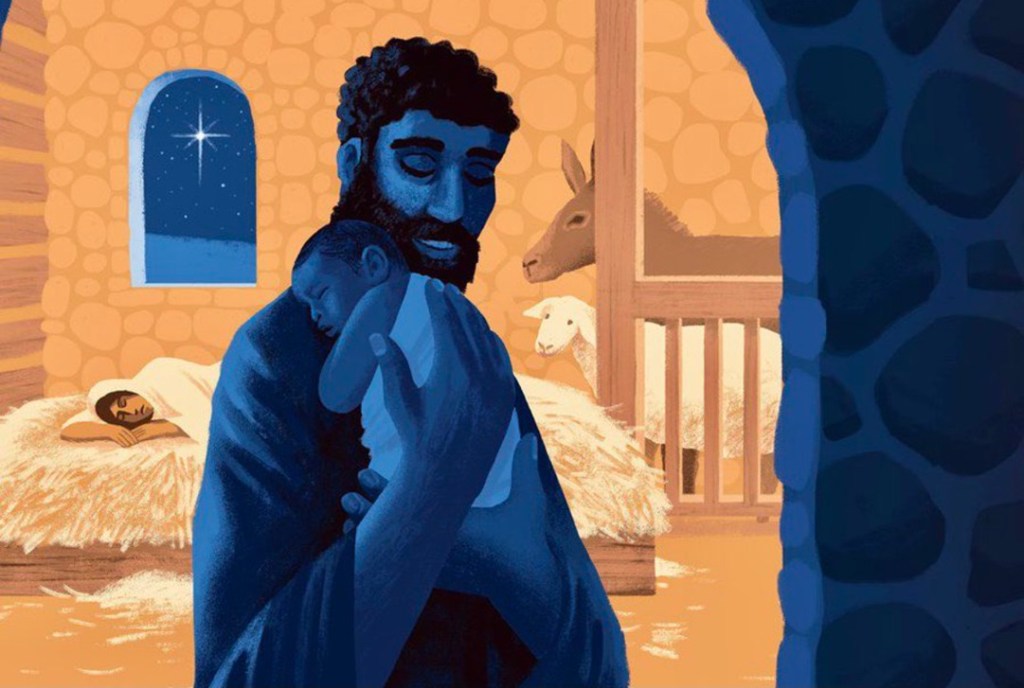
Take a moment today to remember that in the midst of so many folks screaming about “biblical values” in regards to gender, marriage, and family, that true biblical values are much broader, much more progressive, and much more beautiful than what they’re saying.
Take a moment today to reflect on how Joseph is a supporting character and presence in the Christmas story, and that can be, and is, part of the Good News.
God of Joseph, remind us, especially us men, that your vision of love and support rarely looks like those of patriarchal, hetero-normative gender roles. Amen.
Thursday, December 8
Matthew 3:7-8
But when [John the Baptist] saw many Pharisees and Sadducees coming for baptism, he said to them, “You brood of vipers! Who warned you to flee from the wrath to come? Bear fruit worthy of repentance.”
I’m a pretty chill dude. I’m polite, I’m authentic, I’m nice and friendly. I’m naturally averse to conflict (though more experience in my professional life has pushed me to be more assertive).
I can’t imagine calling any of colleagues a “brood of vipers.”
Okay, that’s not true. I can’t imagine calling any of colleagues a “brood of vipers” to their face.
Okay, that’s not true either.
But it would take a lot!
John the Baptist is a pretty fiery guy who says a lot of things and doesn’t often tip-toe around it. But still, calling these folks a “brood of vipers” is serious. So what were they so wrong about?
First of all, as an important side note, I want to make something clear. Check any anti-semitism at the door (or, I guess at the homepage of this blog). There’s a long history of the Church justifying anti-semitism with gospel passages like these. And let me make this point: John the Baptist isn’t mad at them because they’re Jewish. For Pete’s sake, he’s Jewish! He’s mad at this particular group for being in leadership roles and taking advantage of people they’re supposed to care for.
And today, where we see anti-semitism more clearly, churches have to be clear about this. The folks John the Baptist (and Jesus himself) had conflict with were just being human – it wasn’t their Judaism that got them the title “brood of vipers.” We all have seen people do good things and bad things in roles of leadership in any institution. So, be careful with assumptions you make with texts like this one.
Okay, side note complete.
In a similar spirit from above side note, John the Baptist is upset with these leaders because they’re acting hypocritical, and they’re more concerned with keeping their own power intact and protecting institutions and systems than standing up for the people who are suffering.
We must take care to make sure that we’re not so concerned with our precious systems and institutions and habits and rituals and buildings that we create idols and fail to love those who God has called us to love.
If we do worship the idols, then the John the Baptist figure that God will send our way won’t hesitate to remind us and call us back.
God of prophecy, remind us of the big picture, of the simple fact, that we are called to care for and love one another, not a status quo. Amen.
Thursday, December 1
Isaiah 11:6
The wolf shall live with the lamb, the leopard shall lie down with the kid, the calf and the lion and the fatling together, and a little child shall lead them.
When I simply hear the word “Advent,” I picture the church I grew up in, all decked-out in garland and candles and purple. I smell evergreen and Bath & Body Works candles. I taste hot apple cider. I feel the cold air outside and the overly zealous heating system inside. And what do I hear? It’s not as much Christmas music, or Advent hymns (which, can we agree, for the most part aren’t that great?), or scenes from Home Alone, or even the story of baby Jesus. I hear this verse from Isaiah.
I’m not sure why this verse is so distinctly tied to my Advent memory.
Maybe because it’s so poetic and utopian. Maybe because it seems so absurd, like a beautiful fantasy. Or maybe because the imagery would make for a great tattoo.
Regardless, it’s in my memory, near the top of the file labeled “Advent.”
If you’re part of a tradition that lights the candles in an Advent wreath, you may recall that the first candle on the first Sunday of Advent is hope, and the second candle on the second Sunday of Advent is peace. Yes, this lectionary text is for the second Sunday of Advent, but as I write this (and when I post this), it will be right between the candles for hope and peace. And that’s where this story sits. It’s a mix of hope and peace. It’s an image of peace while being so fantastical, it requires a radical hope to imagine that it’s even possible.
Sometimes that’s a lesson of Advent. To truly catch a glimpse of God’s vision for what this world can be, we have to be willing to fall into the radical imagery that feels like fantasy. We must entertain the absurd, just long enough, to remind us of what just how great God’s dream for the world can be, and how much work we have before us to make it real.
God of the wolf and the lamb, continue to inspire the prophets with these absurd visions as a reminder of what’s possible through your love. Amen.
Thursday, November 24
Isaiah 2:4
He shall judge between the nations, and shall arbitrate for many peoples; they shall beat their swords into plowshares, and their spears into pruning hooks; nation shall not lift up sword against nation, neither shall they learn war any more.
Amazing, isn’t it, that when prophets proclaim hope for the future, there’s a description of a post-war world, a peaceful world? Amazing, isn’t it, that when our elders tell us their hopes and dreams for future generations, the words are filled with peaceful living and no need for fighting? Amazing, isn’t it, that when each of us is honest, what we want in our lives is peace, contentment, and flourishing?
The active and devout peacemakers of our world know that the work for peace is not easy, not simple, and may not even be possible in their own lifetimes. And those who have witnessed the horrors of war will be the first to speak of the value of peace. And those somewhere in-between the pacifists and the soldiers will tell you that peace is simply unrealistic.
All of us desire a future where there is safety, security, and peace. We all want a world where there is no war.
Even though all of us want a world of peace, even though we hope for a world of peace, we still buy guns, we still turn a blind eye to nationalism and sinful military budgets, and we still teach our children that war is inevitable and that, in certain circumstances, it’s honorable to kill.
When will we learn?
When will we recognize that all people desire peace, and that this vision is possible, if only we have the courage to teach it to our children, proclaim it with our voices and votes, and work for it in our daily lives.
The prophet Isaiah speaks the divine words of a future that will be ushered in, one that does not include war. How can you be a part of ushering it that new world, of making that vision a reality?
God of peace, inspire us to be bold and imaginative in the ways we seek to wage peace. Amen.
Thursday, November 17
Jeremiah 23:1
Woe to the shepherds who destroy and scatter the sheep of my pasture! says the Lord.
God, speaking through Jeremiah, is angry at those who are supposed to be stewards, caretakers, “shepherds” of people who are in need of care, especially older folks, folks grieving, folks who are marginalized, and young children. This verse is resonating with me this week, in particular.
On Tuesday night, I had the honor of attending an event at Rhodes College for students to get to meet religious leaders who serve at open and affirming faith communities. This event was put on by our Parish Associate Pastor at Evergreen, Chaplain at Rhodes, and a friend and colleague, Rev. Beatrix.
And this coming Sunday is Transgender Day of Remembrance.
As I write the devotional for today, in between the event on Tuesday and this coming Sunday, I reflect on the unique space I occupy as Christian clergy, as a white, straight, cis man, and as an open and affirming pastor who deeply wants to be the best ally he can be. In fact, being an ally is central to my pastoral identity and ministry. At the same time, when I put on a clergy collar and go out in public, for many, I symbolize an institution that causes pain and trauma, that marginalizes people, and that has a terrible history of patriarchy, colonization, and oppression.
I’m a shepherd that comes from a long line of terrible shepherds and wonderful shepherds.
As I reflect on the event at Rhodes, and all of the students and colleagues I talked with who have been burned by the Church, and as I think on the upcoming, annual acknowledgement, Transgender Day of Remembrance, I pray for all of us who spend seasons of our lives as caretakers.
Whether we are mentors, teachers, parents, older siblings, pastors, or anything in between and beyond, may we truly be embracing and compassionate and affirming guides and sources of unconditional love. May we offer the same care that the God of love offers us. And may we be fierce to call out the shepherds that hurt those they’re called to love.
God of care, help us to guide one another through love, validation, and affirmation. Amen.
Thursday, November 10
Luke 21:5-6
When some were speaking about the temple, how it was adorned with beautiful stones and gifts dedicated to God, he said, “As for these things that you see, the days will come when not one stone will be left upon another; all will be thrown down.”
In this scene, Jesus and the disciples are entering Jerusalem, and there’s a good chance, for some of the disciples, it’s their first time in the sacred city. They see the Temple in all its glory and they marvel at it.
And of course, Jesus is the buzz kill.
I imagine they wanted him to be in awe with them. Or maybe give them a history lesson on the architecture. Or say something Jesus-y like, “And behold, the wonders of God’s people! This grand Temple was built on firm ground by the meek peacemakers who had the faith of just a mustard seed.”…or something like that.
Nope.
He essentially says, “Big Whoop. It’s gonna fall apart.”
We should keep in mind that Luke is writing his gospel about 10-20 years after the Temple was actually destroyed. It’s possible that Luke includes this scene as a comfort to the Israelites that have had their faith shaken as their sacred place was demolished. It’s also possible that Luke is making the case to the Gentiles, Luke’s primary audience, that God is not limited to a human structure and God’s faithfulness continues even when sacred relics are gone.
Either way, there’s a lesson for us here today.
Don’t be distracted by the pretty buildings and the fancy things when it comes to church. Now, hear me, I don’t want to shun the crafts-person-ship and artistic skill that goes into our buildings and spaces. I believe the divine can often be praised and encountered through the sharing and expressions of art, creativity, imagination, and labor. The important element, though, is that these things are icons that point to the divine, and not idols that become the divine. God can be encountered through ancient ruins and historic cathedrals, as well as through train-car graffiti and weeds piercing concrete.
Allow all of it to point to the wonder and awe of God, rather than becoming your God.
God of wonder, remind us that the icons all around us are gifts, but that none of them should become idols that distract us from you. Amen.
Thursday, November 3
Psalm 149:1-3
Praise the Lord! Sing to the Lord a new song, his praise in the assembly of the faithful. Let Israel be glad in its Maker; let the children of Zion rejoice in their King. Let them praise his name with dancing, making melody to him with tambourine and lyre.
I often wonder what the people in the town from Footloose do with verses like this.
I mean, the psalmist is telling folks to dance (gasp).
Growing up in rural Appalachia, surrounded by hellfire warnings, I always loved seeing areas of the Bible that promoted a party. At the same time, I grew up in a downtown, white, Presbyterian church. So…a party is fine, but do it on your own time and never at the church. (Plus, have you ever tried to dance to a pipe organ? No thanks.)
There’s something comical and also hypocritical about different Christian traditions saying what kinds of celebrations in church life are cool and what’s not. On a serious level, these rules are often rooted in a desire for control, patriarchy, white supremacy, and colonialism. On the surface, they’re just annoying and a massive buzz kill.
The psalmist here is praising God for Her ability to do a new thing and Her faithfulness in actually, well, doing it. And the response? A Party! Make music and dance and celebrate!
Whether you come from no church background, or a mainline tradition, or some fundamentalist “don’t have-fun” crew, always be challenging yourself to be open to the ways people have fun and celebrate. Don’t be judgmental. If people wanna sing off key, clap for ‘em. If they wanna dance like a fool, get on the dance floor, too. If they wanna bow to the ground in sincere prayer, give them space to do their thing.
God is always up to something sneaky and new, and who are we to judge how people celebrate that?
God of what’s new, help us to embrace the newness of your Spirit and your will in our lives (and keep our judgmental snobbery at a minimum). Amen.
Thursday, October 27
Psalm 46:1,10a
God is our refuge and strength, a very present help in trouble…Be still, and know that I am God.
I’m wrapping up week two of two weeks out west. The first week was vacation time with CK, my partner. This second week has been time for continuing education with a cohort of clergy I’ve been with since 2015. This is the first time we’ve all been together since COVID lockdown (though one of our original members who discerned that she needed to leave the group, which was terribly sad but understood, given her context and needs for her ministry).
So here we are, six clergy serving congregations in Tennessee, New Jersey, North Carolina, Colorado, and Wyoming, in rural and urban settings, gathered to recharge and learn from each other. We find time to check-in with each other on how we’re doing…like, really doing. We discuss a book we’ve all read. We compare notes on various ways of “doing church.”
And in our casual conversations at meals, we’ve all noted that being in the southwest together for this overdue gathering is particularly special. The desert just has this way about itself. It’s mysterious, beautiful, unpredictable, and wild. It’s offered each of us an atmosphere upon sacred ground to pause and reflect, to reorient ourselves toward our senses of calling in ministry.
Psalm 46 is a perfect psalm for what I’m experiencing this week.
These wise words from the psalmist offer some perspective. I don’t know about you, but I have a nasty habit of thinking that I have the answers to all of the world’s problems. And then I have the audacity to think that I, along with my comrades in my own little corner of progressive Christianity, have all the right methods for carrying out said answers.
And then I pause. I take some breaths of mountain air and get away for a while. I enjoy time in nature with my person. I have conversations over breakfast burritos and coffee with my cohort. And I get perspective. I’m reminded that it is God, and not my own ego, that is my refuge and strength. I’m reminded it is God, not my poor excuse for wisdom, that will lead our community of Evergreen from one season of life to the next.
So today, I’ll sit outside on a dusty rock and stare at the snowcapped mountains of northern New Mexico, and I’ll be still. And I’ll reorient myself to the Creator, and try to be at peace.
God of refuge and rest, thank you for being near to us, and for giving us grace when we get too big for our britches. Amen.
Thursday, October 20
Well, I’m late on the post, and that’s because I’m out west on vacation and enjoying National Parks! So for the devotional this week…go outside and just be.
Thursday, October 13
Luke 18:2-5
[Jesus] said, “In a certain city there was a judge who neither feared God nor had respect for people. In that city there was a widow who kept coming to him and saying, ‘Grant me justice against my opponent.’ For a while he refused; but later he said to himself, ‘Though I have no fear of God and no respect for anyone, yet because this widow keeps bothering me, I will grant her justice, so that she may not wear me out by continually coming.’”
Wisdom shows up in the strangest places, doesn’t it? (I’m not referring to Jesus – it’s not strange to me that he’s wise.)
What made me think that is a quote from The Pirates of the Caribbean film. (I kind of did a marathon of those movies when I had COVID last.) Jonathan Pryce, playing the part of Governor Weatherby Swann, says to his daughter, Elizabeth Swann, played by Kiera Knightley, “Sometimes the right decision made for the wrong reason is the wrong decision.” In case you didn’t just watch the movie like me, he was referring to her saying ‘yes’ to marrying a man he wanted her to marry but she didn’t want to marry and she only said yes to save the life of the man she truly loved, which is tragic and beautiful but don’t worry it all works out in the end….okay. I’ll stop before I just rehash the whole film.
“Sometimes the right decision made for the wrong reason is the wrong decision.”
Did the judge in this parable make the right decision or the wrong decision since it was for the wrong reason? O does his motivation even matter?
This parable from Jesus feels like it hasn’t aged a day. How often to we see people in power, especially men, just like the judge Jesus talks about, deny justice to the oppressed in our world?
We can all name leaders in politics and business who stubbornly refuse to do what’s right…until…sometimes…the pressure is too much.
And sure, they end up caving and making the right decision to save face, avoid a lawsuit, keep the business from crumbling, get re-elected, or shut up the protestors. It’s the right decision but often for the wrong reason.
But in regards to the oppressive powers-that-be:
- We don’t always know why they do what they do. We don’t have a window into their heart, after all. These decisions are between them and their own conscience, between them and God.
- Jesus tells the parable not to complain about the judge that’s being a jerk, but to encourage the hearers to find inspiration in the widow’s persistence.
And that’s what we should do today.
It’s easy to criticize and complain about the decisions of the powerful people who seem to run this world. And it’s easy to make assumptions about their motives and debate whether or not it’s right or wrong based on our assumed motivations.
The harder, more beautiful, and more faithful call is to be the widow. To persist. To be the pain in the neck for those who oppress. To draw their oppression into the spotlight, in the hopes that it will lead to the changing of hearts and minds, transformation of systems, and liberation for those who are suffering.
Look back through history. The biggest shifts for justice were often led by people of faith communities, persisting in spite of terrible odds. Keep it up, my friends. God’s liberating hand moves fastest when we’re not complaining about the jerks, but when we’re persisting, when we’re getting to work.
God of persistence, inspire us to have the faith of the widow, and to change the world through pestering and persevering. Amen.
Thursday, October 6
I’m off for a vacation with some hometown buddies! Don’t forget to take time for friendships and fun!
Thursday, September 29
Habakkuk 1:2, 2:2-3
O God, how long shall I cry for help, and you will not listen? Or cry to you “Violence!” and you will not save?” …Then God answered me and said: “Write the vision; make it plain on tablets, so that a runner may read it. For there is still a vision for the appointed time; it speaks of the end, and does not lie. If it seems to tarry, wait for it; it will surely come, it will not delay.”
Ever swam in the ocean?
When I do, I always end up swimming too far out. It doesn’t matter if it’s memories from childhood or from a trip to the beach with friends a year ago, I always end up far out to a point where waves crash into me and I have to fight to get my mouth above water to catch breaths. I’ve never felt like I was in any true danger, but the experience has always been enough to cause me to be 100% present to my body and the movement of the water, completely unable to do or think about anything else.
The past few years, I’ve felt this way on a daily basis. I feel like I’m fighting for air with my body and my mind, trying to breathe deep while waves that threaten keep crashing into me.
There seems to be more and more news that threatens daily life for so many in the US and in the world. And then there’s the large-scale, existential threats like nuclear war and the climate crisis. It takes its toll not just on those directly hurt in that day’s crisis, but on all of us. Our spirits start to get tired and heavy. In these days, I feel like every time I gasp for air, I let out a small prayerful plea, asking God to show up.
But the waves keep coming.
In these verses from Habakkuk, God asks for us to see the big picture, to embrace a faith that looks toward the endgame. We’re asked to write out a vision, lay out our hope and then look at it. And God asks that we trust, that we have faith, that God will be at work and is at work, and that sometimes we’re just too distracted by the immediate crashing of waves to see the big picture.
I have hope and faith that this is the cycle the people of God experience. I have hope and faith that God is in the endgame, and that we truly are moving toward a brighter future of love and grace, of peace and justice. Somedays I can write out the vision and believe it. Some days I’m just too busy with the waves. But either way, I think God is still here, working toward the endgame anyway.
God of the endgame, keep encouraging us when we’re too busy with the waves to see the big picture. Amen.
Thursday, September 22
1 Timothy 6:7-10
…for we brought nothing into the world, so that we can take nothing out of it; but if we have food and clothing, we will be content with these. But those who want to be rich fall into temptation and are trapped by many senseless and harmful desires that plunge people into ruin and destruction. For the love of money is a root of all kinds of evil, and in their eagerness to be rich some have wandered away from the faith and pierced themselves with many pains.
Who is a mentor you’ve had? Who’s someone, or a group of someones, who nurtured you, taught you, cared for you? One of my mentors, Alan, who was the Director of Christian Education at my home church growing up, called these kinds of people “Lanterns of Love.” One night at youth group, Alan asked us to create a list of our Lanterns of Love. I still have it.
This letter, called 1 Timothy, is the first letter that Paul wrote to his friend, Timothy (at least, that we have in scripture).
Paul was Timothy’s mentor, a Lantern of Love, guiding his life and ministry.
When we read these verses with that in mind, it changes our interpretation from something akin to “God wants us to live simply and not oppress people and worship the idols of wealth because it destroys us and others,” to “Paul, as a person who has seen a thing or two, is imparting wisdom to his mentee.”
Now, I’m not saying the former interpretation is off. Not at all! In fact, I think the context, that is, Paul departing wise words to Timothy, helps deepen the meaning in the sage advice regarding wealth. These words aren’t merely a cold code of ethics, but lessons learned from a long life of redemption, imprisonment, faith, and resilience.
Today, I invite you to take some time to recall one of your Lanterns of Love. And try to remember some of the advice they offered to you about what leads to a fruitful and fulfilling life, one that shows compassion and offers grace.
God of wisdom, thank you for our Lanterns of Love. May we live by the Holy Wisdom they share with us, inspired by you. Amen.
Thursday, September 15
Jeremiah 8:18, 9:1
My joy is gone, grief is upon me, my heart is sick…O that my head were a spring of water, and my eyes a fountain of tears, so that I might weep day and night for the slain of my poor people!
Even if you don’t live in Memphis, you probably heard about the tragedy and terrors that took place here last week.
There were two abductions, one of a young mother and teacher, and one of a teenage girl. The teenager made it home, though not without trauma, I’m sure. And devastatingly, the other woman did not make it home, and her body was found a few days after her abduction.
And then, within a day, a 19-year-old man got in his car and went on an almost 24 hour shooting spree throughout the city, killing and injuring several people. A week ago, I, along with all Memphians, was watching the news and staying indoors, hoping for that moment when we’d get word that the shooting ceased.
It’s in days like these that our faith is put to the test. We get scared. We feel no sense of control. Our hearts break for people and places we know. We want to scream, or sigh with exhaustion, or mumble, or whisper through tears, “Why does God allow this to happen?”
There’s so much we can say and pray and quote and hope in response to this. And I could offer a ton of book recommendations that try to give answers. (Let me know if that would be helpful to you and we can chat.)
In today’s devotional, though, I want to recognize these words from Jeremiah, and the deep feelings within the words, in the lectionary for this Sunday.
Words like these are all throughout the Christian scriptures – words of lament and pain. The prophets, the psalms, Jesus in the garden and on the cross, in the questions asked of Paul that he responds to in his letters – in all of these (and then some), we see people shout to God with doubt and anger and despair.
If you haven’t been told this before, let me tell you now: You can shout your laments and anger to God, you can whisper your doubts and fears to God, you can raise your fist dramatically in the rain and scream nonsense at the heavens until you lose your voice. God can handle it.
God already knows how you feel it, so let it out.
There’s an ancient story in Genesis about a guy named Jacob. He wrestles with this ambiguous person along the banks of a river all night. (The text tells us that it’s an angel or God.) After the wrestling match, Jacob is renamed “Israel,” which means “Striven and prevailed with God.” And it’s the people who eventually come from Jacob who are known as God’s people, called “Israel.”
Isn’t this interesting? God’s people throughout scripture are those who struggle with God.
It’s not a sin to yell at God. In fact, it’s faithful. And you’d be in really good company.
God who can handle our anger, keep wrestling with us. Keep hearing our laments. Guide us to the other side. Amen.
Thursday, September 8
Luke 15:1-2
Now all the tax collectors and sinners were coming near to listen to [Jesus]. And the Pharisees and the scribes were grumbling and saying, “This fellow welcomes sinners and eats with them.”
I LOVE JESUS.
I don’t say it enough. Most of what I type in these things is all, “Jesus sounds like a turd in this verse, huh? But guess what, he’s actually edgy and cool and here’s why…”
But from time to time, I guess a Christian Pastor should say, “I LOVE JESUS.”
And let me give you a reason why.
Have you ever heard of Montreat? It’s a super Presbyterian thing. It’s a Presbyterian Church (USA) National Conference Center in the town of Montreat, North Carolina, near Asheville. I would go there as a youth for summer conferences, and it didn’t take long for Montreat to become sacred ground for me. Once I was a college student, I was eligible to work for the conference center on their summer staff. I applied and got a job the summer of 2008. It was probably the best summer of my life.
Once I arrived, I started to settle into a friend group of other future seminarians who liked to talk about theology and politics and wear Chacos and go hiking. After the first couple of weeks, though, I realized that some of them would get super judge-y. They would point to some of the other staff, mostly older, and talk about how they partied too much or how they didn’t have a plan after college or how they were “too open” to other people. After a couple more weeks, I started to gradually gravitate toward the “partiers,” especially since my 21st birthday was coming up (and I had lived a very sheltered life and was a little scared but also excited about trying a beer for the first time…okay, maybe fourth time).
And it was in hanging out with the partiers that I realized that they were more gracious, more honest, more open, more thoughtful, more empathetic, and more compassionate than my other new friends. They knew that they needed grace, like we all do, and they lived life with their hands and hearts and minds open. Some of those people are still close friends of mine today.
I don’t think Jesus was more interested in hanging out with the sinners because he saw them as “fresh soon-to-be converts in need of saving.” I think Jesus was more interested in hanging out with them because they were more open to his message of love and acceptance. They were more authentic and curious. And he gravitated toward them for those reasons.
And that’s one of the many reasons that I LOVE JESUS.
God who-hangs-out-with-sinners, thank you. Stay with us, and close down the party. Amen.
Thursday, September 1
Deuteronomy 30:16-18
[Moses said] “If you obey the commandments of the Lord your God that I am commanding you today, by loving the Lord your God, walking in God’s ways, and observing God’s commandments, decrees, and ordinances, then you shall live and become numerous, and the Lord your God will bless you in the land that you are entering to possess. But if your heart turns away and you do not hear, but are led astray to bow down to other gods and serve them, I declare to you today that you shall perish; you shall not live long in the land that you are crossing the Jordan to enter and possess.
I don’t like it when we reduce our faith to transactions. I don’t like when our path of discipleship is all about statements like “If you do x, then God does y.” That’s not much of a relationship, and life is far more complicated than that.
At the same time, there are consequences for actions.
It’s true that our journey of faith in God can be complex and deep, and that we recognize that we, as individuals and as communities, may reap what we sow.
Moses presents two choices to his community, the Israelites, who are learning how to understand life and society outside of enslavement in Egypt, and those choice are life or death.
The choice seems obvious, right? These people have been through hell, and the hope is that it gets better, and that there is a future of thriving and flourishing and a new home. But that’s the thing about temptation – it’s a real turd.
And yes, it’s odd for a progressive, Presbyterian Church (USA) pastor to get all “beware of temptation,” but let’s be honest for a sec. In day to day life, it’s quite tempting to just “look out for number one,” to serve first and foremost our own self interests, and to become complacent with those things that are “out-of-sight, out-of-mind.” We make moral justifications, among other excuses.
Or maybe it’s just me.
The Israelites will soon face the temptations of breaking the bonds of community and the hopes of equity and justice for their own self-interests, and they’ll begin to lose perspective.
Today, take time to breathe deep, and think about the big picture. Get some perspective. Think about others in your community and society. And ask what choices you can make that lead to life, to equity, to hope.
God of our choices, continue to guide us in how you’d have us live, and remind us over and over when we forget. Amen.
Thursday, August 25
I’m away on study leave, so I use this simple devotional to encourage you to take time to read and write and rest.
Thursday, August 18
Isaiah 58:12
Your ancient ruins shall be rebuilt; you shall raise up the foundations of many generations; you shall be called the repairer of the breach, the restorer of streets to live in.
Rebuilding and renovating projects are awful. At least, in my own experience, and with my limited skills, I’ve never enjoyed them. And with said limited skills, the final product hasn’t been very rewarding because I usually did a poor job.
So when this prophet starts talking about rebuilding, I hand my hammer to someone else and then ask the prophet, “How else can I help?”
But that’s the beauty of God’s transformative power. We don’t rebuild and renew and repair and restore alone. We do it with a team. We do it in community. AND…the Spirit of God calls this transformation to not only be one of literal handiwork, but also of the culture, of the minds, of the hearts.
In this section of Isaiah, the prophet is addressing a community coming back to a shattered Jerusalem after the Babylonian exile. What they remember (or really, what stories they were told since many hadn’t seen Jerusalem since they were in exile at least 50 years) doesn’t match what they see. There’s disrepair. There’s dysfunction. There’s corruption.
Wealthy elites in politics and religion are hoarding resources and blaming it on the “foreigners” who have come into the city, and the community coming from exile believes this, and prejudice takes hold and the division keeps a potentially diverse and vibrant people from thriving as one community.
How might God’s Spirit be calling you to join with folks different from you to rebuild something? Where is God’s Spirit up to transformation, and how can you jump in?
God of repair, help us to follow your Spirit, and keep us open to those who are different than us, that we may learn from them, love them, and work alongside them. Amen.
Thursday, August 11
Luke 12:49-53
“I came to bring fire to the earth, and how I wish it were already kindled! I have a baptism with which to be baptized, and what stress I am under until it is completed! Do you think that I have come to bring peace to the earth? No, I tell you, but rather division! From now on five in one household will be divided, three against two and two against three; they will be divided: father against son and son against father, mother against daughter and daughter against mother, mother-in-law against her daughter-in-law and daughter-in-law against mother-in-law.”
Okay, this is scary Jesus. Or at least, I picture a goth teenager Jesus who’s super pissed at his parents.
And it’s especially weird that a gospel like Luke’s which begins with lots of “peace talk” during the Christmas-y sections turns into Jesus talking about “no peace, but division.” We wonder if Luke wrote this section after a particularly bad day, or if Jesus just changed his mind on his mission. But there’s something that is crucial to the context. As Dr. Jerusha Matsen Neal, Assistant Professor of Homiletics at Duke Divinity School, writes in her commentary on this passage, “Jesus’ call to ‘interpret the present time’ (verse 56) is critical.”
There are “present times,” or seasons, where lives are at stake.
In these scary days, I’ve had so many conversations, both with friends and with members of the church, who struggle with their families and the disagreements they have. It’s beyond whether or not pineapple belongs on pizza. They’re disagreements on whether or not to support what happened in DC on January 6, 2021. It’s disagreements on whether or not LQBTQIA+ people should or shouldn’t have rights, or whether or not they’re condemned by God. It’s disagreements on whether or not systemic racism exists.
These are real. These are not just “agree to disagree” conversations, but full-on ideologies that lead to violence, to shame, and to life and death.
And when we find ourselves at a crossroads with family and friends, we have to ask ourselves, “Is it time to put in a boundary?” And if so, what does that boundary look like?
It’s not easy. And there’s no clear answer I can offer. But I can say that there are some moments in life where, to protect ourselves and others we love, we must put in boundaries that do end up causing divisions. And it hurts and it sucks. And we have to also ask ourselves, “How can I still show compassion, empathy, and grace?”
These questions are for each of us to discern in our own contexts. And we’re all different.
For me, I’m fortunate in that vast majority of my close family and friends recognize the work our society has to do to be more just and loving. And I have a lot of privilege, so a lot of the ally work I can do is going into white, male, cis, straight spaces and advocating for more generous, more beautiful, more open perspectives, vocabularies, and ways to live. But there’s still times where I have to put in boundaries on how much time I can spend with people, or what subjects I have the bandwidth to talk about. It’s not just a matter of preference or mood, but of self-preservation and even my own health.
When your boundaries cause divisions, it’s tough, but sometimes it’s necessary for your own health, your own dignity, and your ability to flourish as the beloved child of God that you are.
God of boundaries, help us discern when it’s time to build bridges and when it’s time to burn them. Amen.
Thursday, August 4
Genesis 15:5
[God] brought [Abram] outside and said, “Look toward heaven and count the stars, if you are able to count them.” Then God said to him, “So shall your descendants be.”
This is one of my favorite stories in the Bible to picture. I love the idea of God pointing to a vast, night sky to illustrate a moment of call and purpose to a person.
God has a wonderful way of doing this throughout scripture.
God challenges people, and offers wisdom and revelation, and then points to elements of our human experiences, our memories, our surroundings, to create metaphors so we can better understand.
In this case, God is calling Abram, alongside his wife, Sarai, to be the beginning of this family tree through which God will work. And to help Abram understand the impact and multitude of this calling, God points Abram to creation, to the stars.
Have you ever looked up at the stars in the middle of the night, especially when you’re far from any light pollution, out in the middle of nowhere? The overwhelming since of wonder captured you, didn’t it? In that type of moment, our imaginations feel liberated. We’re in awe of creation and our place in it.
This sort of moment between God and Abram isn’t limited to this one story, written thousands of years ago.
You are called. You have a purpose. In fact, you have many calls and many purposes throughout life. And the potential is vast…as vast as the stars in the night sky. Don’t limit yourself when God, the creator of the entire cosmos, reveals plans for you.
God of the night sky, liberate our imaginations so that we can more faithfully move into the many callings you have for us. Amen.
Thursday, July 28
Luke 12:21
[Jesus said] “So it is with those who store up treasures for themselves but are not rich toward God.”
This verse comes at the end of an encounter Jesus has with a man who speaks up from a crowd (you know, the usual). This unnamed man wants Jesus to come to his aid and convince the man’s brother to split the inheritance with him. Jesus responds by warning him about the dangers of greed, and then Jesus tells a short parable about storing up goods for yourself until you have so much that you have to buy more land and build another barn to hold all your crap.
People fighting over wealth, and then struggling with what to do with it all. Not much has changed in two thousand years, huh?
We still see some hoarding wealth while millions of people struggle and starve. We still watch CEOs and politicians destroy the planet for the sake of Wall Street. And it’s not because any of these people are inherently evil. It’s because greed is a powerful force. That’s why Jesus warns first about greed and not possessions. Having something isn’t bad in and of itself. It’s being driven by greed, the desire for more, and having so much and being unwilling to share with others and work for equity and justice that hurts the world.
But many of us aren’t millionaires. Many of us aren’t sitting on some fancy board making ruthless business decisions. Many of us are just trying manage our budgets, hoping we can keep our jobs so we can still have healthcare and that we won’t have to invest in a new HVAC system anytime soon.
For many of us, we’re not poor, and we’re not rich.
But that doesn’t mean that greed isn’t still something we have to watch out for.
Greed, even in a small dose, can disrupt relationships, harden our hearts, and cause us to objectify people.
There is enough in this world – enough food, enough land, enough water, enough stuff – for all of us to survive and thrive. But we have to be willing to share, we have to be willing to shop responsibly, we have to be willing to make some sacrifices here and there, and we have to live simply. And in these counter-cultural practices, we will soon find that there’s enough to go around, and that what makes life abundant is not things, but the love we share with one another.
God of simplicity, keep us mindful of what’s really important in life. Amen.
Thursday, July 21
Colossians 2:8
See to it that no one takes you captive through philosophy and empty deceit, according to human tradition, according to the elemental spirits of the universe, and not according to Christ.
This is one of those verses that can be taken so many different directions.
If I saw it on a bumper sticker, I’d probably assume that the owner of the car interpreted it as “Don’t believe in science or horoscopes and maybe the bones of the dinosaurs were just put in the ground to test our faith. Yay Jesus! (Shoots a gun into the air)”
But…the more I think about it, especially in the larger context of the letter to the Colossians and in the context of our human day-to-day experiences, it’s pretty powerful and pretty deep and pretty good advice.
“See to it that no one takes you captive.”
There were very real, tangible forces then and there are very real, tangible forces today that take us captive. For you, it may be credit card debt, medical bills, or a dead end job with an unfair boss. It may be the torment of mental illness with a lack of resources or support to cope. It may be the continued ruthless legislation regarding abortion or stripping of rights for LGBTQIA+ people. It may be literally taken captive by law enforcement, incarceration, white supremacy, and the death penalty.
There are powers in this world and in our society that seek to take us captive. And it’s true that it often happens, for example, “through philosophy (gaslighting) and empty deceit (lying politicians), according to human tradition (outdated and unjust economic systems, constitutions, and legal precedents), according to the elemental spirits of the universe (falling into hopelessness, with a platitude of “everything happens for a reason,” or believing that the world is only earth and fire and water and air devoid of any love or magic or mystery), and not according to Christ.”
It’s not easy, but seek to follow the Greatest Liberator as we work for liberation – liberation for those excluded and exploited and oppressed, liberation for our imaginations, liberation for hopes and dreams, liberation for peace and justice for all people.
To follow Jesus is to believe and live as if all captives can be set free, and that we can rise above the deception and death of the unjust systems that surround us. To follow Jesus is to believe and live as if another world is possible, here and now.
God of liberation, call us to work for freedom, for peace, for new life. Amen.
Thursday, July 14
Luke 10:38
Now as they went on their way, [Jesus] entered a certain village, where a woman named Martha welcomed him into her home.
This verse comes from Luke’s telling of the Mary and Martha story, a story that has become popular through the ages. Here’s the synopsis: Mary and Martha are sisters, and, when Jesus arrives, Mary sits at Jesus’ feet and talks with him. Martha is painted as a “busy body” in the story, and eventually asks Jesus to tell Mary to get up and help her. Jesus isn’t much help to Martha, and tells her that Mary is the one who’s actually getting it right, being present and enjoying the time with him.
Stories like this one are powerful, and speak to us in real ways for good reason. But sometimes we’re so taken aback by the direction of the central theme, we miss other vibrant details that surround it.
For starters, there’s some incredibly radical elements of equality here, given the times. Pastor Niveen Sarras writes:
Luke’s statement that Martha opened her home to Jesus implies that Martha was an independent woman and financially stable. Martha may be a widow because there is no mention of her husband, and she owns and manages her house. If she had lived with her brother Lazarus or her husband, Luke would have said Lazarus’ house or mentioned her husband’s name. In the Middle East and first-century Palestine, the house is attributed to the family’s oldest man, not a woman. Men are always the head of the family.
Furthermore, the fact that Mary is learning from Jesus is also fascinating, as learning from and interacting with a teacher, especially a religious one, was something only men did.
Jesus is engaging in some bold stuff for his day.
And this whole scene begins with Jesus accepting the hospitality of Martha. Pastor Sarras, again, offers beautiful words on this act of Martha, writing that “hospitality is about allowing the guest to share the sacredness of the family space.”
Sure, this story is about being present, putting down the to-do list and enjoying the time we have with fiends and guests. But it’s also about how intimate acts of hospitality can be bold, and can challenge and subvert the status quo simply by doing life in your own home.
How can you subvert the injustices of the world through bold hospitality, through conversations and meals with people that wouldn’t usually be at your table?
God of overturning tables as well as sitting at tables with those you shouldn’t, inspire us to be bold and subversive in our hospitality, trusting that in that work, we meet you there. Amen.
Thursday, July 7
Luke 10:29b-32
[The man] asked Jesus, “And who is my neighbor?” Jesus replied, “A man was going down from Jerusalem to Jericho, and fell into the hands of robbers, who stripped him, beat him, and went away, leaving him half dead. Now by chance a priest was going down that road; and when he saw him, he passed by on the other side. So likewise a Levite, when he came to the place and saw him, passed by on the other side.
The story often referred to as “The Good Samaritan” is full of wisdom that can be unpacked from every angle, as most parables from Jesus can. I mean, right off the top of my head I can think of three directions from which I’ve heard preachers unpack this story. There’s the history and division between Jews in Palestine and Samaritans. There’s the reaction of the man Jesus tells the story to, revealing that he can barely stomach hearing such a tale. There’s the way Dr. Martin Luther King Jr used this text for his “I’ve Been to the Mountaintop” speech, given here in Memphis, the night before he was assassinated.
But I’m compelled to think about it from another direction, maybe one of the most obvious directions. This story reveals how one is called to love their neighbor, and it opens with the examples of religious people failing to do it.
Christians, as one large, collective category, really suck at showing the world that we love our neighbors. This has been happening for so long, yet it feels more obvious to me, now, in 2022, in the United States. It goes beyond the immediate connection we make to the Good Samaritan story, of passing by people in need, as we too often ignore folks asking for help at Memphis street corners while we wait for the light to turn green, though that’s as real as any life or death issue. It expands to a macro level, into the body politic of the United States as well as into the denominational squabbling over who can be in and who can be out, all while people continue to suffer from white supremacy, sexism, heterosexism, gun-worship, and lacking the key social safety nets and human rights the need to survive.
I feel like I’m often apologizing to strangers I meet on an airplane or at a bar about my religion, saying “I’m not that kind of Christian,” or “No, really, progressive Christianity is a thing.” But I realize that too often, for many folks, the damage is done. Churches and Christians have failed to love.
And just when I’m tempted to get self-righteous, and point fingers, I realize that I go through each day, doing a bit here and a bit there, largely ignoring the plight of the people who feel this exploitation most acutely. I could easily be the Levite from Jesus’ parable, ignoring the bloodied man because I’m in a hurry to get to my favorite coffee shop so I can right a sermon, and my face is in my phone as I share a statement on my Instagram story about the hypocrisy of the Religious Right.
True, we each have to give ourselves some grace. But sometimes grace can come with a side of “lighting-a-fire-under-our-butts.”
We must do better. As humans, and especially as followers of Jesus.
God of love, inspire us to make the sacrifices we must to better love our neighbors, with our wallets, our efforts, our time, our votes, our protests, our empathy, and our compassion. Amen.
Thursday, June 30
Luke 10:1
After this [Jesus] appointed seventy others and sent them on ahead of him in pairs to every town and place where he himself intended to go.
Notice that Jesus really likes to send people out in pairs.
Makes me think of a song, You’ll Never Walk Alone, by Gerry and the Pacemakers. When I spent my year in Northern Ireland, several friends I made were big Liverpool Football Club fans, and this song was kind of like Sweet Caroline at Ohio State football games for the Liverpool supporters. It was their theme song, it was shouted/sung in all the Liverpool pubs and at the stadium.
Of course, when you listen to the lyrics, the song nods to the companion that walks with you as being the feeling of hope, not another person.
And sure, going forward into life with hope is a great thing. But that’s not always easy. Hope often begins to diminish when we’re isolated.
Jesus knows this. And that’s one of the reasons he sends these folks out in pairs.
The work we’re called to isn’t easy, and the world can be a scary place, especially when you’re working for justice and equity and challenging the oppressive powers of the day, proclaiming a love so powerful that it would topple tyrants.
For the sake of hope, for the sake of safety, for the sake of “keeping up our spirits,” and for the sake of embodying the community and friendship that Jesus has modeled for us and called us to, we never walk alone. We’re in this together.
In this continued season of terrifying news, where so much seems to be hanging by a thread, do your best to be a friend. We need each other.
God of calling, sending, and friendship, help us to continue the hard work you have in store for us, and remind us, always, that we have each other. Amen.
Thursday, June 23
Galatians 5:22-23
…the fruit of the Spirit is love, joy, peace, patience, kindness, generosity, faithfulness, gentleness, and self-control…
When I was in college at Auburn University, the campus ministry I was in would often take a spring break mission trip with another campus ministry with students from our bitter rival, University of Alabama. Those trips were always a lot of fun, and they were helpful in my maturing as a young adult and as follower of Jesus. Of course, it’s easy to criticize a lot of mission trips these days, especially ones that involve a bunch of white students going to poorer areas to play savior, in addition to the criticisms from a place of stewardship – “Is it the most faithful use of our funds to take a trip somewhere else to do some good tasks?”
I trust, though, that God was still at work in us, as valid as these criticisms are.
One year we went to Orlando and spent our days gleaning fruit from farms and taking that fruit to local places that fed those who are hungry. It was hard work, and even boring sometimes. Most of what we picked were oranges, and it seemed like after hours of picking oranges and putting oranges in baskets and carrying oranges in baskets to the trucks we had barely put a dent in one row of trees…and there were so many rows of trees. (Are they technically trees? Or bushes? Whatever. They were above ground.)
As we would load up in the church bus after a long day, it was fascinating to look out the window and watch the sun begin to set on farm after farm filled with oranges. So. Many. Oranges.
To this day, I can’t take a bite out of citrus and not think about that trip. Really, it’s hard for me to look at any fruit now days and not imagine where it came from.
And that’s the thing about fruit. It grows. It has an origin. It comes from a seed. And hopefully, once it’s a full piece of fresh fruit, it finds its way to an animal or a person and helps nourish.
The fruit of the Spirit, love, joy, peace, patience, kindness, generosity, faithfulness, gentleness, and self-control, it all comes from somewhere. And it’s meant to nourish others.
And that somewhere, that origin, those seeds that grow and eventually bear fruit? That’s the Divine Spark within us all.
You have this fruit within you. Make space in your life to let it out. Find ways to offer the fruit to others so they can be nourished.
God within us, help us to awaken to Your Spirit that rests in the core of who we are. And inspire us to nourish others. Amen.
Thursday, June 16
Luke 8:35-37
Then people came out to see what had happened, and when they came to Jesus, they found the man from whom the demons had gone sitting at the feet of Jesus, clothed and in his right mind. And they were afraid. Those who had seen it told them how the one who had been possessed by demons had been healed. Then all the people of the surrounding country of the Gerasenes asked Jesus to leave them; for they were seized with great fear. So he got into the boat and returned.
This is a healing story that is a bit bizarre. Jesus has just left the province of Galilee, his hometown of Nazareth, and crossed the waters to the country of the Gerasenes, a mostly Gentile area. The trip, we’re led to believe, is one that is spontaneous, so the locals weren’t expecting him and certainly not excited to see him. In fact, the only two greetings he receives is from a man who is possessed by a multitude of demons, and the demons themselves, who are collectively called “Legion.” (Not only does this name illustrate that there’s a whole bunch of demons bound up inside this man, but it also serves as a nod and reminder to Luke’s readers of Jesus’ conflict with Rome and its military occupation in addition to his conflict with spiritual forces.)
The man who is possessed is known for not wearing clothes, behaving in an unpredictable and frightening way, and living in the local tombs. Jesus heals him by casting the demons out of the man and into a group of pigs nearby, who end up running off a cliff to their death.
So…yeah. Odd story.
But the ending seems relevant for our time.
After Jesus heals and restores the man to the community, the town folk kinda freak out. They are “seized with great fear” and they ask Jesus to leave.
The man? He gets some clothes and stays close by to Jesus, and essentially asks to be a disciple, going with Jesus and the gang from here on out. Jesus tells him no, asking him to “return to your home, and declare how much God has done for you.”
At first, I thought, “Dang, Jesus. That’s dismissive.”
But let’s look at what Jesus is really saying. Jesus is asking the man (calling the man, one could say) to preach, here, in this town. Jesus is calling this man into ministry, not as a follower from town to town, but to stay in his hometown and to preach about Jesus. I guess that’s not really dismissive at all.
How often do we, good church folk, marginalize people that we think are “odd,” or “off-the-mark,” or “too radical”? And how often do we refuse to befriend them, help them, listen to them and their needs? And how often do we fail to see that God has worked within and through them and even called them to preach a word to us?
God of showing-up-where-we-least-expect, help us to be stretched by your word proclaimed to us, no matter how it shows up. Amen.
Thursday, June 9
Proverbs 8:30-31
…then I was beside God, like a master worker; and I was daily his delight, rejoicing before her always, rejoicing in God’s inhabited world and delighting in the human race.
Chapter 8 of Proverbs illustrates a beautiful poem of an image: God’s wisdom personified as “Lady Wisdom.” She is described as being with God, co-creating and co-loving and co-maintaining and co-ordaining all of life.
I only included two verses here, but I encourage you to take time to read the whole chapter today.
It’s a gorgeous chapter, isn’t it?
Proverbs, coming from the Hebrew Scriptures (or Old Testament), wasn’t written as an additional theological treatise to the Trinity nor as an argument against it, given that it was written hundreds of years before Jesus of Nazareth was born and over a thousand years before the theological concept of the Trinity became orthodox.
So if you’re reading this trying to make sense of how Lady Wisdom fits into the “Father, Son, Holy Ghost” gang, slow your roll.
Take time to do this, instead: Spend some time outside. As Dr. Sara Koenig, Professor of Biblical Studies at Seattle Pacific University, writes in her commentary:
[Wisdom was present with God in] all three realms of creation—sky, waters, land… for God created the heavens (chapter 8, verse 27) and the clouds above (28), the deep (27-28) and the sea (29), and the earth (29). God’s acts of creation are described in detail, as God not only creates, but also sets boundaries for created things. God “shapes” the mountains and hills (verse 25); “makes” earth, fields, and dust (26); “establishes” the heavens and the springs of the deep (27, 28); “inscribes a circle” on the face of the deep (27); “makes firm” making firm the skies (28); “sets a limit” to the sea (29); and “marks out” the foundations of the earth (29). All this activity of creation, according to Proverbs 8:22-31, is done in the presence of Wisdom.
So, again, go outside. Look up at the clouds. Touch water. Put a bare foot on land. Imagine the ways that God has created and is still embracing the created world, a world that is good. And embrace the mystery of how God’s personified wisdom, Lady Wisdom, wasn’t just present thousands of years ago, but is in every atom of this material world. And that should give us comfort and inspire hope. The mystery of God’s wisdom is in the air we breathe and the earth upon which we stand, delighting in creation and in us.
God of Wisdom, thank you for your creation, your love, and your delight in us. May we, in response, take time to delight in you. Amen.
Thursday, June 2
Acts 2:1-4
When the day of Pentecost had come, they were all together in one place. And suddenly from heaven there came a sound like the rush of a violent wind, and it filled the entire house where they were sitting. Divided tongues, as of fire, appeared among them, and a tongue rested on each of them. All of them were filled with the Holy Spirit and began to speak in other languages, as the Spirit gave them ability.
I love Pentecost, the Sunday where we celebrate the Church’s birthday. We read this section from Acts 2, we wear red (a symbol of the flames of the Holy Spirit), and we talk about how great the Church is and the Holy Spirit is and, for us Presbyterians, we try to keep everything all neat and orderly as we proclaim the Good News of a spontaneous Spirit.
Which is kind of hilarious.
White Presbyterians don’t know what to do with Pentecost, really, besides wear red, read Acts 2, and recite Pentecost liturgies that have been edited within an inch of their lives. Oh, and these liturgies will also include up to, but not exceeding, 3 exclamation points (which will not be honored as the congregation still speaks each line in a zombie-esque tone).
This Sunday, for the first time in Evergreen’s history, we’ll have a weekend full of Pride festivities as well as Pentecost, and that’s because, until this summer, Pride in Memphis has been celebrated in September.
And the more I think about Pentecost and what I’ve experienced at various Prides over the years, there’s a lot of similarities!
- Both events are rooted in the shared experience of pain (For Pride, the exclusion and oppression; For Pentecost, the sudden execution of Jesus) and hope for a brighter future.
- Both events are full of spontaneous magic and beauty.
- Both events proclaim that what happens is “beyond” them. That is, that there’s more to the story than just what happens in that one place on that one day.
- Both events are full of diversity and eventual unity.
- Both events include people who “speak different languages yet come to understand each other.”
It’s number 5 I want to focus on.
On the day of Pentecost, people come from all sorts of places, from various cultures, speaking in different languages. The Spirit of God enables them to both speak in different languages and understand different languages. It’s a miracle, rooted in the new ability to communicate and connect.
At Pride, people come from all sorts of places, from various cultural backgrounds, speaking in different languages (ie. New labels, non-binary terminology, asking about one’s pronouns). And somehow, through all of the barriers, people seem to find ways to laugh together, parade together, and celebrate together (not to mention sweat and get sunburned together).
Perhaps one of the greatest gifts we can offer each other, both at Pride and in the life of the Church, is a more generous spirit when it comes to communicating and connecting with one another. If we can commit to this work, y’all, we can witness miracles daily.
Spirit of the Living God, help us to keep up the spirit of Pride, one of joy and resistance, and help us to keep trying to be open and learn from one another. Amen.
Thursday, May 26
Acts 16:25-26
About midnight Paul and Silas were praying and singing hymns to God, and the prisoners were listening to them. Suddenly there was an earthquake, so violent that the foundations of the prison were shaken; and immediately all the doors were opened and everyone’s chains were unfastened.
Christianity in the United States is a hot mess. I feel like everyday I’m reading headlines, both local and national, that make me want to scream from the rooftop of Evergreen, “We’re not that kind of Christian!”
Lots of American Christians love to talk about:
- God creating the earth.
- David and Solomon ruling the kingdom of Israel.
- Jesus dying the cross and rising from the dead.
- The Church being born at Pentecost and spreading like wildfire.
- Paul writing letters full of wisdom.
But they’re scared to admit:
- God created the earth…and we should take care of it.
- David and Solomon ruled the kingdom of Israel…and their lust for power and wealth led to arms-dealing and a full-on split and collapse of the kingdom.
- Jesus died the cross and rose from the dead…and what put Jesus on the cross was not him being a “nice guy,” but Jesus proclaiming that we love our enemies, welcome those intentionally excluded, and him challenging the values of empire.
- The Church being born at Pentecost and spreading like wildfire…and that it was a peculiar community, and it spread due to its radical modeling of communal care and sharing everything (#socialism).
- Paul writing letters full of wisdom…but before that, he was Saul, a terrorist to the faith, and the letters in the New Testament that get quoted by so many evangelicals are the words of a converted terrorist, proving that every human being is worthy of a future and redemption.
And it’s that mindset, a mindset of ignoring Biblical texts that challenge the values of a “traditional America,” that leads to many of us not often hearing as much as we should about this particular story, the story of Paul and Silas in prison and being liberated.
The United States incarcerates more people than any other nation and has the highest per-capita incarceration rate. 1 in 5 people who are incarcerated worldwide are incarcerated in the United States. To make matters worse, the United States is one of the few developed nations that claims to have a democracy yet still uses the death penalty. Other countries who still practice the death penalty are: Iraq, Egypt, Saudi Arabia, Iran, Botswana, Bangladesh, China, Japan, Vietnam, North Korea, South Sudan, Yemen, Somalia, and Syria. Many of these countries are often called-out for their human rights violations, often by the U.S., though it’s here that we find our own country in their company.
To add insult to perversion-of-the-gospel, the United States began to privatize prisons in response to the failed War-on-Drugs, and now we have an economic system dependent on incarcerating people.
It shouldn’t surprise any of us, then, that churches in the U.S. are scared to talk about Jesus proclaiming “release to the captives” and on a Sunday morning to read this story of Paul and Silas in prison and their liberation.
But we must, for the sake of the gospel and for the sake of the future of this country, become comfortable criticizing our so-called “American values,” especially those that worship the ideals of money, violence, and control, and those that value profits over people.
It is the calling of every Christian to resist war, death, and incarceration. It is the calling of every Christian to love you enemies and work for systems that seek to redeem and rehabilitate. It is the calling of every Christian to pray, daily, for the liberation of not only our hearts and minds, but also those incarcerated, isolated, and objectified.
Hell yeah, it’s tough. It’s a battle for me everyday. But who ever told you that following Jesus was easy?
God of life, for us to stand-up to the systems of death and profit and destruction, it takes courage and commitment. Help us. Inspire us. And love us every step of the way. Amen.
Thursday, May 19
John 14:23-29
”I have said these things to you while I am still with you. But the Advocate, the Holy Spirit, whom the Father will send in my name, will teach you everything, and remind you of all that I have said to you. Peace I leave with you; my peace I give to you. I do not give to you as the world gives. Do not let your hearts be troubled, and do not let them be afraid.
John’s gospel is bonkers. John totally rearranges the timeline of Jesus’ public ministry, adds metaphors galore, and John writes Jesus as a preacher who is SO long-winded. Ugh. Even long-winded preachers get tired of long-winded Jesus.
And you know what else is bonkers? The trinity.
So here we go. We’re gonna look at a couple verses of John where he has talkative Jesus talk about the trinity. Sort of.
First of all, here’s some seminary-style True/False.
True of false? The trinity is God in three parts.
False! It’s three persons.
(There. Now my professors are proud of me.)
They’re each complete persons, yet still one God. It’s a paradox to our minds. Most good theology is.
And these three persons are not in some sort of hierarchy. When we think about the relationship as exclusively as God, the Father with an offspring of Jesus, the Son, and then a Holy Spirit that comes after the Father/Son, then we start thinking about a pecking order.
This pecking order leads to bad theology. For example, it leads us to imagine dad God putting little boy Jesus on the cross to satisfy dad’s anger and Jesus ends up saving us from dad. And now we have divine child abuse, a God who redeems through violence, and no Holy Spirit to be found.
See? It’s awful. And not consistent with who we know God to be.
Now, I could go on and on about Jesus and God and their relationship to each other, but I want to focus on the Holy Spirit (because she’s often left out), the “Advocate,” as Jesus refers to her in John’s verses here.
I love how Jesus describes the Holy Spirit to the disciples as a gift, a gift that will never leave them. Because that’s what she is. The Holy Spirit is God abiding with us, God within us, God guiding us, God inspiring us. While there is a person of the trinity who is a Parent, a creator, who is the the Holy source of all, and while there is Christ, the Savior and Redeemer, who dwelt among us in flesh as God’s way of experiencing what we experience so that God can fully understand creation and teach creation how more fully understand God, there is also the Spirit, the Advocate, who is harder to describe, harder to imagine, but just as powerful as the other two persons of the trinity. And just as old.
And these three distinct persons, they do not live in a hierarchy, but in harmony.
There’s incredible artwork out there of the trinity as three persons, dancing together.
I love it.
I love picturing God not as the Monty Python and the Holy Grail God in the sky and not as the Jesus in the Sunday School room paintings, but as more of a mystery, a Divine and beautiful blur. And within that blur is the Spirit.
And that Spirit binds us together and binds us to heaven. And even inspires heaven on earth.
So the next time you find your smile filled with joy, your soul overcome with peace, your heart on fire to work for justice, and your hands open with generosity and compassion…wonder if it could be the Holy Spirit at work within you.
Spirit of the Living God, we give you thanks for the mysterious ways you’re always at work within us and all around us. Amen.
Thursday, May 12
Acts 11:17
If, then, God gave them the same gift that God gave us when we believed in the Lord Jesus Christ, who was I that I could hinder God?”
Okay that’s a little wordy. It makes more sense in the larger section, but I didn’t want you to have to read all of that.
Here’s the situation: Some apostles are giving Peter grief because the scary Gentiles (non-Jewish people) are “in” now. This was radical stuff, for a God to be a universal God and be alongside and available to just any sort of folk.
Peter tells the apostles giving him grief about a vision he had recently from God, which led to him having to grow a little bit. In the vision, Peter is taught that the “boundaries” he thought were so important to his faith were actually hindering it. God essentially tells Peter, “I’m bigger than you think.”
According to this section of Acts, Peter actually tells his story of his vision and his lesson he learned accurately! I would’ve embellished. I would’ve made myself out to be the hero. But Peter owns his shortcomings and how he was transformed.
The lesson that he learned from that encounter is the same lesson he his now trying to teach his critics. If God is up to something amazing, who are we to get in the way? (Yes, even if it breaks our bounds of who we believe is in and who we believe is out.)
Some of my favorite sermons to preach have been to more conservative-moderate, predominately white congregations, encouraging them to see the face of God in those forced out into the margins, to hear the Spirit of God in the protests of those trampled and tossed out of traditional, pinkies-up church culture.
But I’ve had this turned back on me. Several years ago, during a summer internship, I had to lead a Bible Study, a Men’s Bible Study (why do we gender this stuff?), with all white, southern, very wealthy men. One Thursday morning at said Bible study, one of the pastel golf shirts piped up to share an anecdote from his last shareholder meeting, which he was racing to get out of so his family could make their flight on a private jet to their third home in the Caribbean (I’m serious). His rambling suddenly broke, though. He paused, took a deep breath, and said one of the most profoundly faithful and beautiful and generous things I’ve ever heard.
And I wished he hadn’t.
I wished he would’ve stayed in his little CEO box so I could continue to write him off and not have to deal with taking him seriously, let alone get to know him as a complex human being a beloved child of God. Ugh.
But he spoke truth. He was vulnerable. He testified to what God has done in his life and how he is feeling challenged to make changes, not just for himself and his family, but for the kin-dom of God.
Who was I to get in the way of what God was up to?
I let mister golf shirt deep pockets take me to lunch. Thrice. We talked about life and the Bible and the Church and a sense of call and politics and sports. We didn’t become besties, but I’d like to think we each nudged each other in our discipleship a little bit. And hey, we still email on Christmas.
Sidenote: Of course, it’s fair to point out that he and I, while different in many of our views and style, are still cis, straight, white men in the USA. Sadly, I’m not sure if he’d react the same way to someone without all of the privilege cards I have…but he’s surprised me before. And I’d like to hope he would again. (And of course, that’s what I hope I can do as an ally – work on the white, cis, straight normies to push them to help create safer places for others, just as I have to push myself and be open to getting pushed by others.)
We all have spaces we can occupy. We all have people in our various circles. And sometimes, some of the most faithful work we can do is remind those in said circles (not to mention, be reminded ourselves) that God can show up in places and people we don’t like. Who are we to get in the way of what God is up to?
God of breaking barriers, help us to discern when you call us to hold fast to the boundaries of justice, and when to open our minds and hearts to the ways you’re at work, even when we disapprove. Amen.
Thursday, May 5
Psalm 23
God is my shepherd, I shall not want. She makes me lie down in green pastures; he leads me beside still waters; he restores my soul. They lead me in right paths for their name’s sake. Even though I walk through the darkest valley, I fear no evil; for you are with me; your rod and your staff— they comfort me. You prepare a table before me in the presence of my enemies; you anoint my head with oil; my cup overflows. Surely goodness and mercy shall follow me all the days of my life, and I shall dwell in the house of the Living God my whole life long.
I usually write these blogs on Wednesdays and then reread, edit, and post them on Thursday mornings.
I’m writing this one on Tuesday, because I’m scared and angry as I can’t shake the news of the Supreme Court draft, revealing that there’s a good chance SCOTUS will overturn Roe v. Wade, leading a dozen plus states to make access to safe abortion (and several other important services) illegal.
So what you’re reading was written on Tuesday, May 3.
I saw the news last night, and I didn’t sleep well. I went and voted this morning in the local primaries, hoping that would remind me of one of the many things we need to do as we work for a better society. And then I went for a run, hoping my shoulders would loosen up. Then I cried in the shower. And then I responded to emails and donated to Planned Parenthood and thought about all the Evergreen folks who are feeling similar to me. Then I tried to get back to work.
This psalm is so good, so relatable, so poetic, that it’s “overplayed,” as we say about some of the most popular songs on the radio. I used to roll my eyes at this psalm because I had an obnoxious classmate in college that would quote it all the time during class discussions. And I remember, when I graduated from college, and from seminary, and when I got ordained, I would get these super cheesy gifts. Several of them had Psalm 23 printed or engraved on them somewhere. So over the years, Psalm 23 became like that overplayed song, “Baby Shark” in my mind.
But now, today, as I discovered that it was a lectionary passage for this coming Sunday, and as I sit with my anger and fear, it takes on a deeper meaning for me.
Even now, as many who have been intentionally excluded and marginalized feel more and more rights taken from them yet they continue to trudge through a valley, I trust that God is with us.
I trust that God continues to guide us, continues to comfort us, continues to inspire us.
But if you’re like me, and if you hold some of the privilege cards that I do, we have to be allies to those who have been pushed away and pushed down. We have to be faithful to the God of liberation, who desires all of us to work for equity, freedom, and peace.
Take a breath, for you’ll need it as you cry out to those who seek to control us.
Relax your shoulders, for you’ll need your strength as we travel this long road.
Dry your tears, for there will be more to shed in the days and weeks to come.
Call or text a friend, for we cannot do this without one another.
Pray, for without recognizing that the Living God is with us, we may burnout.
God of action, remind us that you are with us, and strengthen us to continue to work for a more just and generous world. Amen.
Thursday, April 28
John 21:3-7
Simon Peter said to [the other disciples], “I am going fishing.” They said to him, “We will go with you.” They went out and got into the boat, but that night they caught nothing. Just after daybreak, Jesus stood on the beach; but the disciples did not know that it was Jesus. Jesus said to them, “Children, you have no fish, have you?” They answered him, “No.” He said to them, “Cast the net to the right side of the boat, and you will find some.” So they cast it, and now they were not able to haul it in because there were so many fish. That disciple whom Jesus loved said to Peter, “It is the Lord!” When Simon Peter heard that it was the Lord, he put on some clothes, for he was naked, and jumped into the sea.
When Jesus appeared to folks after his resurrection, he appeared to friends. Not to Pilate or Herod or Caesar. Not in Rome. Not in the places of power to prove people wrong, but to his friends, wherever they may be.
In this story, some of the disciples have reverted back to what they know: fishing. And this is common. When we experience something traumatic, we revert back to what we know. It helps us get our bearings and brings us comfort. The disciples are human, and they were probably questioning the past year of their lives. They left everything to follow this guy, and then, very suddenly, he was arrested and crucified. They’re grieving, shocked, confused, scared, and traumatized.
They go back to what they know: fishing.
Jesus appears to them, but not in the boat to scold them for reverting back. Not with a big storm to shock ‘em. But simply on the beach. And he kind of messes with them at first, as he pokes at them for not catching anything. And then he tells them to try fishing on the other side.
I think there may be a metaphor here.
You know Jesus had to be frustrated. He had to be thinking, “I taught them so much and showed them how to live and even commissioned them to go out and move on. Yet here they are. Fishing.” So, Jesus plays with them a bit, before really getting their attention so he can teach them yet again, one more time.
Jesus yells out to them to try casting their nets on the other side. And right away they catch SO MANY FISH!
This seems impossible and unexplainable, and in their astonishment, they realize it’s the resurrected Jesus on the shore. And Peter can’t help himself. Into the water he goes.
God shows up in our lives regularly. Sometimes we notice it, and sometimes we don’t. Regardless, God shows up and meets us where we are, often calling us to do things slightly differently (like fishing on the other side).
When we’ve experienced the calling of God, we must be careful not to revert back to what we knew before. We must be careful not to backslide into the old way of doing things when we have learned that there is a more beautiful, more generous, more faithful way to live.
But here’s the good news: Even when we do backslide and fall into old habits, God doesn’t scold us. God still shows up, may mess with us a bit, and then lovingly embraces us, teaching us one more time.
God of call, help us to grow and try doing the new things you’ve called us to. Amen.
Thursday, April 21
Acts 5:27-29
When they had brought them, they had them stand before the council. The high priest questioned them, saying, “We gave you strict orders not to teach in this name, yet here you have filled Jerusalem with your teaching and you are determined to bring this man’s blood on us.” But Peter and the apostles answered, “We must obey God rather than any human authority.”
This story of the apostles on trial before the Sanhedrin has been used by many conservative evangelical Christians to defend their religious views and behavior. These days, we most often see this in regards to human sexuality and gender, book banning, private schools, praying at Friday night football games, and using the “faith over fear” line to justify distrust of science during a pandemic. And there’s many more examples.
Funny enough, these folks are close to getting the point, but also SO off-base. And they miss the greater concern when this scene is put in context.
How are they close?
Yes, the apostles are defying authority.
Yes, the apostles are elevating their religious beliefs over the powers of the day.
How are they off-base?
The apostles seek to follow Jesus. Jesus was not interested in having political power and mandating his will. He wanted to fascinate and love people into the Kin-dom of Heaven, not coerce them.
As a professor of mine, Dr. Raj Nadella, has written, “Whereas the Roman emperor would have exercised absolute power in order to maintain his status, Jesus sacrificed his power and status in the process of bringing salvation to everyone.”
As for the greater concern when this scene is put into context…
Luke, the author of the gospel of Luke and Acts, puts us in a tough spot and makes things harder on us by putting the Jewish authorities at odds with the apostles as they argue over who is responsible for Jesus’ death.
As Luke wrote this scene, this was an opportunity to reveal how the Roman Empire was to blame for the crucifixion of Jesus. After all, the charges against Jesus were not of a religious nature, but for challenging the economic and political interests of Rome. Furthermore, crucifixion was a practice of the Roman Empire, a way to kill non-Romans who challenged Rome. Luke paints this scene as two groups at each other’s throats – the apostles who follow Jesus in a brawl against the Jewish authorities. Maybe Luke is telling it accurately, and this is really how it went down.
At the end of the day, though, the Jewish people, even those with authority, were marginalized under Roman occupation. And the apostles were certainly marginalized. Pitting two marginalized groups against each other, who both fear for their own safety, would be exactly what Rome needs to win. This perpetuates marginalization and Roman oppression.
Where are marginalized groups pitted against each other today? And how do their conflicts distract from and perpetuate the oppression of the Empire?
It’s the values of Empire that crucified Jesus. It’s the values of Empire that create marginalized people. It’s the values of Empire that turn people into objects.
If you’re going to resist authority, make sure it’s the right ones. Don’t forget who the real enemy is. It’s not people who are also scared and hurting. And in fact, the real enemy isn’t people at all! It’s the values of Empire that seep into our society, our communities, our hearts and minds. And believe it or not, we can shed all of that – through love.
God of resistance, remind us that when we challenge authority, it is for the sake of love and equity and justice, not for power-plays. Amen.
Good Friday at-home Devotional
Friday, April 15, 2022
Feel free to sit outside in creation, no matter the weather. Perhaps even go for a walk. Maybe it’s in your neighborhood or downtown or on Overton Park or looking at the Tulips at the Dixon.
Opening Prayer
Holy God, I come to you on this day,
in the gathering shadows of Jesus’ suffering and death.
I come with his friends,
those who followed him
in every place and generation,
to live once again this story of service and betrayal,
of weakness and of courage.
I come to witness your love in action.
Be with me, I pray, in Jesus’ name. Amen.
Good Friday reading: John 18:1-19:42
Response
Look around. Maybe take out a journal and doodle or write your responses to the prompts below:
What do you see?
What do you hear?
What do you smell?
How does your body feel?
How is it with your spirit?
Take some moments of silence, reflecting on the Good Friday story.
Where are there Good Friday moments in the word today? Where are people or plants or animals crying out?
Try to stay present with the suffering in this world that you can imagine. Try not to avoid it or make sense of it.
Hope will come in God’s gift of resurrection, but today is still Friday, and Jesus is still on the cross.
Closing and Benediction, from Emily P. Freeman
As you finish your hour, go in peace – knowing that God hears and loves you dearly. As we enter Holy Saturday, pray this prayer, knowing that your community – your family, prays with you:
Today is the waiting day.
We wait like schoolchildren for the final bell.
We wait with tapping foot, huffing breath, rolling eyes.
We wait like a mother for the gushing of birth water.
We wait like branches holding pink petaled secrets.
We wait with tears of frustration or eyes filled with anger.
We wait with tears of joy or eyes wide with wonder.
In the waiting rooms of life, our hope is mixed, our longings more so.
But still, we wait. Forgive us for our impatience, God.
We believe, help our unbelief.
We carry the sorrow of loss even as we hold on to hope of gain.
We watch and we wait for your resurrection life.
Even though we may not see the evidence, we wait with hope.
Because today is the waiting day.
Thursday, April 7
Luke 19:29-31
When [Jesus] had come near Bethphage and Bethany, at the place called the Mount of Olives, he sent two of the disciples, saying, “Go into the village ahead of you, and as you enter it you will find tied there a colt that has never been ridden. Untie it and bring it here. If anyone asks you, ‘Why are you untying it?’ just say this, ‘The Lord needs it.’”
It’s fascinating to me how different flavors of Christianity celebrate this season. For some, it’s still focused on an expression of Lent that is reverent and somber. For others, it all feels like Good Friday – a terrifying and gruesome focus on the suffering and death of Jesus. And then there’s many for whom this season is wall-to-wall pastels from Palm Sunday to Easter, filled with egg-hunts for kids and chocolate bunnies and lots of theology elevating the joy of resurrection and the hope of salvation. Ah, spring time.
All of these elements of the season have their place (although I don’t pull off pastels as well as others – I think my personality lacks the “bubbly” aspect), and it’s important that we try to keep these elements in balance with one another.
A close reading of the gospel stories that inspire Palm Sunday help us achieve such a balance.
At this point in the gospels, Jesus has made his way through the towns and rural areas during his public ministry and is entering Jerusalem. He seems to know what most do not. He knows that crowds will welcome him and lay down branches and cloaks to guide his path. He knows that he will have moments in the next few days enjoying meals with his friends. And he knows that the powers-that-be have it out for him.
He knows all of this for a couple reasons. Sure, we can say it’s divine foreknowledge. And I think that is certainly part of it, but we can also see the small ways throughout Jesus’ ministry that he subverts oppressive power, and he has to know that this will have consequences. And in these two verses for today, we see another example.
Jesus instructs two disciples to go fetch him a ride into Jerusalem. And read these verses closely. Doesn’t it seemed planned? Jesus knows what they’ll find. And he tells them what to say of anyone asks, which almost sounds like a code word kind of situation, right?
He’s arranged to ride into Jerusalem on a colt. (In John’s gospel it’s a donkey, and in Matthew and Mark it’s a donkey as well as a colt.) Someone riding into Jerusalem, David’s Holy City, with the welcome he’ll receive would remind people of a triumphant entrance of a warrior king (like David) on a war horse. It’s similar, but also incredibly different. He doesn’t enter on a large war horse wielding a sword, ready for a fight. He has arranged to enter on a humble colt. And soon he’ll wield a towel to wash feet, and his crown will be made of thorns.
This Sunday we pay attention to the genius of Jesus, and the creative ways that he challenged power. And then in Holy Week we’ll focus on the last night with his friends, his moments in the garden, his arrest and trial and crucifixion. And then we’ll celebrate the Good News that death and oppression will not have the final say, and that love wins, and that resurrection is real.
But not just yet. Today, stay with the Palm Sunday story.
God of the palms, remind us of your genius, your humility, your challenge of oppressive powers, and the love you have for us. Even when we cheer for you and lay down palms one day and then yell “crucify” the next, your love is steadfast. Amen.
Thursday, March 31
The Lord’s Prayer
This Thursday, here’s something a little different. On Saturday, we’re going to have Evergreen Day Out! at Shelby Farms, where we’ll have time to go for a walk (individually or with the group) with a guided devotional and then time to together to enjoy our bagged lunches. I mean, we can’t have a Lenten series on the environment and not get out in nature, right?!
So, for today’s devotional, here is the guided meditation for Saturday, which is exploring The Lord’s Prayer:
During our walk today, I invite you to to do a few things:
- Pay attention to nature. What do you hear? See? Smell? Feel? What are you noticing that you usually wouldn’t?
- Think about how you’re breathing. Take deep breaths. Slow breaths. Maybe you have to sit for a moment or walk slowly to get the deep breaths you need. That’s okay. No rush. Breathe deeply.
- Once you feel settled in your surroundings, take time to slowly read and pray The Lord’s Prayer or the Our Father.
We’ll take the prayer piece by piece.
For some background, this prayer is taught by Jesus, and it’s found in two of the gospels: Matthew and Luke. (Matthew 6:9-13 and Luke 11:2-4) Due to the prayer coming from two sources, which are a little different from one another, and differing interpretations of the Greek mixed with centuries of church traditions, this prayer is offered in different ways. Don’t get too tied up in all that. Try to focus on the spirit of what the prayer is about.
Our (Mother and) Father, who art in heaven…
At Evergreen, we add “Mother and” to show that God is not exclusively male (or even gendered at all).
- What other words would you like to use for God that show God as a close parent, a loving caretaker that could transcend the binary of mother/father?
- Why do you think the first word is “our” instead of “my”?
- What does it mean for God to be in heaven? Does that mean God isn’t in other places? And where is heaven?
Hallowed be thy name…
- What does it mean to be “Hallowed”?
- Why does the prayer begin with the paradox of God being close and intimate to us and then also “hallowed”?
Thy kingdom come, thy will be done, on Earth as it is in Heaven…
- What do you imagine God’s kingdom is like? I’ve also heard and seen it as “kin-dom,” as a way of thinking about God’s community being like family, plus shaking the patriarchal and hierarchal baggage of something belonging to a king.
- What do you imagine is God’s will?
- How do you imagine heaven being, working, feeling? What would “heaven on earth” be like?
Give us this day our daily bread…
- Why daily instead of annual? Wouldn’t it feel more secure to have a stockpile to depend on?
- What do you need, at the simplest level, to flourish daily?
And forgive us our debts, as we forgive our debtors…
- What do you need to be forgiven for? What do you need to forgive yourself for?
- What do you need to forgive others for? How do you offer grace?
- Why do you think the word is “as,” rather than something like, “and then we will”?
And lead us not into temptation, but deliver us from evil…
- What temptations do you fight? What, if anything, do you want to change about how you think or behave, so that you are better loving yourself and others?
- What evils do you sense in the world? How is God calling you and others to be “delivered”?
For thine is the kingdom, and the power, and the glory, forever…
- What do these final three words (kingdom, power, and glory) say to you about who God is?
- Why does it say, “forever”? Do you think God ever changes?
Amen.
Thursday, March 24
2 Corinthians 5:17-18
So if anyone is in Christ, there is a new creation: everything old has passed away; see, everything has become new! All this is from God, who reconciled us to himself through Christ, and has given us the ministry of reconciliation.
Me and reconciliation have a fun relationship. Is “fun” the right word? Maybe “complex” or “frustrated” are better?
I didn’t think much about the word “reconciliation” until I went to spend a year in Belfast, Ireland. During that year, working with a church as well as with a couple non-profits, one of them focused on reconciliation work between British-Protestants and Irish-Catholics, I found myself in a crash course studying the difficulties of a “ministry of reconciliation.” It also gave me new eyes with which to see my home: the American southeast.
And I’ve carried those lessons into my seminary education and my few years of ministry in rural Ohio, and then Birmingham, and now Memphis.
And in these pandemic and political divided days, I continue to wrestle with a ministry of reconciliation. I’m learning more and more each day how important it is to more deeply understand my place of privilege as both a pastor and as a straight, cis, white man. I’m unpacking daily how the histories of White Supremacy, Christian Supremacy, and Patriarchy have led to the stealing of land that I now live on, the elevated status that I unfairly hold in this society, and the colonization paradigm that lives in our national and global systems as well as in my mind and in my heart.
Reconciliation is more than just one apology and shaking hands with someone. It’s hard work. And it’s work that doesn’t end. It’s a two-way street that requires wrestling and love and grace and courage.
God’s walk with humanity and with all of creation hasn’t been easy. The Old Testament is a story about God never giving up on people, even after they’re genuine pains-in-the-neck. And then when God came closer to us in Jesus Christ, we certainly had moments of laughter and joy with Jesus, but we also crucified him.
I’m sure God’s journey of reconciliation with creation hasn’t been an easy one, but that’s what makes the love of God so beautiful. God still loves us, always, even when we mess up. And then God has the audacity to reconcile us and redeem us, transforming us and our relationship to God into something new.
In response to that Holy love and redemption, and in the inspiration we find in God always coming to us, always extending a graceful hand to us, we go through the complex and frustrating work that is the ministry of reconciliation with one another.
God of reconciliation, thank you for loving us in such a profound way that it teaches us to work for reconciliation with one another. Amen.
Thursday, March 17
Psalm 63:1
O God, you are my God, I seek you, my soul thirsts for you; my flesh faints for you, as in a dry and weary land where there is no water.
This morning, around 4:40am, I woke up PARCHED. I keep a full water bottle (covered in a bunch of social justice-y and brewery bumper stickers) and, in the dark bedroom, unscrewed the top and then sat up just a little bit and chugged and chugged and chugged. (And then I immediately had to pee, because I guess this is the mid-thirties life.)
That was the first story that came to mind when I read this opening verse in Psalm 63.
But then I thought about the whole of Psalm 63 and my interpretation of the real essence of the writer’s thoughts.
And that process reminded me of another story.
In a fit of “What should I stream on my iPad while I shave?” the other day, I impulsively pushed the play button on a show called Single Drunk Female.
The actor who plays the lead was a lot of fun in a similar show which also revolved around debauchery, self-sabotage, and the resilience of people trying to do their best called The Mick.
Look, both shows are flawed and are rated R, if nothing else for the themes that drive the plots of each episode. But let’s be honest. Most…not all…but most of us have had moments or even full seasons of life where we hit some sort of rock bottom. We give into vices and make poor decisions, struggle with shame and regret, and do all we can to pull ourselves out of it…eventually…maybe.
And again, let’s be honest. Sure, I’m a pastor, but I’ve been there. More than once. And I’ve had those moments of putting my face in my hands and asking myself, “Why did you do that?” I’ve looked in the mirror and felt shame. And often, in those moments, I’ve wanted to feel nothing but love, acceptance, grace, and comfort.
Even with centuries and miles and language and culture separating me from the psalmist, I imagine she was desiring something similar.
I imagine the feelings became so overwhelming that she had to write them down, pray them out, and scream them into the night sky.
If you’ve been here, too, trust that you are loved by a God who knows every single thing about you and will be with you every step of the way. You are worth more than the worst thing you’ve ever done, ever thought, ever said.
Take a deep breath. Take a big chug of water. Take in the love of the Spirit of the Living God.
God who is with us at rock-bottom, thanks for loving us over and over again, and loving us into healing. Amen.
Thursday, March 10
Luke 13:31
“At that very hour some Pharisees came and said to [Jesus], ‘Get away from here, for Herod wants to kill you.’”
One of the things I’ve missed most during this pandemic is going to the theater. Any theater. Movie theaters. Big theaters. Small theaters. Love ‘em! I especially miss shows and movies with plenty of drama and intrigue. I miss taking in the beginning of a show, learning everything I can about each character, wondering who’s good and who’s bad, who’s a victim and who’s the grand manipulator.
Sadly, I behave similarly when I read the gospel stories. I’m keeping an eye out for what twists and turns may come, while desperately trying to put each character into some sort of box. I make assumptions about the integrity and motivations of characters based on little evidence, without reading the stories very closely, and often based on assumptions about what I’ve heard about “those types of people” from popular culture, whether it be Pharisees or Roman Centurions or Judas. I treat the gospels like the early scenes of movies and plays, trying to put each character into a box, asking myself, “Are they a main character or a trivial character, a good guy or a bad guy?
Any play or movie worth its weight will blur the lines of these distinctions, and develop the characters in a deep way, making sure each character is fully human with plenty of layers.
The gospels give us small hints and clues that help develop the characters. True, each gospel was written to a specific audience for a specific reason, and the authors were focused on what they wanted to achieve in telling the story of Jesus. That doesn’t change the fact, though, that each individual Jesus encounters, whether they’re a Pharisee or a Roman Centurion or Judas or another disciple or someone in need of healing or just a random bystander in one of the “crowds” isn’t a full human with layers.
Today’s reading opens with an interaction between Jesus and the Pharisees. Until I went to seminary, I saw the Pharisees as the “bad guys.” Their job was to be the storm troopers of the Jesus story – disposable, dangerous, always around in bulk, failing at what they’re supposed to do yet a nagging thorn in the side of Jesus anyway.
But perhaps when we read stories like this one, we should give them a little credit. Sure, one could interpret this interaction of one beginning with manipulation, one in which the Pharisees are simply using Herod as an excuse to get Jesus out of town. But what if they’re telling the truth? Or what if they’re not all of one mind, and one Pharisee wants to see Jesus safe, one Pharisee wants rid of him, and the third is unsure how he feels and just goes along with the movements of the tides because he’s six months away from retirement and just wants to be on his fishing boat collecting his pension?
Who’s to say?
And, maybe I shouldn’t care that much about humanizing Pharisees. Then again, I believe there’s a lesson here for me, and perhaps for you, too.
First of all, when we push ourselves to wonder about the characters of the gospel and imagine their layers, we humanize them. We begin to relate more deeply to the stories. We begin to see ourselves in the gospels. And it’s when we put ourselves into the gospel narrative that these stories come to life and bring meaning to our lives today.
Secondly, there’s been anti-semitism that has crept its way into even the most thoughtful congregations through our finger-pointing of the Jewish religious authorities’ treatment of Jesus. We must be careful in how we view and talk about the Pharisees, Sadducees, Scribes, and Chief Priests, because whether it’s intentional or not, we may start to tell our imaginations that everyone from a Jewish tradition has it out for Jesus, or that everyone involved in a religious institution has ill-will toward outsiders, or that any leader of a certain group should have a harmful stereotype associated with their character.
Take a moment to read a few stories from a gospel today – any of them! And read them closely, asking yourself questions, allowing yourself to imagine some extra depth behind a few of the characters. Maybe that will offer you some insight and relatability you weren’t expecting. And maybe your faith will be the better for it.
God of the whole cast of characters, help us to refrain from putting people into boxes, whether it’s a stranger at the gas station or a Pharisee in the Bible. Amen.
Thursday, March 3
Deuteronomy 26:10-11
So now I bring the first of the fruit of the ground that you, O Lord, have given me.” You shall set it down before the Lord your God and bow down before the Lord your God. Then you, together with the Levites and the aliens who reside among you, shall celebrate with all the bounty that the Lord your God has given to you and to your house.
Have you heard people say that we, who live in the United States, live in a “Christian Nation”? I grew up hearing this. Not so much at church or from my parents, but just from…people. It seemed like a general idea that was casually accepted and perpetuated.
It doesn’t take long, though, to realize that this doesn’t make sense. First of all, in American history you realize there’s been a dream for this country to be a democracy with freedom of religion. Second, while you’re looking through American history, you realize that there’s some awful stuff that people have done, and it’s not in spite of any religion, but often in the name of Christianity!
In addition to the common lie that the United States is a Christian nation, there’s also another lie that goes around that says that the God of the Old Testament is angry and vengeful and just a regular jerk. And the God in the New Testament is warm and fuzzy and loving and sweet.
Again, this is a lie. For starters, Jesus (who is the main character of the New Testament) is not always warm and fuzzy. Secondly, the Old Testament God, while a little bristly for sure, is a God who is very passionate about justice and equity.
We get a glimpse of this in these two verses. These lies that I grew up hearing (and maybe you did, too!) are disputed. We see a God in this section of Deuteronomy (often regarded, alongside Leviticus, as a really boring rule book) who asks for the “first fruits” of the harvest to be shared. And not just with “your own,” but with immigrants and refugees and all neighbors.
This is not an attitude we see in the United States very often, nor is it a command that we associate with the stereotype of the “angry, vengeful Old Testament God.”
Now that the season of Lent has begun, take some time to ask yourself, “What lies have I been told about my religion or my country?” And then, take some time to read, think, pray, discern how you can explore and find a more beautiful truth.
And if you struggle to find where to start – maybe take a lesson from Deuteronomy. Sure, you may not have a farm or some hipster raised beds that offer you first fruits to share, but consider just inviting a stranger to have a meal with you…and see what you may learn…about them, about yourself, about God.
God of justice and sharing, continue to push us, as you did your ancient people, to work for equity and hospitality. Amen.
Thursday, February 24
2 Corinthians 3:12
Since, then, we have such a hope, we act with great boldness…
I’m so drawn to these few words, this idea of having hope, a specific hope, that moves us to bold action.
Too often, when I’m feeling hopeless, I desire a hope that comforts me and mitigates my cynicism. Essentially, I desire a hope that serves me. And that’s not necessarily bad. We need hope in our lives. We need to have our souls soothed. Perhaps, though, it’s equally important for hope to move us into bold action. Maybe a more beautiful and less discussed version of hope is one that serves others.
I’m taking some time for study leave this week with two colleagues, and one of them introduced me to a word that I hadn’t heard before (and maybe I’m super uncool and late to the party and you’ve already heard it, but it was new to me, dangit). The word is slacktivism. I love it. And I hate that I can relate to it. I’ve been very guilty of slacking on activism, of being an armchair expert on all things social justice while I scroll through Twitter and eat Doritos.
I want to be a better activist. But more than that, I feel called to be a more faithful disciple. And, in my interpretation of the Gospel, being a better activist is a big part of that. But before I can get there, I have to take some deep breaths and free myself from my insecurities and excuses and fears.
In this section of the letter, Paul is urging the church in Corinth to be free – free from the walls they put in between themselves and others, free from theologies that hold their imaginations captive, free from a belief system that limits their relationship to God.
This is a hope I’m reaching for in this season. I want to have hope in the God of love that is so deep and inspiring that it frees my mind, opens my heart, and shoves me out the door to act with boldness.
We have to find ways to free ourselves and one another, and to harness that deep hope that inspires us to act boldly. The world needs it. And God is calling us to it.
God of boldness, help us find a hope that gets us moving. Amen.
Thursday, February 17
Luke 6:27-28
But I say to you that listen, love your enemies, do good to those who hate you, bless those who curse you, pray for those who abuse you.
What if Jesus really meant what he said?
Enemy love is easily the most radical thing to ever come out of Jesus’ mouth, if you ask me. I mean, he said some off-the-wall $h!t, but loving your enemies has to take the cake.
Yet it’s also one of those virtues that Jesus embodies throughout his entire public ministry. The way he takes time to talk and argue and challenge religious authorities is, in my opinion, an act of love for those who wish him ill. The way he digs deep for patience with his disciples, especially with some of whom come from adversarial groups and want to kill each other. (Clarence Jordan once wrote, “Two of the disciples were Matthew the Publican and Simon the Zealot. [Matthew worked for the Roman Empire and Simon fought against all Romans and Rome sympathizers.] The only thing that kept Simon’s knife out of Matthew’s ribs was Jesus.”) And when Jesus died on the cross, he didn’t ask for vengeance upon his killers, but prayed that they be forgiven.
Enemy love is the corner stone of the message of the Gospel of Jesus Christ.
And that is tough stuff.
Hell, if I’m at a sports bar and someone is routing against my team I have to fight the desire to throw a coaster at them.
But let’s be real. As tough as enemy love is, as much work as it takes, and as deep as we have to dig to summon the courage to simply try to love our enemies, maybe that’s a more lasting, more beautiful, more Holy response to violence than more violence.
We live in a world where the answer to violence is more violence. We live in a world where we kill people to teach people that killing people is wrong. We live in a world where interpretations of religions and the priorities of governments justify and even, thanks to the entertainment industry, romanticize killing as a swift, effective, and righteous way to bring about justice.
But is our world one of peace and harmony? Have all of the wars and military responses and government-sanctioned executions led us to peace?
No.
It hasn’t worked yet, and it never will. Violence begets more violence.
The only way to seek true justice, true reconciliation, is through the horrible yet deeply redeeming journey toward loving our enemies.
It’s tough, but it’s the only option that can truly lead to flourishing and peace.
God of enemy love, this is hard. Please, PLEASE, help us. Amen.
Thursday, February 10
1 Corinthians 15:12
Now if Christ is proclaimed as raised from the dead, how can some of you say there is no resurrection of the dead?
A core element of Christian theology has been and is the resurrection of Jesus after he was crucified. There’s lots of directions that theologians have taken this thought the years, of course, and there’s definitely Christians out there who say, “I don’t buy it.”
I’m not going to argue any specifics. But I do embrace the idea that our faith is centered in a cycle of death and resurrection – as things die, God brings about resurrection.
Rachel Held Evans, a brilliant writer who tragically died too young, said:
It’s just death and resurrection, over and over again, day after day, as God reaches down into our deepest graves and with the same power that raised Jesus from the dead wrests us from our pride, our apathy, our fear, our prejudice, our anger, our hurt, and our despair.
Death is sometimes painful, like when we lose someone we love. Death can be cause for rejoicing, like when an unjust system is dismantled. Either way, it’s a way of life. People and animals and plants and systems and nations die. And in God’s graciousness, there is always new life that comes about, a resurrection that shows that there is hope for more beautiful days ahead. When the unjust systems fall, God’s Spirit guides us to reimagine new possibilities. And when we lose those we love, God’s Spirit will, along with all of creation, redeem them in Eternal Life.
Where do you see this cycle in your own daily life? And where do you see God’s “reaching down,” as Rachel Held Evans describes it?
God of resurrection, help us to see you in the cycle of death and resurrection, finding within it, Good News, comfort, and new possibilities. Amen.
Thursday, February 3
Luke 5:11
When they had brought their boats to shore, they left everything and followed him.
What would it take for you to say, “You know what, I’m gonna follow this guy?”
I don’t know that I would. Just drop what you’re doing? Just leave? I’d at least want to Google the person I’m considering following.
The commitment Jesus asks us to make is real. It includes some deep thought, sacrifice, and faith.
In my corner of Christendom, it’s easy to point to more conservative, evangelical groups and criticize them by saying, “You’re only about words and saying that you believe in Jesus, and not actually following Jesus!”
But in my same corner, I look around and even look in the mirror, and I see a lot of us who criticize those on the Religious Right while we ourselves aren’t following Jesus that faithfully either. Sure, I spend hours and hours each week reading theology and then researching books and essays on social justice and listening to podcasts to inform myself of what’s going on in the world…and all of that is good and I’m glad I have the privilege to be able to do it… but is that fully following Jesus? Or am I slightly missing the point?
When I’m honest with myself, there’s a good chance that I could spend a lot more time talking to Jesus and less time talking about Jesus. There’s more time I could spend caring for those in my life and the strangers that I meet than creating Google docs and replying to emails with “let me circle back to that.”
There’s moments where I’m too caught up in the minutia of church work and critiquing someone else’s theological perspectives when what I should really be doing is working to make sure I’m living more simply, consuming less, caring for those who are hurting, and speaking out for justice in the name of the God who hears the cries of the oppressed.
I find that every year, about this time, post-Christmas and into the January-February lectionary passages of Jesus calling disciples, it’s a good practice for me to look at my daily life and my priorities. It’s a good time for me to evaluate where my mind and heart really are. It’s a good time to make sure that I’m really challenging myself to follow Jesus more deeply, more fully.
And I’d love others to join me.
God of the invitation, help us focus on following you. Amen.
Thursday, January 27
1 Corinthians 13:1
If I speak in the tongues of mortals and of angels, but do not have love, I am a noisy gong or a clanging cymbal.
I remember being a know-it-all college student, and a mentor of mine asked me to come see her in her office. She didn’t say why, but I knew. I had gotten triggered in a political debate with a church youth (yeah, a high school freshmen five years younger than me) and got worked up and raised my voice and went full angry-rant. I knew I needed to apologize to the youth for being a jerk and setting a bad example, but I hadn’t done that yet (it had only been a day, for Pete’s sake).
I knocked on the office door of my mentor, and she was so kind and welcoming. She offered me some hot tea, asked me to sit on the couch in her office, and then sat opposite me and just looked at my with a grin. After a nervous moment of me settling into the comfort of the sofa, she said, softly, “Patrick, my friend. No one cares what you have to say if you’re an asshole about it.”
I literally think about this moment at least once a week.
And it was what immediately came to mind when I read this verse from Paul’s letter to the church in Corinth.
Y’all, we live in some deeply troubling times. And there’s different perspectives on why the times are troubling. It’s beyond differences of preference or simple philosophical approaches. It’s about justice or oppression, truth or lies, democracy or fascism, life or death. I confess, I have little time for the “civility speech” these days. I want to speak up, speak out, and get out there and help where I can, in both my personal and professional life. I want to use every platform I have to make sure that I am raising my voice and amplifying other voices for what I belief is faithful and beautiful.
In this constant effort, my fiends, I find myself sidelining love.
I don’t think about doing this work from a place of love, but from a place of anger and fear and anxiety. I don’t take time to appreciate and share the love that’s around me, but push it away so I can sit festering in my hopelessness.
It is possible to both do the justice work and be immersed in love. In fact, it’s the best way to do it. It’s the most faithful way to do it. It’s the most sustainable way to do it. It’s the most rewarding way to do it. It’s the most effective way to do it.
As Paul writes, we can have all the prophetic wisdom and waterproof logic and inspiring rhetoric, but if we forget why were doing it – if we forget that it’s not because of what we hate, but what we love – and if we forget that love is what can truly transform the hearts and minds and votes of people, then we’re just making noise. Sure, maybe it’s noise that gets a “repost” or a “retweet” or even an applause…but more change is possible when love is at the foundation.
God of love, remind us that love is at the center of you and should be at the center of all of our work together. Amen.
Thursday, January 20
Nehemiah 8:9-10
And Nehemiah, who was the governor, and Ezra the priest and scribe, and the Levites who taught the people said to all the people, “This day is holy to the Lord your God; do not mourn or weep.” For all the people wept when they heard the words of the law. Then he said to them, “Go your way, eat the fat and drink sweet wine and send portions of them to those for whom nothing is prepared, for this day is holy to our Lord; and do not be grieved, for the joy of the Lord is your strength.”
I’m incredibly intrigued by the book of Nehemiah. And the book of Ezra. (And I don’t think I’ve ever written a devotional nor preached on either until today!)
As it says in verse 9, Nehemiah is the governor and Ezra the priest. The books that are named after each of them tell the same story, but from a different perspective, focusing on different aspects of life while a community is rebuilding itself. The book of Nehemiah focuses on the literal building project while the book of Ezra focuses on the rebuilding of the spiritual life of the faith community. Makes sense, given that Nehemiah is the governor and Ezra the priest, right?
Both books are fascinating, and it’s beautiful to see how they tell the story of people who have suffered who are now trying to find their way back to wholeness through the rebuilding of their community spiritually and physically. Now, fair warning, there’s some incredibly progressive elements to the rebuilding process, and also some SUPER troubling ones. There’s the cancelation of debt as well as reinstitution of Torah (Law) that helps build more equity within the city, but there’s also the enforcing of divorce of Jewish men from their non-Jewish wives, with additional rules outlawing marriage to any other ethnic group (which I have come to interpret as a huge, prejudice-filled swing-and-a-miss in the effort to build-up an oppressed community and inspire within them a strong spiritual and ethnic identity).
By chapter 8 in Nehemiah, the rebuilding process is complete. The walls of Jerusalem are standing again and the people should feel safer from the violence they’ve experienced. Additionally, their home is newly renovated, and who doesn’t love the fresh smell of new digs?! So why the weeping?
In the verses for today, as Ezra reads the Law (and other assistants help translate and interpret to those in the crowd who may have trouble understanding), people start crying. Nehemiah and Ezra ask people to stop weeping and be joyful, and they should be, right? Their home and peace-of-mind is rebuilt!
Some scholars have contended that the weeping is brought on by guilt. The people realize, as the Law is read, that they’ve strayed quite a bit and in their shame, they weep.
Another possibility has been posed by other theologians: What if the weeping isn’t brought on by guilt, but the product of hurtful interpretation? What if the Law, as being interpreted by some with privilege and used to enforce divorce between couples with a non-Jewish spouse (and in the book of Ezra, the removal of children from these mixed marriages), is not good news but heartbreaking news?
No matter how the weeping is interpreted (and heck, the reason one person weeps could be different from the reason of another), one important lesson is this: When it comes to religious proclamations, be curious and think for yourself, because there’s a lot of toxic theology out there. Whether it’s the crowds hearing the Torah thousands of years ago, or your aunt making you watch a suspect sermon on YouTube, we need to stay curious. Be curious about what’s proclaimed, be curious about interpretations, be curious about what triggers you, be curious about the emotions that come up when theological lines are drawn in the sand.
I wish people in the crowds hearing this would’ve shared why they were weeping. I wish they would have told the truth and confessed the sins that led to injustice in the community, and begun the work of processing the guilt, making amends, and reconciling. And I wish that they had told Ezra and Nehemiah, when families were about to be torn apart, “Hell no.”
It is possible for leaders like Ezra and Nehemiah to have good intentions, to be effective leaders in guiding a society forward during a time of transition, and to also be wrong.
God of curiosity, help us to do the inner-work you’ve called us to. Help us rebuild our lives and communities after things fall apart. Help us stand up and challenge bad theology. Amen.
Thursday, January 13
John 2:1-5
On the third day there was a wedding in Cana of Galilee, and the mother of Jesus was there. Jesus and his disciples had also been invited to the wedding. When the wine gave out, the mother of Jesus said to him, “They have no wine.” And Jesus said to her, “Woman, what concern is that to you and to me? My hour has not yet come.” His mother said to the servants, “Do whatever he tells you.”
This is the beginning of the scene where Jesus turns water into wine at a wedding, a story that has inspired many a joke and meme. There’s a lot to say about the beauty and nature of this miracle of Jesus, as well as some unpacking of the whole “They serve the better wine last! Who does that?! Maybe it’s a metaphor about John the baptist being good wine but Jesus is the GREAT wine?!”
Rather than getting into all that juicy stuff, though, I want to focus on the beauty of Jesus’ humanity that we see in his exchange with his mom.
Read these couple of verses slowly. Maybe even act it out in your head. Can’t you hear the delightful back-and-forth?
Dream it up. They’re at a wedding, there’s pretty lights and decorations, the sound of the guests, the smell of the food, music in the air…what a joyful event!
As the night moves along, Mary makes an observation that really isn’t an observation: “They have no wine.” I can picture her saying that out of the side of her mouth to Jesus, looking at him, and then looking at the wine.
Jesus replies, in what could be read in 2022 as a very disrespectful way (but isn’t in the literal words in the Greek), “Woman, what concern is that to you an to me? My hour has not yet come.”
I like to picture Jesus saying this to his lovely mother while putting a bacon-wrapped-shrimp in his mouth and then wondering what to do with the dirty toothpick (always grab the cocktail napkins, Jesus!). Perhaps Jesus just wants to enjoy the party. Maybe his vision for his first kickoff miracle would be different.
And what does Mary say? Does she respond, “Well, you’re Jesus, Son of God, so whatever you say, dear”? Or, “I’ll buy you that new fishing equipment for Christmas, errr, birthday, if you fill my glass up”?
Nope. She doesn’t directly acknowledge what Jesus says. She looks at the servants and states, “Do whatever he tells you.”
Gah, I can hear a mom saying that. The tone is so clear in my mind. Sure, it seems like the decision belongs to Jesus in the words spoken, but the tone says, “Oh, he’s going to do as I say.”
I can see the body language, too. I can see Mary speaking to the servants, while saying these words loud enough for Jesus to hear, while also keeping some of her torso toward Jesus so he knows that what she’s saying is implying that he better do what she wants.
What do you think? What do you imagine?
We too often take Jesus too seriously. And yes, a lot of what he does and says is DAMN serious. But he was also human, and that aspect of his identity is important in our Christian faith. Don’t forget to connect with that part of Jesus.
God of snarky family conversations, remind us that you most intimately understand the fun we have with people we love. Amen.
Thursday, January 6
Luke 3:15-16
As the people were filled with expectation, and all were questioning in their hearts concerning John, whether he might be the Messiah, John answered all of them by saying, “I baptize you with water; but one who is more powerful than I is coming; I am not worthy to untie the thong of his sandals. He will baptize you with the Holy Spirit and fire.
This coming Sunday is “Baptism of the Lord Sunday.” Like most weeks, I zoom-in on a short clip of one of the lectionary readings, and for anyone who follows the Christian calendar and lectionary closely, it may be odd that I chose two verses that don’t even include this coming Sunday’s main point, the whole shebang. Or maybe you’re someone who couldn’t care less.
As beautiful as the imagery is in the storytelling of the baptism of Jesus, on this day, Thursday, January 6, 2022 (both the Christian day of Epiphany AND the one-year anniversary of the deadly insurrection at the capitol), I’m finding myself pulled closer to the first few words in verse 15: “As the people were filled with expectation.”
It’s a new calendar year. It’s a midterm election year. It’s about time for omicron to peak and for COVID numbers to go back down. There’s reboots of The Matrix and Saved By the Bell. Needless to say, expectation is in the air.
The people following John in the wilderness had expectations filled with hope (and perhaps even desperation), and they wondered if John was their hero, their Messiah, their Savior.
We do this, don’t we? We find something or someone that speaks to us, we place our expectations and hopes onto them, and then sometimes there’s fulfillment, and then most of the time it all falls apart and we’re left to pick up the pieces of shattered expectations.
In the last episode of Ted Lasso, season 1, Mae, the bartender (easily one of my favorite characters in a long line of favorite characters), tells Ted, “It’s the hope that kills ya.” I’ve found myself embracing this theme for a while now. It seems to match my cynical, yet charming disposition. (Go ahead, roll your eyes.)
But today, I’m going to be…I don’t know…an optimist? Hopeful? Annoying?
I’m going to ask that we consider that God can come into our world, just as God did incarnate in Jesus Christ over 2,000 years ago, to show us that perhaps the future is not what we expect, but even grander. Sure, it may not go the way we think it will, and it doesn’t mean it won’t be hard and there won’t be highs and lows and whirlwinds of emotions along the way. But God does love us enough to call us beloved, to continue to come near to us, and to call us and guide us and pull us into a future of faith and hope and love.
No matter where your expectations are these days, trust that God is at work, shattering our expectations by offering us something even grander than we could’ve imagined, and bringing about something beautiful. And guess what. We’re called to be a part of it.
God of shattering expectations, please help us find you and your call in these new seasons of life. Amen.
Thursday, December 30
Jeremiah 31:9a
With weeping they shall come [home], and with consolations I will lead them back. I will let them walk by brooks of water, in a straight path in which they shall not stumble.
I spent a year in Belfast, Ireland. Well, 11 months. Well, technically, 322 days.
After the long flight back to the states after that season in Belfast, I’ll never forget getting off of the plane, walking through the terminal, seeing my parents, getting my bags, walking out the car, riding in a car back to my hometown, and walking inside my parents’ house.
It was odd, exhausting, comforting, and joyful, all at once.
After a year abroad, being transformed from the inside out, in cloudy weather, surrounded by thick accents and delicious Guinness and memories of sectarian violence, I was home.
Jeremiah is prophesying to people who have been away from home and in exile – people who were violently and traumatically and forcefully removed from their homes and sent away. And now they are being given a word from God through the prophet, news that they will one day be led home.
I can’t imagine what that hope felt like. I can’t imagine how much their minds indulged fantasies of going back home.
When I got to my parents’ house after 31 hours of travel (one of the flights was delayed for a while), I shed tears upon entering my childhood bedroom. And that was only after a year, after being safe and having an adventure and making friends, going into a year-long program BY MY OWN CHOICE.
Coming home for me was emotional, and I can’t even begin to imagine what intense hope the Israelites felt upon hearing Jeremiah’s words that they would one day be led home. They had been away from home for years and years, and had pasts filled with pain and trauma, were unsafe and scared, and until Jeremiah speaks to them, they had no timeline in site that included going back home.
Can you even imagine?
Tragically, the world is experiencing the worst refugee and displacement crisis in modern history. People from Syria, Afghanistan, Ethiopia, and many other countries, have had to leave home, either by force or desperation. And it’s only going to get worse, especially as climate change wrecks so many communities, especially in the global south and developing world.
It’s crucial for us to be reminded by the prophets of the hope and joy of feeling safe and secure at home. In that reminder, we must find ways, on large and small scales, to combat climate change, welcome refugees, and continue to pay attention to this displacement crisis and the needs of so many of God’s children.
God of our homes, lead us toward hospitality, climate justice, and non-violent solutions in how we engage with our global neighbors. Amen.
Thursday, December 22
Isaiah 9:6a
For unto us, a child is born.
Do you like surprises?
I don’t. At least, most of the time I don’t.
God seems to enjoy giving us surprises, though.
The birth of Jesus was quite the surprise.
I mean, sure, the Old Testament is full of prophecy about a Messiah and a child who will be born and lead us to redemption, but the expectations for said kid only came in one of three categories:
- New David – a warrior king who would lead people out of oppression and use military violence to destroy their enemies and through his rule, provide prosperity.
- New Elijah – a shock-and-awe prophet who would “wow” people into salvation by lighting things on fire and what not.
- New Moses – a law giver who would offer God’s updated version on The Law as a guidebook for achieving a closeness to the Divine and into the Divine’s favor.
God surprised us with Jesus because, spoiler alert: Jesus doesn’t end up being any of those.
And if that isn’t enough, Jesus also doesn’t end up being born in an epicenter of power, like Jerusalem or Rome. Jesus is born in a barn in Bethlehem after his mother and father were rejected from places when looking for shelter. And then Jesus is raised in the podunk town of Nazareth. And then he creates regular people to join him in his ministry. And then he tells weird stories and pulls coins out of a fish’s mouth and walks on water and… (I’m getting ahead of myself).
Point is…Jesus wasn’t what anyone expected.
But that’s what God does. Time and time again, God shows up and surprises us. It’s often not what we wanted or what we expected, but it’s exactly what we need. And thank God for that.
For unto us, a child is born.
God of surprises, thank you for doing it your way, and not ours. May we all have a Merry Christmas. Amen.
Thursday, December 16
Micah 5:5a
…And he shall be the one of peace. If the Assyrians come into our land and tread upon our soil, we will raise against them seven shepherds and eight installed as rulers.
The Micah lectionary text for Sunday is beautiful prophecy of what’s to come in Bethlehem. But while the prophecy looks ahead to the future, it also addresses the current fears of the hearers of Micah’s words: The threat of bigger, more powerful countries like the Assyrians.
The Assyrians weren’t as much of a concern when Jesus was born. By that time, it was more about the Romans. What is powerful about this text from Micah, though, is that while Micah is prophesying about a messiah who will usher in a new season, something that is big and universal, Micah also addresses one of the contemporary fears, something that is local and particular.
This both/and of the universal and the particular is a powerful concept that offers us hope year after year.
It’s an incredible gift, and even awe-inspiring, to trust in a God that is big and universal, a God who knows all of the earth and galaxy and all of time, beginning to end. It’s also an incredible gift, and even deeply comforting, to trust in a God that is local and particular, who knows our fear and present afflictions.
Our God is the God of the both/and.
I can’t tell you how many times I’ve made a pastoral care call to someone and when I ask, “How ya holding up?” they’ll just keep saying, “Well, others have it worse than I do.”
Absolutely, totally, 100% of the time, that’s true. Even in some of the worst circumstances I’ve seen in my still-young tenure in ministry, there’s always someone who has it worse. But…both things can be true. You can have a broken heart, a terrifying diagnosis, or a mountain of debt in addition to a recent layoff and a car that got totaled…and there can be other horrific things happening in the world to other people, too.
Our God is a God of both/and. Our God is the creator of the cosmos as well as the God who is near you in your most intimate, private moments of grief and tears.
Whatever has you scared or stressed or even just mildly concerned is important to God now. Trust, in this season where we tell a story that’s 2,000 years old, that doesn’t mean that we worship a God who checked-out 2,000 years ago.
God of every detail, thank you for being in the big picture of the universe and in the small moments of day-to-day life. Amen.
Thursday, December 9
Luke 3:7, 10-11
John said to the crowds that came out to be baptized by him, “You brood of vipers! Who warned you to flee from the wrath to come?
And the crowds asked him, “What then should we do?” In reply he said to them, “Whoever has two coats must share with anyone who has none; and whoever has food must do likewise.”
You ever read parts of the Bible and think, “Why on earth are all of these prophets so angry?”
It seems like the only thing the prophets have in common is a disgruntled disposition. This motivates most of them to yell at people, or take some sort of creative and divinely inspired action to subvert an empire, or, in John’s case, to baptize folks at record pace.
No matter how the anger of the prophets comes out, they all seem to be angry.
For a lot of people these days who are “over” church, whether they grew up in churches or not, it’s the anger, the self-righteousness, and the judgmental tone of religious people that drive them away. (There’s a TON of other really good reasons, too, but I want these Thursday posts to be short…)
And look, I get it. It’s a huge turn off for me to be around people who are angry and ranting and being all “high and mighty.” (I don’t think I would’ve enjoyed hanging out with John the Baptist. At least not more than an hour or so.)
But if you’re like me and find the anger and yelling and self-righteousness to be a turn off, let’s take a beat. Let’s look at why they’re angry.
Time after time, whether it’s the Israelite prophets throughout the Hebrew Scriptures (or Old Testament) or John the Baptist right here at the beginning of the New Testament narrative, the prophets are angry about stuff that matters. They’re angry at injustice.
The prophets usually aren’t angry over doctrinal issues. Or someone saying “Happy Holidays” rather than “Merry Christmas.” Or the design of a Starbucks cup. Or what color the new carpet will be in the church library.
The prophets are angry and calling for change because there are people who are oppressed. There are people who are starving while a few enjoy a lavish lifestyle. There are people who suffer under the boot of an empire. There are people who are treated like objects. There are people who have run out of tears to cry.
That’s why the prophets are angry. And that’s why they call out for change in the systems.
Maybe we should all take a hard look at the world, get angry, and work for change. Perhaps it’s time for us to join the call of the prophets of old and find creative ways in our daily lives to disrupt injustice and share love with those who are suffering.
After all, if we believe that we are all children of a loving God, then we should work for social and economic systems that give us all a chance to flourish.
God of anger, help us get angry over the same things that anger you. And then, help that anger to motivate us to loving, creative ways to disrupt unjust systems. Amen.
Thursday, December 2
Malachi 3:1a-3
See, I am sending my messenger to prepare the way before me…But who can endure the day of his coming, and who can stand when he appears? For he is like a refiner’s fire and like fullers’ soap; he will sit as a refiner and purifier of silver, and he will purify the descendants of Levi and refine them like gold and silver, until they present offerings to God in righteousness.
I grew up in a church, but I didn’t grow up in a “fire and brimstone” church. Thank Goddess.
But it doesn’t mean that I was immune to the fiery talk about God, or general rhetoric like, “You’re going to hell,” or “That’s an abomination,” or “God hates _____(insert some group here),” or “Are you saved,” or “Are you pure.” This crap was common conversation on the playground in elementary school (thanks, Bible Belt/rural Appalachia). And since that crap is so deeply burned into my brain, I read prophetic messages like this one from Malachi and immediately want to figure out how to interpret this reading so I can say, “Malachi is full of it.”
Here’s the rub, though. I can’t let this specific brand of toxic theology that’s only been around a relatively sort time in the history of Christianity dictate my interpretive process. I can’t let that stuff live rent free in my brain. So…if I’m challenged by Malachi’s words, no matter the reason, I need to work through it, wrestle with it, and unchain my imagination so I can not avoid it, but more faithfully seek to understand what the Spirit is saying in the text.
So what is this section of Malachi about? It’s announcing the coming of a messenger (for many Jews, this is a messenger yet to come, while most Christians believe that this messenger is John the Baptist who will prepare the way for Jesus). Malachi also offers a metaphor of what this messenger will do: purify and refine.
If you’re like me, the word “purify” is gross thanks to BS “purity culture,” and the word “refine” is just not that exciting of a verb. But the more I thought about it, the more I realized that toxic theology has a lot more to say about the Spirit’s actions of “purifying” and “refining” as a form of “fixing” someone, often an individual, and is more focused on the (supposed sinful) past of that person. There’s another way to look at this, though.
What if the purifying and refining isn’t about an individual being fixed because their past is bad and God is upset with that person, but rather, that purifying and refining is about a whole community becoming prepared and God is excited about what the future could bring?
Let me put it like this: When getting a vaccine, the needle is sterilized not because of “where it has been,” but because of its purpose, because of what the vaccine is about to do. When I wipe down and clean up the worship space for Sundays, it’s not because it’s all gross – it’s because I want it to be a safe and hospitable place for the community when we gather again.
The Spirit of God will work through Malachi’s messenger not to shame individuals who God’s mad at, but to prepare entire communities for the work that God calls us to.
It’s not about sulking in our shame. It’s about God’s dream coming to fruition in the future and the work we have to do to achieve it.
God of the cleansing fire, may your Spirit prepare us for what’s to come. Amen.
Thursday, November 25
Jeremiah 33:14
The days are surely coming, says the Lord, when I will fulfill the promise I made to the house of Israel and the house of Judah.
First of all, happy Thanksgiving/Turkey Day/Tofurkey Day. I hope you get some time to feel grateful and see some people you enjoy.
Now, let’s talk Advent and Christmas. Christmas is just around the corner, after all, and Advent begins on Sunday. So what the hell is Advent?
It’s a time to be patient and impatient. It’s a time to wait and to get busy. It’s a time to trust in hope and also recognize that life can be rough. It’s a time to put our faith in the values of the kingdom of God and also spend a bunch of money on gifts and travel. It’s time to talk about baby Jesus showing up and then in a few months he’ll die and then “Boom!” Resurrection!…and then a year from now we’ll do it all over again.
Jeremiah, like a few of the other prophets, talks about this Savior who’s on the way, and that in the Messiah, God’s promises will be fulfilled. I don’t know about you, but year after year I keep wondering, “So when is this fulfillment and what exactly are these promises and what is this fulfillment going to look like?”
A few years ago, I heard something that helped me make sense of these prophecies, questions, and Advent. Here it goes: Advent is a season of experiencing God coming to us in Christ in three ways (Of course it’s three. In Christianity, it’s either 3 or 7 or 40): History, Mystery, and Majesty.
So let’s first talk about Christ coming to us in history. A little over 2,000 years ago, a baby was born in Bethlehem, raised by Mary and Joseph in the town of Nazareth in the province of Galilee, and even at his birth, he was a threat to those in political power. Jesus of Nazareth grew up in a time of great conflict. That particular place was Jewish in its religion, Greek in much of its culture (thanks, Alexander the Great!), and occupied by the military of the Roman Empire. When we dig deeper and deeper into this particular historical setting, it allows us to explore the ministry and teachings of Jesus in a deeper way and understand God in a more universal way. Through the history of Christ coming to us, we are able to zoom in to the particular and gain universal truths.
Next up, mystery. It’s funny how so many of us, especially pastors like me, tell people all about God, when really, God is within all of us. And I’m not going to say that we have to go on some search to “find” God, because God ain’t lost. Throughout the scriptures, it’s never people “finding” God after a long search, it’s God coming to them. The work isn’t going out on a search. The work is opening up our hearts and minds to see how God is coming to us everyday, most especially within ourselves and within others. Next time you look in the mirror, ask yourself, “How is the Spirit of the Living God at work within me?” And next time you encounter a stranger, ask yourself, “How am I affirming that I am encountering Christ in my encounter with them?” Through the mystery of Christ coming to us, we are able to better love the Divine spark within ourselves and within others.
And finally, Advent is Christ coming to us in majesty. This is probably what you imagine. Play Joy to the World on repeat and allow yourself to be fascinated by a future filled with hope, peace, joy, and love. Imagine a world where there are no more tears, no more deception, no more broken-hearts. Imagine a future where God’s grace has redeemed all of creation, we are united by love, and Christ is glorified. Through the majesty of Christ coming to us, we are able to set our eyes on a future that we can’t yet see, but perhaps catch a beautiful glimpse of in imaginations.
Advent is when we both wait for and celebrate Christ coming to us in history, mystery, and majesty – in the memories of the past, in the surprises of the here and now, and in the hope of a grand future.
Happy (almost) Advent.
Thursday, November 18
Revelation 1:8
“I am the Alpha and the Omega,” says the Lord God, who is and who was and who is to come, the Almighty.
Oh, Revelation. I really want to just type away nerding-out on all the fun facts about this book and how it doesn’t mean what Kirk Cameron says it means. But I’ll refrain and stick to the verses in front of me.
While Revelation is a scary and super “out there” book full of code and metaphor, it also gives us glaring hope.
I confess, even as a pastor, I have my moments these days where I read the news and doom scroll through Twitter, and hope feels like a distant memory. God, though, reminds us throughout the Scriptures, and even in Revelation, that she’s got this.
As bad as things get, and as hopeless as our world can seem, there are still so many people working hard for justice, peace, and equity. There are still people helping their neighbors, showing up when needed, and taking risks for the sake of others. I see God in those moments, and I remember that God hasn’t left, God hasn’t expired, and God hasn’t given up on us.
God is the beginning and the end. God is in the endgame, and we have to keep chugging along, together, with our eyes on the big picture.
God of beginnings and endings, help us find you in the hopelessness. Amen.
Thursday, November 11
Mark 13:1-2
As he came out of the temple, one of his disciples said to him, “Look, Teacher, what large stones and what large buildings!” Then Jesus asked him, “Do you see these great buildings? Not one stone will be left here upon another; all will be thrown down.”
I have this memory, that is both super specific and also incredibly fuzzy. (A lot of memories exist in that way, huh?) I may have been about six years old, and my parents and I were driving into Atlanta. Growing up in a small town, I wasn’t used to seeing skyscrapers regularly, and I was in awe of all of the big buildings lit up at night as our minivan drove south down I-85/I-75. The “big city” was inspiring and magical and captivating.
Maybe the disciples felt this way? They’d heard so often about this Temple in Jerusalem, and now, after traveling with Jesus for a year, they’ve arrived at the center of their political and religious world. They’re in the “big city,” beholding the Temple. It’s magnificent.
And of course, in their awe, they can’t keep quiet and tell Jesus to look at it, probably wanting and hoping that he’ll say something Jesus-y like, “Behold, my Father’s house,” or “For it is written, a talented architect is as valuable as a rosebud,” or something like that.
Here’s the thing about Jesus, though. He always sees beyond. He sees what’s underneath the surface to what really matters in the end. Sure, the building may be beautiful and breathtaking, and I’m incredible moments of spirituality for the community and for individuals have taken place within the Temple walls. But at the end of the day, the beauty of these buildings will not last, and these buildings are not what matter the most.
(It should also be noted that Mark’s gospel was written right around the time of the destruction of the Temple, and Mark is probably writing this to remind readers and hearers that God’s power transcends the Temple, and also to paint Jesus as a figure with profound prophecy.)
It’s easy to be captivated by human-created buildings and institutions. This is all too common in churches. We love the buildings and the programs so deeply (and often for good reason, given that in those programs and buildings some our most treasured memories were created), but they are not what last, and they are not what define us and give us life.
Don’t worship the idols of buildings and programs and institutions. Look beyond, to what really gives life.
God beyond buildings, may we focus on what really matters. Amen.
Thursday, November 4
Mark 12:38-44
As he taught, he said, “Beware of the scribes, who like to walk around in long robes, and to be greeted with respect in the marketplaces, and to have the best seats in the synagogues and places of honor at banquets! They devour widows’ houses and for the sake of appearance say long prayers. They will receive the greater condemnation.”
He sat down opposite the treasury, and watched the crowd putting money into the treasury. Many rich people put in large sums. A poor widow came and put in two small copper coins, which are worth a penny. Then he called his disciples and said to them, “Truly I tell you, this poor widow has put in more than all those who are contributing to the treasury. For all of them have contributed out of their abundance; but she out of her poverty has put in everything she had, all she had to live on.”
Funny how we arrive at this text in the heart of stewardship season, huh? It’s a great Sunday to say, “Look at this woman who was so generous and gave everything she had to the church! She had less than you, so you better up that giving for next year, you know?”
I’m a realist, and in the late-stage capitalism society in which we live, organizations have to have income not only to survive but to pay and keep staff so that those individuals can survive,. When you’re a church, vast majority of the time your budget comes from members of said church donating to it. And this is how I, a full-time pastor, make a living, have benefits, go to conferences to learn more, and pay for my french fry addiction.
But we can’t ignore that Jesus wasn’t that interested in the maintenance of the institution.
I read some Ched Myers toward the end of college and he blew my wee sheltered mind. He contends (and I’m sure many others before him have, too, but I didn’t read them) that Jesus is not celebrating this woman and her generosity, but rather, he is asking the disciples to notice how messed up this system is. Look at what he’s teaching them right before they sit down: “Beware of the scribes, who like to walk around in long robes…They devour widows’ houses.”
It’s as if, when he points out to the disciples how much the widow is giving, he’s saying, “Exhibit A. This is what I was just talking about.”
So let me be bold. If you happen to be considering how you’re spending your time or energy or money, examine the institutions. Are they taking advantage of people? Are they doing ethical work? Or are they trampling people for their own image and benefit?
God of justice, help us take a stand to unjust institutions, even religious ones, so that all may have a fruitful life. Amen.
Thursday, October 27
Psalm 46: 1, 7
God is our refuge and strength, a very present help in trouble.
The Lord of hosts is with us; the God of Jacob is our refuge.
The Bible is full of testimonies like this. There’s statement after statement saying that God shows up and helps us. There’s full narratives where characters in scripture pray hard enough or live righteously enough and they make it through hell just fine (looking at you, Daniel in the lions’ den). There’s also statements made in scripture where people are crying out to God, asking why God allowed something terrible happen, or even why God caused something terrible to happen. There’s stories where those who are righteous die horrific deaths (looking at you, Stephen in Acts).
I think it’s tough to go to the Bible for answers to the question, “Why do bad things happen?” We can find specific stories or texts that seem to give us very straight forward, black and white answers. And then turn the page and get the same straight forwardness…on the opposite end of the theological spectrum.
I think there’s some asking, “Why do bad things happen?” in the Evergreen community right now. It’s not only due to our congregation’s awareness of what’s going on in the world and our commitment to social justice, but also because we’ve lost a longtime church member and friend this week. We ask ourselves, each other, and God, “Why do good people suffer?”
I’m not going to pretend that I have the answers to that, but here’s some responses I can offer up, from the couch in my office, while my tired soul and eyes try to guide my typing fingers.
In these couple verse from the psalmist, the writer tells us that God is “our refuge,” “our strength,” “our help,” and “is with us.”
For me, I understand God most clearly in the personhood of Jesus of Nazareth. I don’t see God as Jesus’ dad as much as Jesus being God incarnate. In Jesus, we see a God who is close to us, does life with us, and feels the pains and the joys of life alongside us. I don’t know that I can speak to why God lets bad things happen, but I know that when they do, God is near us, feeling the same pain we feel.
The shortest verse in the Bible (at least, in English) is “Jesus wept.” Why does he weep? Hi best friend had just died. God knows the pain of losing a loved one.
Jesus suffers torture, humiliation, and execution, and on the cross he cries out. This tells me that when we feel pain, God can say to us, “I’ve been there. It’s awful.”
And throughout the ups and downs in the Bible, God never leaves people. God stays close.
When things fall apart and our high expectations get blown up and we cry and scream, trust this. God has been through it. God feels it. And God doesn’t leave.
Why do bad things happen? Honestly, I don’t know. But I do know that God understands, and that God is near.
God of comfort, give us strength and peace in the tough times. Amen.
Thursday, October 21
Psalm 126
When God restored the fortunes of Zion, we were like those who dream.
Then our mouth was filled with laughter, and our tongue with shouts of joy; then it was said among the nations, “God has done great things for them.”
God has done great things for us, and we rejoiced.
Restore our fortunes, O God, like the watercourses in the Negeb.
May those who sow in tears reap with shouts of joy.
Those who go out weeping, bearing the seed for sowing, shall come home with shouts of joy, carrying their sheaves.
Often hope comes to us in the form of memories. We remember good days, good things, good people. And then, somehow, even when everything seems so crummy, hope is inspired by “the good times.” And I don’t mean in a nostalgic way. I don’t mean in a “reliving the glory days of high school” kind of way. I mean in a trust and faith kind of way. We trust that we’ll find fulfillment again because we’ve had it before. We have faith that we’ll laugh again, but there were days in our past where even a giggle seemed impossible.
The psalmist speaks of a communal hope that comes from memory. These are memories held by a group of people, memories of a God who has delivered people out of bondage and into flourishing many times over, and the psalmist believes God will do it again.
Sometimes that’s the good news in feeling like something is lost: If it feels lost, it means you’ve had it before. If it showed up then, it can show up again.
If hope is lost, we can remember what it was like to have it, and in a really beautiful way, that can give us hope that we’ll find hope again.
God of memory, when we’re in the low times of life, ignite within us memories that inspire hope. Amen.
Thursday, October 14
Mark 10:35
James and John, the sons of Zebedee, came forward to him and said to him, “Teacher, we want you to do for us whatever we ask of you.”
I’m glad to know that people were saying this stuff to Jesus 2,000 years ago. There’s this weird comfort to me in knowing we humans have been this foolish for a long time, rather than assuming it’s a recent phenomenon.
I love Jesus’ response to this. If I were Jesus, I would’ve either been so annoyed that I would’ve taken away their Disciple membership card. Jesus doesn’t do that. He asks what they want, and when they respond with nonsense about their own desire to have status with Jesus. Jesus takes this as an opportunity to teach (which is just such a Jesus thing to do). He teaches them what real discipleship can look like, and that the motivation for it isn’t status and praise – it’s a faithful and fulfilling life that leads to communal flourishing.
The lesson probably didn’t sink in right away, but hopefully readers and hearers of this gospel learned something, and were reminded that God is not a genie nor a lucky rabbit’s foot. As a colleague of mine once said, “God is not handy, God is Holy.”
This small but relatable interaction between James and John and Jesus leads us to two questions: (1) When do we ask Jesus to do something for us, knowing deep down that it’s probably pretty self-serving? (2) When we pull this crap, what lessons are we being taught afterward?
God who redefines what “success” looks like, may we never reduce our relationship to you to one of transactions.
Thursday, October 7
Hebrews 4:12-16
Indeed, the word of God is living and active, sharper than any two-edged sword, piercing until it divides soul from spirit, joints from marrow; it is able to judge the thoughts and intentions of the heart. And before God no creature is hidden, but all are naked and laid bare to the eyes of the one to whom we must render an account. Since, then, we have a great high priest who has passed through the heavens, Jesus, the Son of God, let us hold fast to our confession. For we do not have a high priest who is unable to sympathize with our weaknesses, but we have one who in every respect has been tested as we are, yet without sin. Let us therefore approach the throne of grace with boldness, so that we may receive mercy and find grace to help in time of need.
Hebrews is a super unique little book in the New Testament. And fun fact: Many scholars agree that it was written by a woman (that’s right, misogyny, take that! Of course, with the many years and many people who went into the effort to tell stories and write them down and those would eventually become the Bible, this can’t be the only book produced because of a woman.). Besides authorship, the book is unique in how it talks about Jesus. For the author, Jesus isn’t described primarily as a teacher, or God incarnate, or a victorious, spiritual Savior. Jesus is the High Priest. For many readers and hearers of this letter at the time, the metaphor would make sense. The High Priest, for better or worse, was seen as the top dog between the people and God. So the author is drawing parallels to say that Jesus is the true or ultimate High Priest, the person between us and God, who is like us in his humanity but like God in his goodness.
And now that we get the metaphor, let’s talk about being naked. Well, not like that. This isn’t that type of blog. The author uses this to say that the living word of God acts as a filter, a measuring stick that helps us examine ourselves honestly, discovering what we’re doing beautifully and where we need to grow. (True, this translation does say “judge,” but the Greek word here, kritikos, could also mean “critical,” “to critique,” “to distinguish.” And this is the one and only time this word is used in the New Testament. There’s plenty of Greek words that can be used that would be more along the lines of “condemnation” if the author wanted to paint that picture.) God’s word helps us examine who we are and how we may fit into God’s dream for this world, a world of justice, freedom, and peace. And yes, in this examination (maybe in our own discernment over coffee in the morning or in the late night filled with tears when grief hits) God can see us so clearly, beyond the masks we put on.
Do you have Facebook or Instagram or Twitter? Look at your profile. Do you curate it so that only one side of you is on display? I know I do. This is natural. There’s parts of ourselves we want to hide, and that’s okay, even good.
God, though, knows our hearts. God knows what passes through our minds. And that can be scary.
But this is where the Good News from the author of Hebrews comes in. There’s comfort, because Jesus is our High Priest. Jesus, full of grace and love, is able to say, “Sure, they’re not perfect, but aren’t they so beautiful?”
It reminds me of a Mr. Rogers quote: “Frankly, there isn’t anyone you couldn’t learn to love once you’ve heard their story.”
God knows our stories. And maybe in spite of them or because of them, God’s grace and love are bigger than any of the awful things we’ve thought or said or done.
Sure, it’s good for us to be honest about the ways we’ve messed up. And it’s important for us to make amends and continue to work at being healthier and more faithful, for ourselves, for those close to us, and for a more equitable world. And at the same time, God’s grace and love will always be bigger than our screw ups.
God of grace, thank you for knowing our stories, and for loving us anyway. Amen.
Thursday, September 30
Psalm 8:3-8
When I look at your heavens, the work of your fingers, the moon and the stars that you have established; what are human beings that you are mindful of them, mortals, that you care for them? Yet you have made them a little lower than God, and crowned them with glory and honor. You have given them dominion over the works of your hands; you have put all things under their feet, all sheep and oxen, and also the beasts of the field, the birds of the air, and the fish of the sea, whatever passes along the paths of the seas.
The psalmist is in awe of two things: (1) How beautiful and magnificent this world is, and (2) how much human beings are loved and cared for by God.
I love scripture like this. I love when someone just sits in awe of the vastness and riches of this planet. (And as this post is uploaded, I’m enjoying hot coffee in a hoodie watching a sunrise in the mountains of Colorado. “Awe” is summing up my mood.) I love when we get these gems of Holy wisdom that remind us of how lovely this world is and how loved we are by the Creator of the Cosmos, as a collective people and as unique individuals. Somehow, though, in scriptures like this we often focus less on the love and the awe, and more on the “dominion over.” I don’t know about you, but the more news I’m reading and hearing about the state of our planet’s climate, and the more I’m continuing to realize that many, especially Christians, don’t seem to care or who are actively fighting science, the more I fear for our future. This s*** is real, y’all. And sadly, this domination theology, a dangerous ideology that justifies the constant taking from and abuse of our planet, as well as the justification of colonialism and the displacement and even genocide of people, has fanned the flames of climate change. (And side note, this issue continues to be a debate in the U.S. not because a bunch of people just “don’t believe the science.” It continues to be a debate because of aggressive propaganda perpetuated by those who make millions in the fossil fuel industry. Domination theology kicked off the justification, and now it serves as a convenient religious propaganda tool in our national rhetoric.)
Having dominion, as the scriptures show us, does not mean that we get to chop down the rainforest (the “lungs of the planet”) at alarming rates, fill the oceans with plastics, and burn holes in the ozone. God is clear, that while we are loved and our human flourishing is oh so important to God, we are to live in peace and harmony with the world. We are called over and over in the Torah to give the earth sabbath, to care for the soil, to embrace clean water, and recognize how one community’s relationship with an ecosystem affects another community downstream.
It can become so overwhelming, if you’re like me, to make the small, individual changes in your own day-to-day life and household, while also voting and praying and protesting and petitioning for larger systemic changes. In being overwhelmed, we must not shut down and become numb. (I have a bad habit of doing that sometimes.) In an effort not to “avoid” the conflict, I found an incredible resource on something called “Watershed Discipleship,” and it gave me some ignited hope and enthusiasm. (Faithful Resistance: Vision for the Church in a Time of Empire by Rick Ufford-Chase, 2017. Chapter 3 by Ched Myers and Rick Ufford Chase.)
Water is a huge theological element, whether it be the waters of baptism, the cleansing power of water, or the destructive ability of water. There’s also the simple fact that without water, we don’t exist. On this planet dependent on water, there’s these things called watersheds, which we’re all living in, whether it be a city, out in the ‘burbs, or a rural, “off-the-grid” area. Watersheds are the geographical areas that create a system where water drains by a watercourse and its tributaries into one particular body of water such as a pond, lake, river, or ocean. Everything that we do – whether it’s in our yard work, as we drive down the road, the pavement and grass upon which we walk, and what we throw away – all of that becomes part of the watershed. All of that ends up, through rainfall, becoming interconnected with the lifestyle of our neighbors as it flows into its body of water destination.
Since we are so interconnected and so interdependent on those within our local watershed, what if we saw our calling of discipleship to be a focus toward the people and the lands within the watershed? What if, in addition to the changes we make in our own lives as well as the systemic changes we push for, we view the calling of our faith communities to be to those that do life within the ecosystem of our watershed, recognizing that God’s beautiful creation, humans and otherwise, is immediately affected by our decisions and behaviors due to the flowing of water in our watershed?
God of water, may our understandings of community and creation continue to be broadened so that we may inherit your prophetic imagination as we seek to witness to your love for us and for all creation. Amen.
Thursday, September 23
Numbers 11:4-6
The rabble among them had a strong craving; and the Israelites also wept again, and said, “If only we had meat to eat! We remember the fish we used to eat in Egypt for nothing, the cucumbers, the melons, the leeks, the onions, and the garlic; but now our strength is dried up, and there is nothing at all but this manna to look at.”
The Israelites are wandering through the desert after being liberated from enslavement in Egypt, and they’re getting cranky. I don’t blame them. They’ve been wandering a long time. I have a hunch, though, that wandering for a while was on purpose. God wanted these people who have just been through this horrific life of enslavement (for generations!) To take time to “walk off” the paradigm of empire, so that when it came time to settle in a space and build their community, they would be able to reimagine how life could be done without slaves and masters. It reminds me of a researcher who was traveling with a First Nations tribe a long time ago and found that the tribe would travel very slowly, not going very far on travel days and staying at each pitstop longer than just one night. The researcher finally asked one of the members of the tribe, “Why do you travel so slowly?”
The tribal member replied, “We’re giving our souls time to catch up to our bodies.”
I love this mindset. Sometimes we move so quickly from the place to place, from event to event, and we don’t take time to pause and let our minds, emotions, and spirits catch up.
God is leading the Israelites through this important, yet difficult, wandering period so they can “walk off” the stench of an unjust empire. God is giving them time for their souls to play catch up. And while on the journey, they’re gifted manna, bread from heaven. They’re also gifted, at various points, water and medicine and shelter. They have all they need, as difficult as the journey is. But they get so tired of the same old that they start daydreaming about the food they ate while slaves…WHILE SLAVES! How complex we are as humans, that even after being liberated from slavery, we may have moments of nostalgia for what we used to eat and what we used to call home, in spite of that food and home being against the backdrop of enslavement.
Look, I’m not going to be naive enough to act like anyone reading this blog has experienced anything like the physical enslavement of their body like the ancient Israelites experienced. There are, though, some things that may have you bound. Maybe for you it’s a form of addiction. Or an abusive relationship. Or a toxic habit. Or a mental or physical illness that’s complex and you have to fight like hell everyday to be well. If you’re suffering, I pray you can find liberation from it. The time of wandering toward the promises of hope and wellness will not be easy, but I encourage you to take the steps you can, one at a time, knowing you’re not alone. If you’ve come out of suffering, I pray that even when you do find the temptation to look back, you find the strength to keep going. And then give yourself grace when you fall short.
The journey will be long, probably longer than you’d imagine, because you’re soul may need some time to catch up as you grow into the person you’re called to become.
Sometimes, the long wandering of becoming healthier and trying to be faithful can be hard, long work. But the work is worth it, and you’re worth the work.
God of the wandering, guide us, sustain us, and pull us forward, even if we’re kicking and screaming, toward our healthiest and most faithful selves. Amen.
Thursday, September 16
Mark 9:33-34
Then [Jesus and the disciples] came to Capernaum; and when he was in the house he asked them, “What were you arguing about on the way?” But they were silent, for on the way they had argued with one another who was the greatest.
A few of us Evergreeners attended the Wild Goose Festival in western North Carolina over Labor Day weekend, and one of the closing speakers on Sunday morning was Pastor Jo Luehmann. Jo was born and raised in Colombia, and if my memory serves me correctly, she came to the U.S. for graduate school, and is now lives here. During her time on the main stage that Sunday morning, she preached one of the most beautiful, most challenging, and most prophetic sermons I have ever heard. And the sermon came from this passage.
Jo preached about the disciples inability to let go of the “who’s better” paradigm, this hierarchy of who is on the top, and the need for them to understand Jesus invitation, nay, command, to not only stop competing, but to abandon the entire paradigm itself. Jo illustrated this point by asking us to imagine a ladder. At the top of the ladder are those with the most power, wealth, and privilege. As one looks down the ladder, the power held is less and less, until one’s eyes reach the bottom, where the ladder sits on the masses of those who are marginalized, silenced, oppressed.
We are called by God to not only see and listen to and care for those that ladder is set on top of, but to destroy the ladder completely. Yet here, in this moment in Mark’s gospel, the disciples don’t only appear to be indifferent to the ladder’s existence, but they’re arguing over their own place upon it.
I do this too often. Especially as a progressive Christian. And this was Jo’s point to us at the Goose, a crowd of mostly white, privileged, progressive people. We get so busy patting ourselves on the back and celebrating our enlightenment as good progressive Jesus-followers that we forget that we’re still playing the “climb the ladder” game, assuming that one day Jesus will tell us that we’ve done it – we’ve become the greatest. That path will not only lead us to a rough awakening, but will also remind us that while we were spending so much time climbing that ladder, those whom God favors the most, those who are oppressed and suffering, were left ignored, bearing the full weight of that damn ladder.
God of liberation, guide us to stop trying to climb the ladder, and inspire us to have the courage to tear it down. Amen.
welcome to the holy week daily devotional
Beginning on Palm Sunday, Pastor Patrick will be posting a short devotional each day through Easter Sunday. And with each day’s scripture and reflection, there will be a picture of local public art that speaks to some of the daily themes from Paint Memphis, a local one-day paint festival.
Disclaimer from Patrick: I am using art from the Paint Memphis Festival that I found incredibly beautiful, profound, and inspiring, and I am not under any assumptions that the artists were thinking about the Christian Holy Week when they created this work. Hopefully you’ll have the pieces speak to you as they did me, visit Paint Memphis website, and even go out and about around town to see these (and others) in person!
Follow My Blog
Get new content delivered directly to your inbox.
PALM SUNDAY

Art from the Paint Memphis website by Eye Cough Art
Luke 19:39-40
Some of the Pharisees in the crowd said to him, “Teacher, order your disciples to stop.” He answered, “I tell you, if these were silent, the stones would shout out.”
I have a confession: I don’t like amusement parks. Roller coasters are fun and all, but I guess sweating in long lines after eating over-priced fried food isn’t my jam. Every time I’d hear this quote from Jesus about rocks crying out, I’d think about amusement parks, though. I’d picture those little fake rocks that are actually speakers that are strategically placed in the landscaping at Dollywood and Six Flags and Disneyland. I always immediately imagine a fake-rock-speaker blasting a sermon from a southern, revival preacher. It’s taken me years to pay attention to what Jesus actually meant in these verses instead of giggling at the idea of Jesus entering Jerusalem only to install fake-rock-speakers in the Temple landscaping.
In the Biblical story that inspired Palm Sunday, crowds gather to wave palms and welcome Jesus as he enters Jerusalem. And how does Jesus show up? On a donkey, hence the art (though maybe that’s technically a horse, but it’s fun and adorable so whatever). As Jesus was being welcomed into the city, not everyone was happy to see him, though. Some Pharisees were getting nervous, probably because what Jesus was doing here was subverting the Roman Empire by mocking the traditional militaristic parade where the leader rides in on a big war horse. They tell Jesus to calm down the folks, hoping to reduce the risk of this being a big scene. But that’s the thing. God can’t be controlled. The Gospel, the message of God’s fierce love that challenges the systems of oppression and the irresistible grace that redeems our mistakes, cannot be silenced. God doesn’t need disciples for God to be God. God doesn’t need the Church for God to be God. Yes, God delights in our praise (and I’m sure Jesus was getting a kick out of the parade celebration), but no matter what we say or what we do, God’s power to bring down the tyrants and exalt those who have been pushed down cannot be extinguished. Just as grass pierces concrete on the sidewalk, the Gospel will always find its way into our world to offer us a glimpse of God’s dream of justice and hope.
God of parades, help us to pay attention to the small ways you speak to us and to your world, even if your voice shows up in ways we don’t expect. Amen.
MONDAY

Art from the Paint Memphis website by LAMARBACK
Luke 4:1-4
Jesus, full of the Holy Spirit, returned from the Jordan and was led by the Spirit in the wilderness, where for forty days he was tempted by the devil. He ate nothing at all during those days, and when they were over, he was famished. The devil said to him, “If you are the Son of God, command this stone to become a loaf of bread.” Jesus answered him, “It is written, ‘One does not live by bread alone.’”
For the next couple days, we’re going to go back to the beginning of Lent, which begins on Ash Wednesday and lasts for forty days (not including Sundays). Forty days because that is what we’re told is how long Jesus was in the wilderness, which really just means “out,” like “out of a town,” because the areas that hadn’t been developed into some sort of organized town were dangerous and rugged. These areas were wilderness, where anything could happen. While he was “out,” the devil pays him a visit. (And I sense that many of you Evergreeners have thoughts or questions on this “devil” business, but for now, I’m gonna stick to the narrative instead of getting sidetracked trying to nerd out on devil stuff.)
The devil gives Jesus three temptations. Today we look at the first one, which is tempting Jesus with his basic, immediate needs. The devil tempts him with food by trying to get Jesus to play his game, proving he’s the Son of God by changing rocks to bread. Jesus refuses to play the game by referencing a quote from the Hebrew Scriptures: “One does not live by bread alone.”
It’s true, tragically, that many on this planet do not have their basic needs met, and the Church has a call to respond to those needs immediately. In addition to those needs, though, the Church is also called to help provide more than basic needs. To fully flourish, it’s not just that we need to have food, water, and shelter, but also purpose, community, and meaning. How can you take time, in these days when a pandemic still defines much of our day-to-day, to find life beyond simply existing? And how can you help others do the same?
God of life, help us to flourish as people who fully enjoy life, make room for what we truly need to be healthy, and help others do the same. Amen.
TUESDAY

Art from the Paint Memphis website by Sarah Painter & Cosby Hayes
Luke 4:5-8
Then the devil led him up and showed him in an instant all the kingdoms of the world. And the devil said to him, “To you I will give their glory and all this authority; for it has been given over to me, and I give it to anyone I please. If you, then, will worship me, it will all be yours.” Jesus answered him, “It is written, ‘Worship the Lord your God, and serve only God.’
Tuesday brings us to the second temptation from the devil: political power. Most days I would tell you I have zero interest in being a politician, but there are days when I think, “If I could just be in charge of everything, this world would be so much better. And there would be free donuts on Wednesdays.”
Obviously Jesus doesn’t give in to this second temptation, especially since it comes with a string attached: Worshipping the devil. And that’s the response Jesus offers when he says no. Jesus cites, again, the Hebrew Scriptures saying that he will only worship and serve God. I imagine, through, that even if the devil didn’t include the whole, “worship me” string to the deal, that Jesus would still say no.
Jesus could have shown up in Jerusalem, at the heart of the religious life of Jewish people, or in Rome, the center of the empire, but he didn’t. He was born in a barn in Bethlehem and raised in the podunk, blue-collared town of Nazareth. This isn’t to say that Jesus was anti-political; on the contrary, in fact. Jesus was just political in a different way. He wasn’t interested in governing over nations and armies. He was more interested in talking to a woman in need of grace at a well and telling farmers that God’s dream for the world is like a little mustard seed.
You know, we often tell ourselves to “dream big.” But today I challenge you to “dream small.” Reflect on the peculiar life and ministry of Jesus, the small, loving ways that he interacted with people, and ask yourself, “How can I think about God’s work through me in ways that are simple and small, yet still profound and beautiful?”
God of mustard seeds, help us to “dream small,” so that we can more fully understand your dreams for this world. Amen.
WEDNESDAY

Art from the Paint Memphis website by Jorden E Miernik-Walker
Luke 4:9-13
Then the devil took him to Jerusalem, and placed him on the pinnacle of the temple, saying to him, “If you are the Son of God, throw yourself down from here, for it is written, ‘God will command the angels concerning you, to protect you,’ and ‘On their hands they will bear you up, so that you will not dash your foot against a stone.’” Jesus answered him, “It is said, ‘Do not put the Lord your God to the test.’” When the devil had finished every test, he departed from him until an opportune time.
I’d love to be bulletproof or have angels breaking my falls or even have superhuman strength (would make moving-in to a new place way easier). Who wouldn’t, right? In this third and final temptation, Jesus shows us that this isn’t the point. Sure, Jesus does some things in the gospels that transcend what human beings can do on a regular basis. I believe that here, though, Jesus is showing us something beyond just what he can do. After Jesus has quoted scripture back to the devil in the first two temptations, the devil decides to quote it back to him in this third temptation. Jesus responds by going one step further: He quotes scripture yet again, and in a way that illustrates that scripture isn’t just about words that backup an argument, but about the overall intention and theme.
Let me say it like this. Just because someone can quote a specific scripture, it doesn’t mean that it’s reflective of what God desires for how we understand and love and interact with one another and with creation. Sadly, I have a feeling we have all had to come to this reality because we’ve heard someone use scripture as a tool to be hurtful and oppressive. I’m grateful that in many cases, including this one, Jesus helps us to keep perspective. Scripture is important, and it’s fascinating and troubling and beautiful, but it also can easily be taken out of context. When in doubt, though, I remember one of my hometown buddies always saying, “Look, here’s the bread and butter: Love God and love your neighbor. Keep that at the center and the rest will fall in place.”
God of scripture, remind us of the bread and butter. Keep us focused on what’s most important: Loving you and loving others. Amen.
MAUNDY THURSDAY

Art from the Paint Memphis website by @kindmindsart
John 13:5
Then he poured water into a basin and began to wash the disciples’ feet and to wipe them with the towel that was tied around him.
Are you proud of your feet? Like, really? I’m not. My feet often stink, especially in the summer when I wear sandals most of the time. They’re hairy, too. Like, hobbit hairy. And my little toes are all messed up and turn in like they’re trying to cuddle with the next toe. Oh, and there’s bruises on my right foot and ankle from an old soccer injury. The bruises have been there fifteen years.
I wash my own feet because I have to. I would hate for someone else to wash them. But someone else has washed them before. Several times, in fact. It’s always happened within the context of Church. It’s horrible and also incredibly powerful.
I wonder what the disciples felt in this moment? Imagine how dirty their saddled feet were. Imagine how much they have admired and respected this man who has taught them and trusted them and challenged them and calmed storms and walked on water and turned water into wine and done miracles over and over in front of their very eyes. Imagine this same man getting on his knees to wash their feet. And then imagine, no…remember, this is God. The creator of the universe, the massive and expansive universe washed the feet of everyday people.
God of humility, help us to be humble. Amen.
GOOD FRIDAY

Art from the Paint Memphis website by Dillon Endico, @dillon_endico
Matthew 27:50
Then Jesus cried again with a loud voice and breathed his last.
Ever recited those old school Church Confessions? A lot of them seem obsessed with making it very clear that Jesus was fully human and fully God, 100% of both, 100% of the time. There’s several reasons for this, but it can all be boiled down to, “There was a lot of debate on the nature of Jesus, and it needed to be clear that he was both God incarnate and also knew what it was like to be fully human.”
Why?
Well, for starters, it’s what the gospel writers try to make clear to us, but far more importantly, it’s because theologically, isn’t it powerful that God would join God’s own creation?! God knows what it’s like to laugh over dinner with friends. God knows what it’s like to have siblings. God knows what it’s like to cry over the death of a best friend. God knows what it’s like to love parents. God knows what it’s like to be hungry. God knows what it’s like to be tired. God has done it all as Jesus of Nazareth. And in this moment, on this day, God knows what it’s like to suffer, to be ridiculed, to die.
God of the cross, today we remember your suffering. And now we know that when your children suffer and cry out in pain, you can say to us, “I know. I’ve been there. And I’m here with you now.” Amen.
HOLY SATURDAY

Art from the Paint Memphis website by Craig Avery, @averycs456
Matthew 27:57-58
When it was evening, there came a rich man from Arimathea, named Joseph, who was also a disciple of Jesus. He went to Pilate and asked for the body of Jesus; then Pilate ordered it to be given to him.
It’s easy, especially in more progressive, mainline traditions, to start to get the idea that God is against those who are rich. There’s a few things that are true: First of all, the Bible has a lot to say about the rich being bad, the rich oppressing the poor, and those at the top being brought down so that those on the bottom can come up. It’s also true that a lot of us in developed nations are wealthy in comparison to the rest of the world and those who have lived on earth centuries before us.
Here’s a hot take, though. I don’t think God is anti-rich. I do think God cares about where our wealth comes from and what we choose to do with it. But as for being rich being sinful? Can’t say I’m on board with that theory.
In this particular text, we see a man with a lot of privilege. Joseph of Arimathea has privilege. He has wealth and he has influence. And if it wasn’t for these realities he wouldn’t have been in a place where he could get an audience with Pilate and have access to the body of Jesus. Joseph of Arimathea used his privilege to do something important, something good.
With whatever privilege and resources you have, how could you use them to do something important, something good?
God who guides our decisions, help us use what we have for the purposes of your dreams and not our own. Amen.
EASTER SUNDAY

Art from the Paint Memphis website by @norm4eva
Luke 24:5b
“Why do you look for the living among the dead? He is not here, but has risen.”
It’s so easy these days to feel overwhelmed with bad news. The past year has been so difficult for so many of us, from the horrific effects of a global pandemic, the racial reckoning in our country, political rhetoric that is R-rated more often than not, and a deadly insurrection in January. (Not to mention the climate crisis and murder hornets.) And all of this is just in our national news, and sadly we know there is much weighing heavily on the hearts of individuals just down the street to all the way on the other side of the world.
The Easter story doesn’t try to cover up this reality. I appreciate that. Easter, for all of its contemporary imagery with pretty pastels and marshmallow birds, is pretty honest about the hope of resurrection coming after suffering and lament. After all, we don’t get Jesus conquering death and being raised without there first being a painful event, one that tragically feels too common in our world. As I read the scary headlines and pray with people who are in despair and have my own battles and low days, I find hope in the resurrection, the reminder that death and despair do not have the final say. The God that created us loves us so much that God would still, no matter what mistakes we make and how deeply we wound each other, work to redeem not only all of us, but all of creation.
Today, in the midst of eating some good food and celebrating Easter as best and as safely as you can, take some time to look at the signs of new life around you. Look at flowers and blooming trees and breathe in some fresh air (yes, even if your allergies will get angry), and even take a second to recall a favorite memory with a childhood pet or an office plant you couldn’t keep alive. And as you practice these things, remind yourself that the Spirit of the living God will redeem all of this. All of it! Death does not have the final say, because Jesus is risen! So when the bad news feels overwhelming, find a practice of your own, maybe a fun Easter dance or admiring a beautiful work of art, that can serve as a reminder for you of the hope of resurrection.
Death and despair will not win, and do not get the final say, for Jesus Christ is risen!
God of redemption, thank you for the hope we have in the new life that comes from you! Amen.
 Churchy Chitchat